
How Many People Sleep on a Tour Bus: Bunk Counts by Coach Layout
A tour bus (also called an entertainer coach or sleeper coach) is a 45-foot motorcoach converted with bunks, lounges, a galley, and a bathroom, so a touring party can sleep while the coach drives overnight between shows. Most US tour buses sleep 12 people in bunks stacked three high, six on each side of a central…
Knights Coaches
Knights Coaches
- Published
- Reading time
- 9 min read
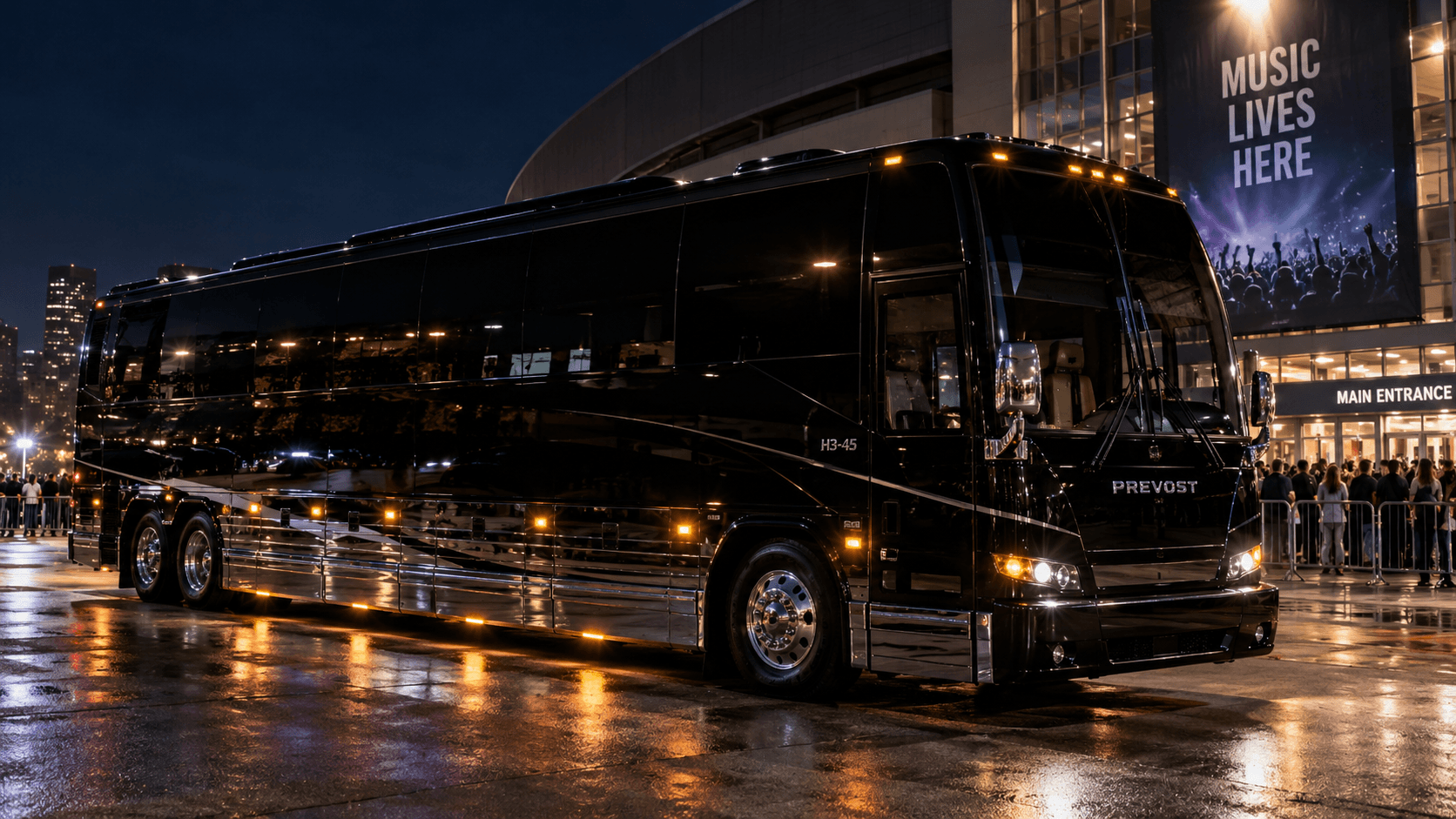
A tour bus (also called an entertainer coach or sleeper coach) is a 45-foot motorcoach converted with bunks, lounges, a galley, and a bathroom, so a touring party can sleep while the coach drives overnight between shows. Most US tour buses sleep 12 people in bunks stacked three high, six on each side of a central aisle. Layouts range from 6 to 14 bunks, depending on whether the coach carries a rear lounge, a star stateroom, or extra crew berths.
Capacity comes down to four physical attributes: bunk count, bunk dimensions, lounge seating, and the floor plan the converter chose. A crew bus trades lounge space for berths. A star coach trades berths for a private suite. And the driver sits outside the passenger count altogether.
Converters build these interiors on Prevost H3-45 and X3-45 shells, the two chassis that dominate the US entertainer market. The Federal Motor Carrier Safety Administration (FMCSA) governs the driver side of the equation through its hours-of-service rules, which is why most drivers sleep in a hotel day room instead of a bunk. Scale matters too: large productions such as U2 and Bon Jovi have run seven or eight sleeper buses on a single tour, mostly for road crew.
This guide answers the questions tour managers ask before signing a lease: how many bunks a standard coach has, how capacity changes by layout, how big a bunk is, who gets which berth, where the driver sleeps, why seats and beds are different numbers, and how to size a coach for your party. The capacity table below sums it up by configuration.
Standard Bunk Count on a US Tour Bus
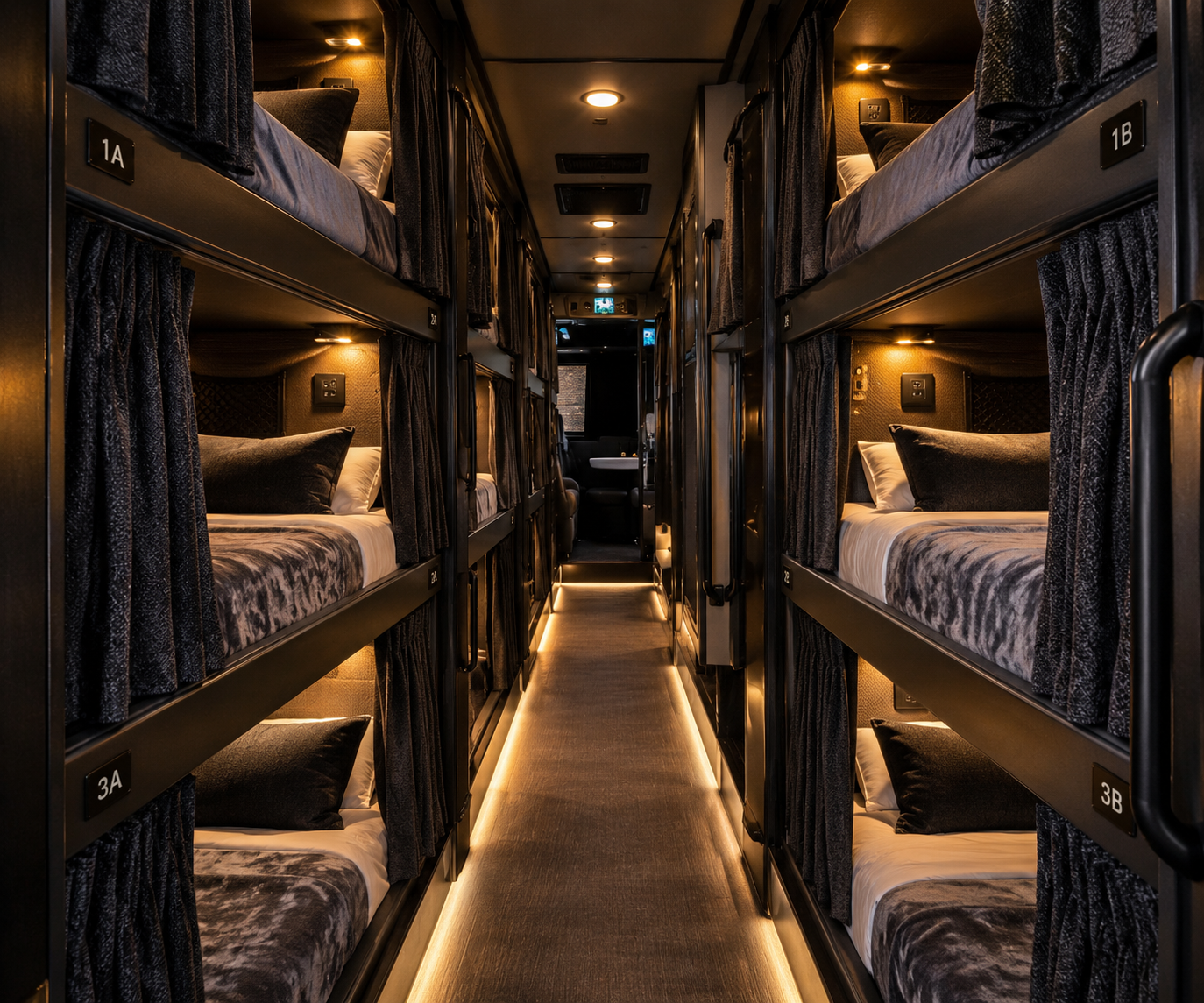
Twelve bunks is the industry default. The bunk alley sits in the middle of the coach, between the front lounge and the rear lounge, with berths stacked top, middle, and bottom along both walls. That gives two stacks of three per side, or 12 berths in roughly 14 feet of floor.
Bunk alley placement is deliberate. The middle of a 45-foot coach sits between the axles, so it rides smoother and stays quieter than either end.
Twelve berths suits most mid-level parties: a five-piece band, a tour manager, front-of-house and monitor engineers, a lighting tech, and a merch seller. Bigger parties either add a second coach or pick a denser layout, which is where configuration starts to matter.
Tour Bus Sleeping Capacity by Configuration
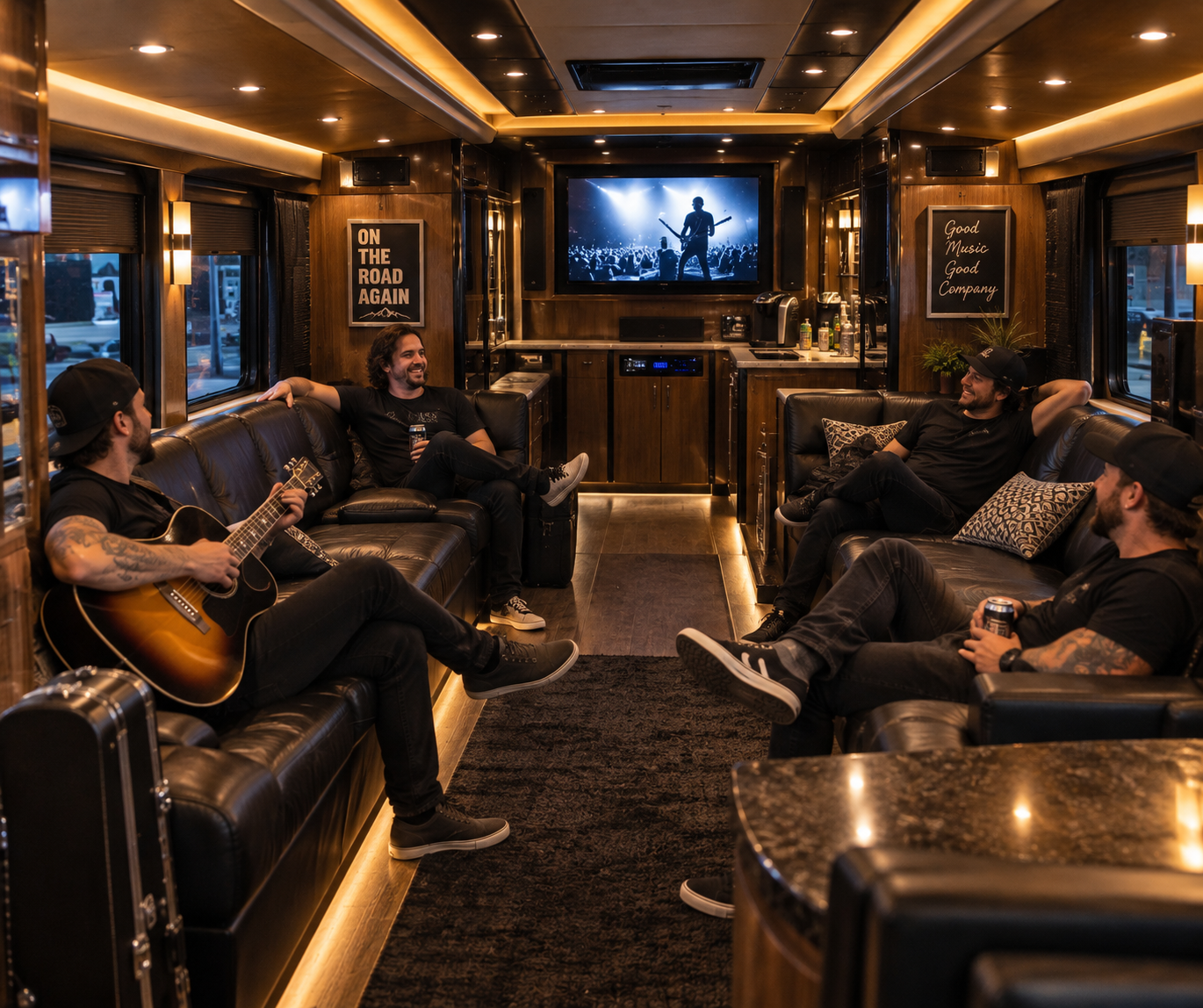
Configurations follow what the client needs most: sleep, social space, or artist privacy. Here's how common US floor plans compare.
Layout | Bunks | Lounges | Typical use |
Crew coach | 12 to 14 | Front lounge only | Production and rigging crews |
Band coach | 12 | Front and rear lounge | Bands with techs on board |
Rear-lounge flex | 10 | Large rear lounge | Smaller bands wanting social space |
Star coach | 6 to 8 | Front lounge plus rear stateroom | Headline artist and inner circle |
Double-deck nightliner (Europe) | 16 to 18 | Upper and lower lounges | European festival runs |
• Crew coaches drop the rear lounge and push extra berths into that space. They suit riggers and carpenters who sleep more than they socialize.
• Band coaches keep both lounges, so the band can hang in the back while crew sleeps up front.
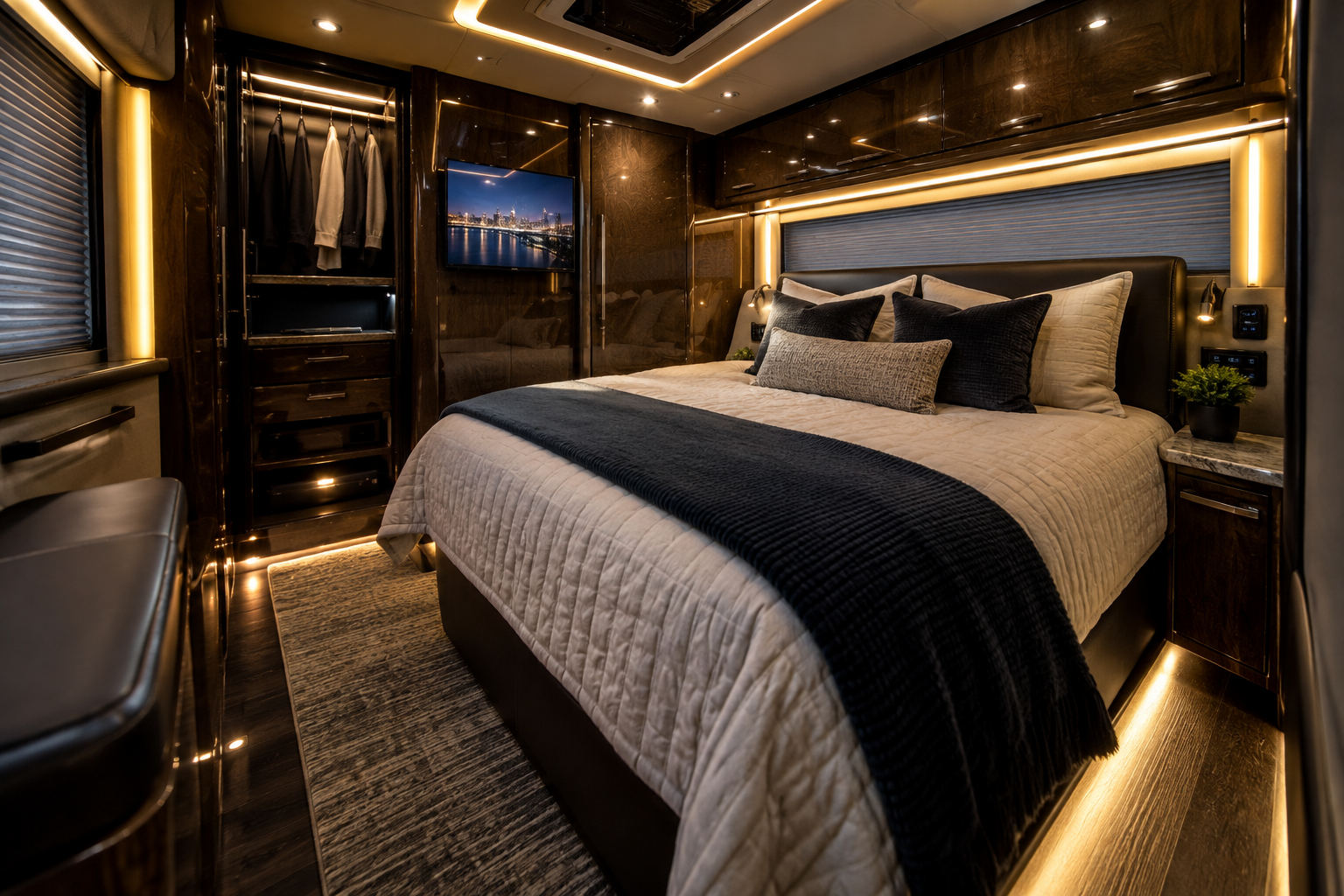
• Star coaches replace four to six bunks with a stateroom holding a queen or full bed, a closet, and sometimes a private bathroom.
• Nightliners stack two decks, a format US bridge clearances rarely allow.
Slide-outs change the picture too. A coach with one or two slides doesn't gain bunks, but its lounges widen when parked, which makes a 12-berth coach feel less crowded on a day off. That extra space ends at the bunk curtain, though, so the size of the berth itself deserves a closer look.
Tour Bus Bunk Size and What's Inside
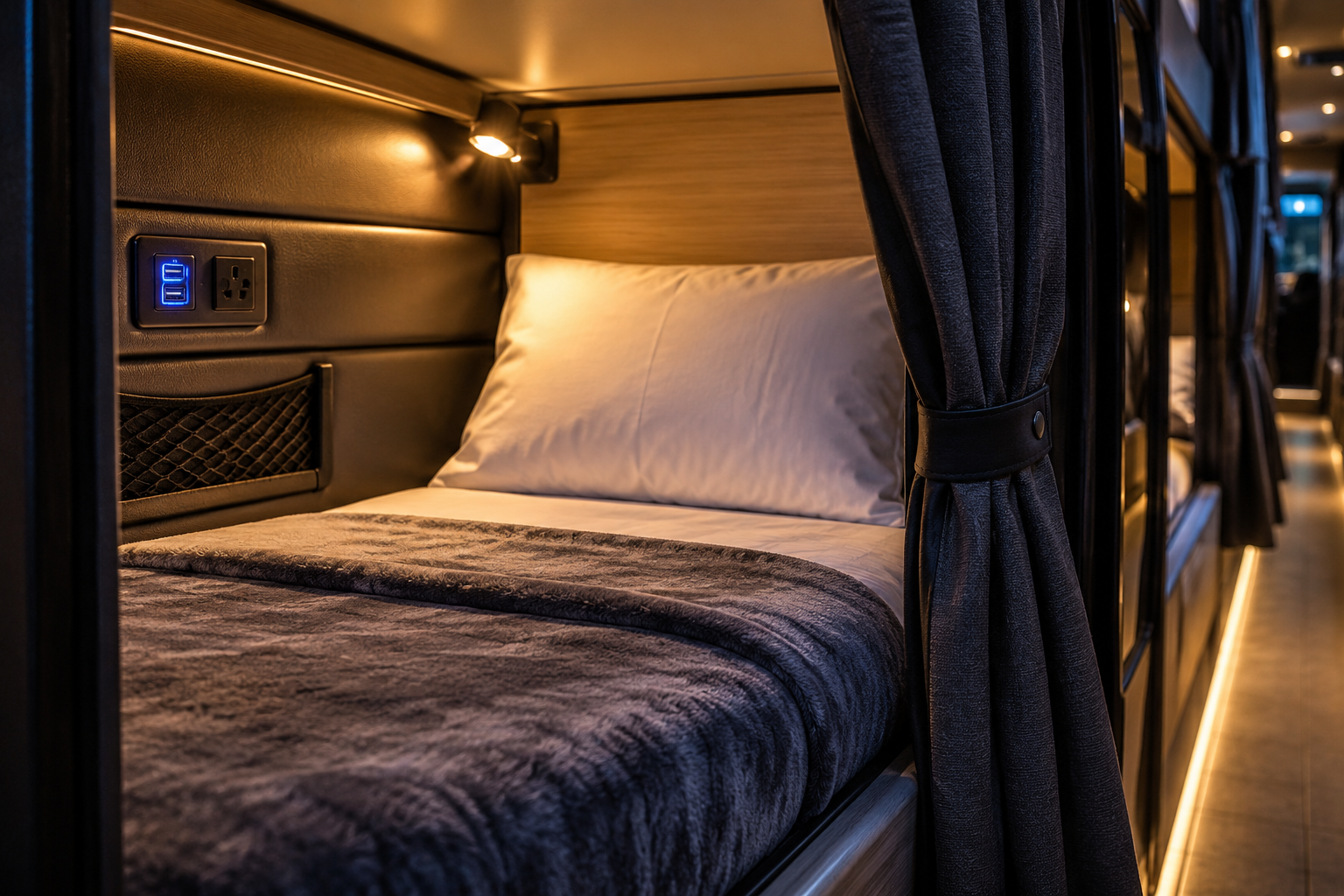
Bunks on a US entertainer coach typically measure about 6 feet 4 inches long and 28 to 30 inches wide, with roughly 2 feet of headroom. That's close to a twin mattress in length but narrower, and you can't sit upright in most of them.
Inside, each berth usually includes:
• Curtain or sliding blackout panel for privacy
• Reading light mounted at the head end
• Power outlet and USB port for phones and laptops
• Air vent tied into the coach's HVAC system
• Screen in some premium coaches, often a small flat panel with an HDMI input
Most operators supply a pillow, sheets, and a blanket. Cold sleepers pack a heavier one, since coaches run the air conditioning low at night. Bottom bunks sit near floor level, top bunks sit just under the ceiling, and the difference between them is why assignment turns political on day one.
How Bunk Assignments Work
Assignments usually follow seniority. The tour manager or production manager hands out berths before the first overnight, and the most senior people claim middle bunks first.
Middle berths are easy to climb into, avoid the heat that rises to the top row, and feel less vibration than the bottom. Top bunks go next, since they give the most privacy and the least foot traffic. Bottom bunks sit closest to the floor, so they catch aisle noise and people's feet on the way to the bathroom.
One berth often gets sacrificed as the junk bunk, a storage slot for suitcases, guitar cases, and merch overstock. On a 12-bunk coach with 11 riders, the empty berth almost always becomes the junk bunk. That leaves the driver, who needs sleep just as badly as anyone on board but rarely uses one of those 12 berths.
Where the Tour Bus Driver Sleeps
Drivers on US tours typically sleep in a hotel day room, not on the bus. The driver takes the wheel overnight while the party sleeps, then checks into a hotel near the venue the next morning and sleeps through the day.
FMCSA rules for passenger carriers explain the setup. A driver can drive up to 10 hours after 8 consecutive hours off duty. Sleeping in a real bed in a quiet room lets the driver log that off-duty time and be rested for the next overnight run. A bunk on a parked coach at a noisy load-in rarely delivers that.
The driver's hotel room is a standard tour budget line. Some coaches add a driver's bunk for two-driver runs, but it doesn't count toward passenger capacity. Passenger capacity itself splits into two different numbers, and mixing them up is a common planning mistake.
Seats Versus Beds: Two Different Capacities
Seating capacity and sleeping capacity are not the same on a tour bus. A 12-bunk coach may seat 16 or more people across the front lounge, rear lounge, and galley booth during the day.
That gap tempts some tours to squeeze extra riders on board. It works for a short daytime hop between two nearby cities. It doesn't work overnight, because every rider needs a berth once the coach rolls after the show. So plan capacity around bunks, and treat lounge seats as daytime comfort.
Riders should also stay seated or in a bunk while the coach moves. Once you know the real number is bunks, the question becomes how many your party needs.
How to Size a Coach for Your Touring Party
Sizing starts with a headcount of everyone who sleeps on the bus every overnight. Then adjust:
• Count band members, tour manager, and every tech who rides nightly
• Add one junk bunk for gear and luggage
• Subtract anyone who flies between cities or sleeps in hotels
• Split the party across two coaches once the count passes 13 or 14
Two buses also solve a sleep-schedule conflict. Crew often loads out until 2:00 AM, while the band wants to rest after an 11:00 PM finish.
A trailer changes the equation as well. If backline, merch, and wardrobe ride in a trailer, you won't need a junk bunk, and that berth returns to a person. With your number settled, the next step is matching it to a real coach and a real quote.
Tour Bus Sleeping Capacity at Knights Coaches
Knights Coaches runs a fleet of more than 20 custom-converted Prevost coaches on H3-45 and X3-45 chassis, with layouts from 6 to 14 bunks. That covers a small acoustic act up to a full production crew.
Every coach comes with a CDL driver who holds a Class A or Class B license and brings at least three years on entertainer coaches. Dispatch runs 24/7, and pickup covers all 48 contiguous states from the Nashville base. You can compare floor plans and daily rates on the tour bus rental page, read about the team's standards on the about page, or send your headcount and routing through the contact page for a quote.
How many people can sleep on a tour bus?
A standard US tour bus sleeps 12 people. Layouts range from 6 bunks on a star coach to 14 bunks on a crew coach, and European double-deck nightliners reach 16 to 18.
Do tour buses have beds or bunks?
Tour buses have bunks, not full beds, for most riders. Star coaches add one exception: a rear stateroom with a queen or full bed for the headline artist.
How big is a tour bus bunk?
A typical bunk measures about 6 feet 4 inches by 28 to 30 inches, with roughly 2 feet of headroom. Riders over 6 feet 3 inches often request a bunk with the curtain side open at the foot.
Which bunk is the best on a tour bus?
Middle bunks are the best for most riders. They ride smoother than bottom bunks, stay cooler than top bunks, and are easy to climb into after a late load-out.
What is a junk bunk?
A junk bunk is an unassigned berth used for storage. Tours fill it with luggage, instrument cases, and merch overstock when the party doesn't need every bed.
Does the bus driver sleep on the tour bus?
No, the driver usually sleeps in a hotel day room near the venue. The driver drives overnight, then rests during the day to meet FMCSA off-duty requirements before the next run.
Which tour bus layouts are available?
The common layouts are crew coach, band coach, rear-lounge flex, and star coach. Each trades bunks against lounge space or a private stateroom to fit a different kind of touring party.
How many tour buses does a band need?
Most mid-level bands need one bus for up to 12 or 13 sleepers. Parties larger than that, or tours where crew and band keep different sleep schedules, usually add a second coach.
Can more people ride a tour bus than it has bunks?
Yes, for daytime travel only. Lounges can seat 16 or more on short hops, but every overnight rider needs a berth once the coach leaves the venue.
Is a star coach or a band coach better for a small act?
A star coach is better when the artist needs privacy and the party is 8 or fewer. A band coach wins when 10 to 12 people share the ride and want a rear lounge for downtime.
Is sleeping on a tour bus safe?
Yes, when the coach is operated by a DOT-registered carrier with a qualified CDL driver. Riders should stay in bunks or seats while the bus moves and keep the aisle clear of bags.
Are there tour buses with private rooms?
Yes, star coaches include a private rear stateroom. The room typically holds a full or queen bed, a closet, a TV, and sometimes an en suite bathroom.
So how many people sleep on a tour bus? A standard entertainer coach puts 12 riders in triple-stacked bunks down the middle of a 45-foot Prevost shell, and layouts run from 6 to 14 depending on how the converter balanced berths, lounges, and staterooms. Crew coaches, band coaches, rear-lounge flex layouts, and star coaches each move that number up or down.
Bunk size, seniority-based assignments, and the junk bunk shape daily life inside. The driver sits outside the count, resting in a hotel day room under FMCSA rules. Seats and beds stay separate numbers, and your headcount, gear, and sleep schedules decide whether one coach covers the tour or two. To match your touring party to the right coach, call Knights Coaches at +1-855-734-5700 or request a quote online.