
Tour Bus Dimensions and Weight: Length, Height, Width, and GVWR Explained
A tour bus ( entertainer coach ) is a three-axle, 45-foot motorcoach shell converted into a rolling hotel with bunks, lounges, and a galley. Standard US tour bus dimensions are 45 feet long, 102 inches wide, and 11 feet 2 inches to 12 feet 4 inches tall , depending on the chassis. A converted coach weighs roughly…
Knights Coaches
Knights Coaches
- Published
- Reading time
- 9 min read
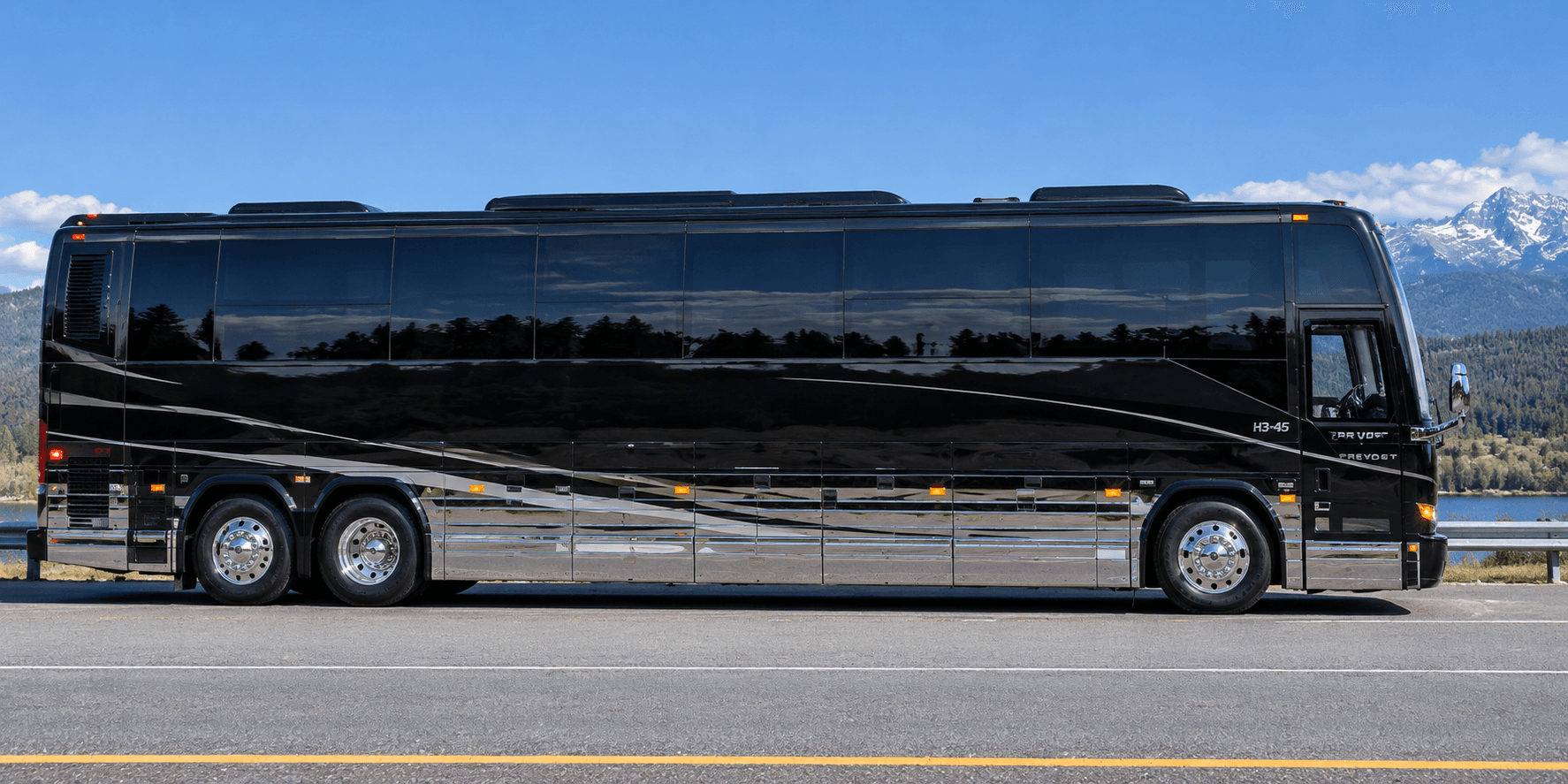
A tour bus (entertainer coach) is a three-axle, 45-foot motorcoach shell converted into a rolling hotel with bunks, lounges, and a galley. Standard US tour bus dimensions are 45 feet long, 102 inches wide, and 11 feet 2 inches to 12 feet 4 inches tall, depending on the chassis. A converted coach weighs roughly 38,000 pounds empty and can reach a gross vehicle weight rating (GVWR) of 55,000 pounds.
Those numbers come from three measurable attributes: overall length, overall height, and axle-by-axle weight. Each one decides something practical. Length governs where the coach can park and turn. Height decides which bridges, parking garages, and hotel canopies it clears. Weight sets tire loads, braking distance, and whether a bridge posting or a weigh station becomes a problem.
Two manufacturers build nearly every entertainer shell in North America: Prevost, a Volvo Buses subsidiary in Quebec, and Motor Coach Industries (MCI). Their data sheets supply the figures below. Federal size and weight rules come from the Federal Highway Administration (FHWA), while each state sets its own height ceiling.
This guide covers the Prevost H3-45 and X3-45 specs side by side, height and clearance limits, width and slide-outs, empty and loaded weight, federal limits, trailer length, and turning and parking space. The spec table in the first section gives the quick version.
Tour Bus Dimensions: Prevost and MCI Compared
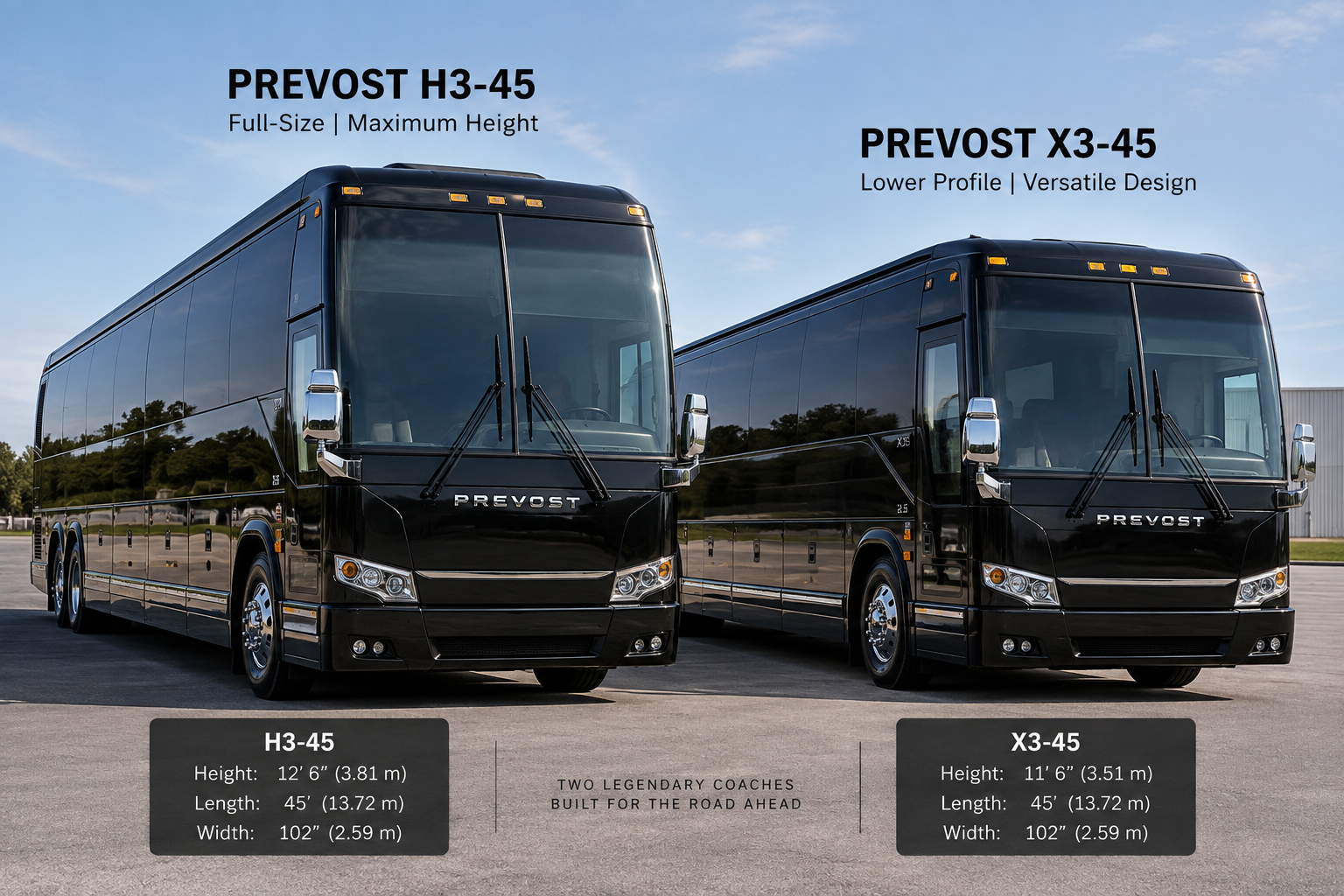
Most US entertainer coaches run on a Prevost H3-45 or X3-45 shell. MCI's J4500 appears less often in the entertainer market but shares the same footprint class.
Spec | Prevost H3-45 | Prevost X3-45 | MCI J4500 |
Overall length | 45 ft | 45 ft | 45 ft 7 in |
Overall width | 102 in | 101.5 to 102 in | 102 in |
Overall height | 146.25 to 148 in | 133.9 to 143.6 in | 141.25 in |
Wheelbase | about 316 in | 334.5 in | not listed |
Fuel tank | varies by build | 203 gal (VIP shell) | varies by build |
Gross weight rating | 53,000 lb | 55,000 to 55,500 lb (VIP shell) | 54,000 lb |
Height varies within one model because Prevost sells a seated coach and a VIP conversion shell. The VIP shells that converters buy carry a taller roofline and a higher weight rating than the seated charter versions.
Length stays constant at 45 feet across the H3-45 and X3-45 because that's the federal maximum for a single bus on the Interstate system. Height is where the two Prevost shells split, and it's the number that matters most on the road.
Tour Bus Height and Overhead Clearance
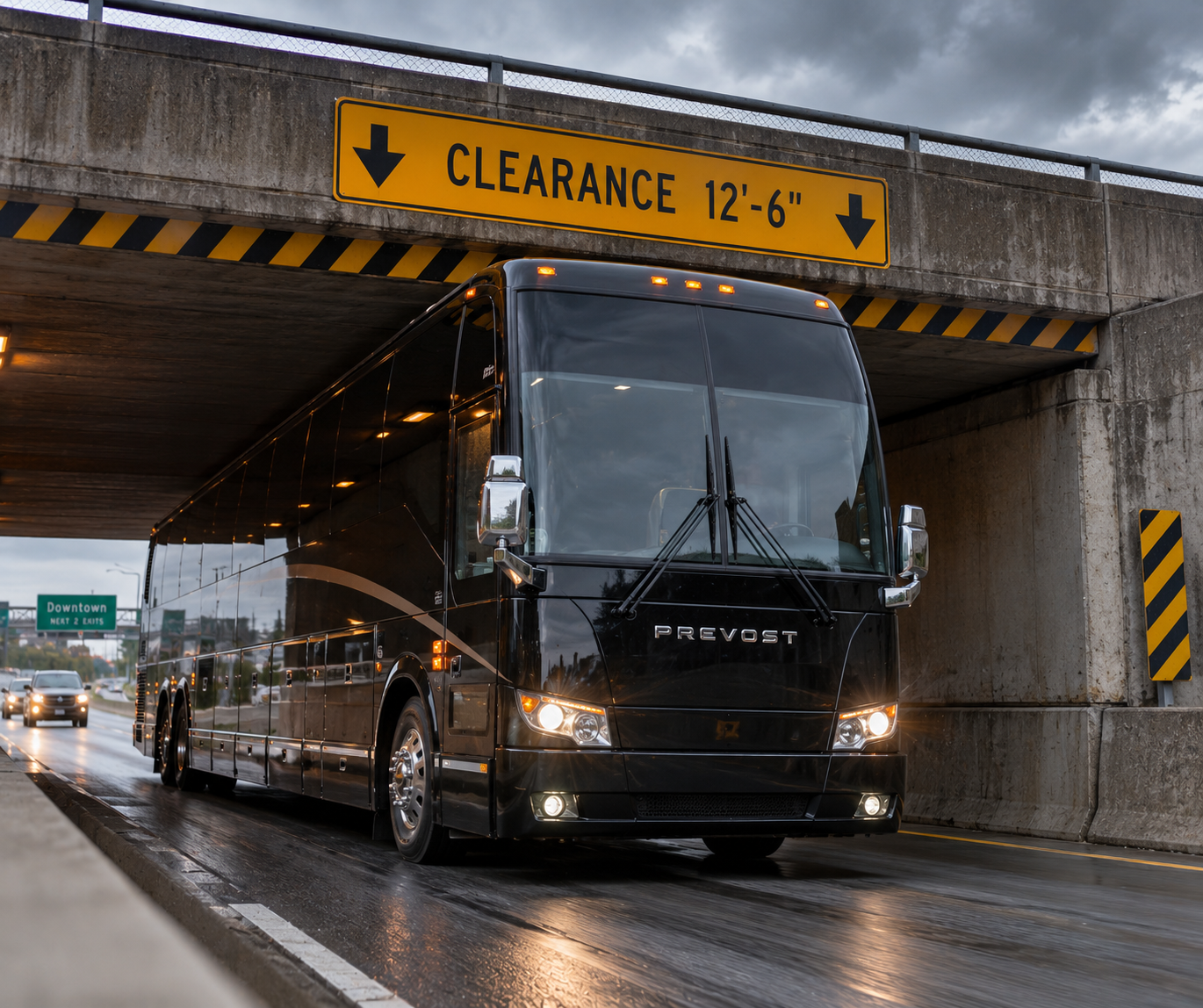
The H3-45 is the tall one. Its raised passenger deck puts the roof around 12 feet 2 inches to 12 feet 4 inches, which gives converters room for a full-height bunk alley and underfloor bays reaching up to 460 cubic feet.
The X3-45 sits lower, at roughly 11 feet 2 inches for the seated coach and just under 12 feet for the VIP shell. Its lower center of gravity makes it steadier in crosswinds. Finished floor-to-ceiling height on an X3-45 conversion runs about 85 to 91 inches, so interior headroom stays generous despite the lower roof.
Overhead clearance rules of thumb:
Plan for 13 feet 6 inches of clearance, the common state limit for vehicle height
Check parkways and older underpasses in the Northeast, where posted clearances fall below 12 feet
Avoid hotel porte-cocheres and parking garages unless the posted clearance is known
Account for roof air conditioning pods and satellite domes, which add inches on some conversions
GPS apps built for cars don't warn about low bridges. Professional drivers use commercial routing tools or truck-specific navigation that factors in vehicle height. Once height is cleared, width becomes the next constraint, especially when the slides come out.
Tour Bus Width and Slide-Outs
Width on the road is fixed at 102 inches (8 feet 6 inches), excluding mirrors. That's the federal limit for commercial vehicles on the National Network, and every modern Prevost and MCI shell is built to it.
Mirrors add roughly a foot on each side. Drivers treat the coach as about 10 feet wide when judging lane position, drive-through canopies, and tight venue gates.
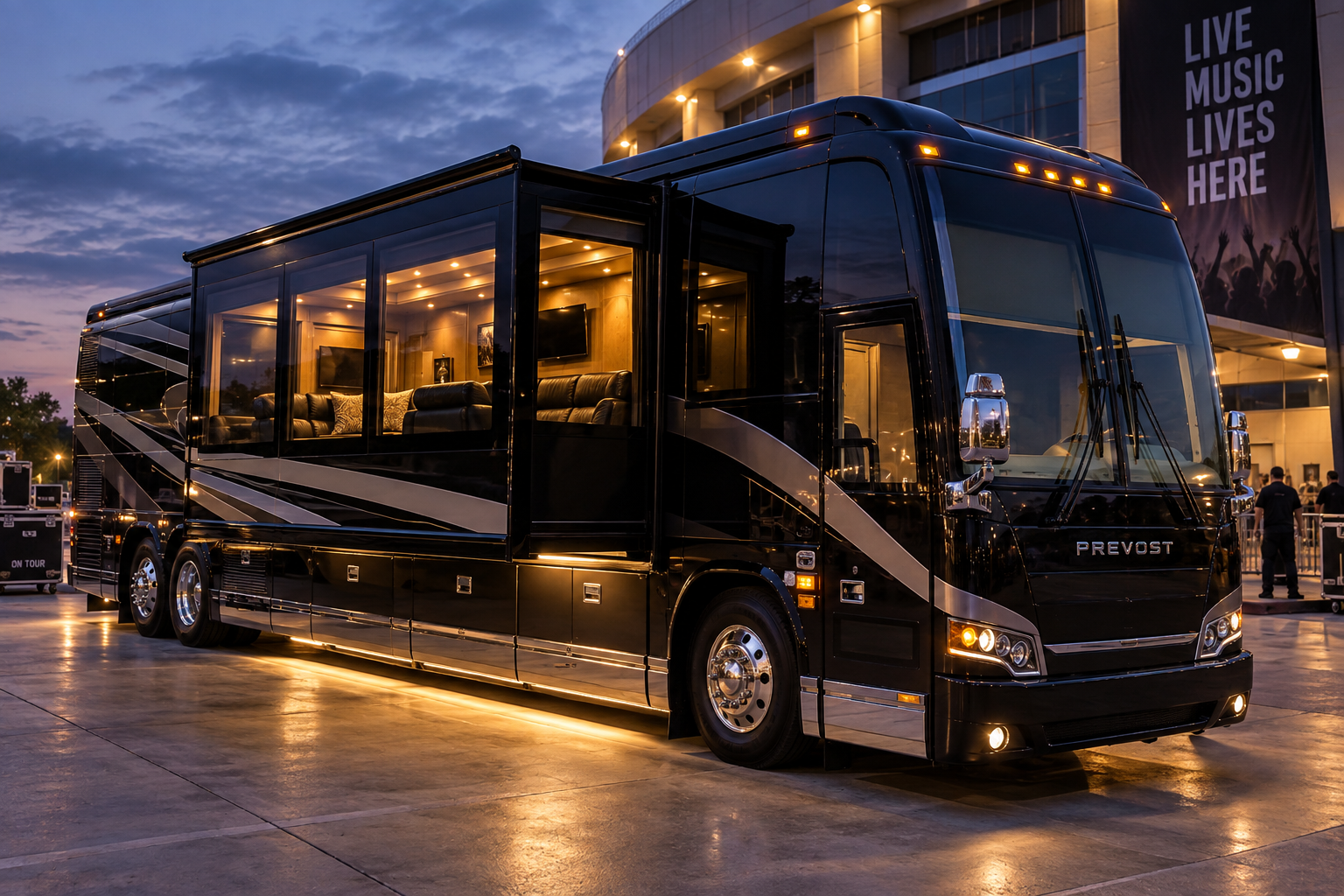
Slide-outs change the parked footprint. Many entertainer coaches carry one or two slides, usually one in the front lounge and one in the rear lounge. Each slide extends the wall outward by roughly 2 to 3 feet once parked. A coach with two opposing slides needs about 13 to 14 feet of width at the curb.
Slides only extend when the coach is stationary and level. Loading dock lanes, tight backstage lots, and street parking outside clubs sometimes leave no room to deploy them. That space problem sits alongside a bigger one: the total weight the coach carries into that lot.
How Much Does a Tour Bus Weigh?
A Prevost H3-45 seated coach weighs about 38,700 pounds wet (fuel and fluids included). The X3-45 comes in slightly lighter, around 37,300 pounds. Conversion work changes both figures.
Entertainer interiors add cabinetry, bunks, a generator, water and holding tanks, slide mechanisms, and extra batteries. Operating weight on a converted coach typically lands between 45,000 and 52,000 pounds before passengers step on. Add 12 riders, luggage, merch, and a full load of water, and the coach approaches its rating.
Weight distribution across the three axles:
Front steer axle design capacity of 19,000 lb on the X3-45 VIP shell
Drive axle design capacity of 22,500 lb, carrying most of the engine and transmission mass
Tag axle behind the drive axle, which shares load and can lift on some shells for tighter turns
Heavy gear in the bays shifts load toward the drive and tag axles. That's why production managers keep the heaviest road cases low and centered. Those axle figures also connect directly to the federal weight rules that apply on every Interstate.
Federal Size and Weight Limits for Buses
Federal rules set the outer boundary for every coach on the Interstate system. The FHWA publishes these under 23 CFR Part 658.
Length limit of 45 feet for a single bus on the Interstate and National Network
Width limit of 102 inches, excluding approved safety devices such as mirrors
Gross vehicle weight cap of 80,000 pounds on the Interstate
Axle allowance of up to 24,000 pounds per axle for over-the-road buses under federal law
States set height limits, which range from 13 feet 6 inches to 14 feet 6 inches in most of the country. A converted coach sits far under the 80,000-pound gross cap. The real limit is the manufacturer's GVWR, which drivers and operators must not exceed.
Weigh station rules vary by state. Some states require buses to enter scales; many exempt them. Operators that stay under GVWR and keep axle loads balanced rarely face issues. The picture changes once a trailer hooks onto the back.
Tour Bus Length With a Trailer
A coach pulling a gear trailer typically measures 60 to 65 feet overall. Most tour trailers run 14 to 16 feet in the box, plus the tongue and hitch.
Many states allow combinations up to 65 feet, and some allow more. The coach's hitch rating caps trailer weight; several Prevost conversion shells list a hitch package rated to 20,000 pounds, though most tour trailers weigh far less when loaded.
A trailer affects more than length. It adds braking distance, widens the turning path, and limits where the rig can park or reverse. Drivers usually drop the trailer at the loading dock and park the coach separately when space is tight. That leads straight into the question every venue asks: how much room does this thing need to turn and park?
Turning Radius and Parking Space
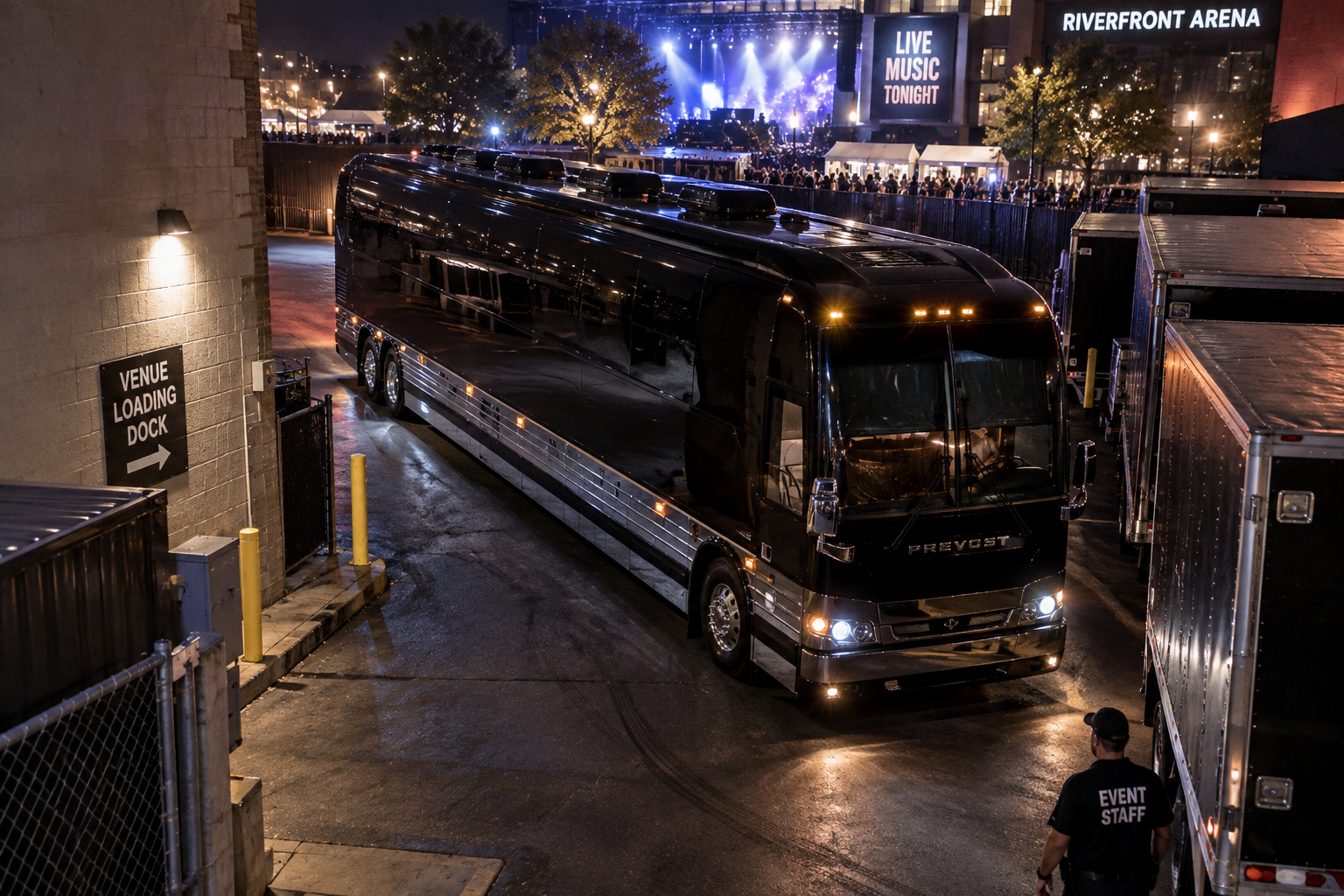
Turning radius on a Prevost X3-45 runs roughly 44 feet curb to curb and about 47 feet wall to wall. A liftable tag axle tightens the turn slightly when raised at low speed.
Parking needs for one coach without a trailer:
Length of 50 feet of straight curb for parallel parking
Width of 14 feet with slides out, 11 feet with slides in
Power access to a 50-amp shore power pedestal, where the venue offers one
Surface that is paved and level so slides and leveling systems work properly
Venues publish bus parking specs in their advance packets. Tour managers send the coach dimensions ahead so the venue's production contact can reserve the right space. Knowing those numbers before load-in saves the driver from circling a downtown block at 3:00 AM.
Tour Bus Specs at Knights Coaches
Knights Coaches runs a fleet of more than 20 converted Prevost coaches on H3-45 and X3-45 shells, so every unit falls inside the 45-foot, 102-inch federal envelope. Drivers hold Class A or Class B CDLs and plan routes around bridge heights and truck-stop parking for a 45-foot coach.
Coach specs, floor plans, and bunk counts sit on the tour bus rental page. The about page covers the company's DOT and FMCSA standing. For a venue's advance sheet, request exact dimensions for your assigned coach through the contact page.
How long is a tour bus?
A US tour bus is 45 feet long. That's the federal maximum for a single bus on the Interstate, and both Prevost H3-45 and X3-45 shells are built to it.
How tall is a tour bus?
A tour bus stands 11 feet 2 inches to 12 feet 4 inches tall. The Prevost X3-45 is the lower shell, while the H3-45 sits higher to allow a raised passenger deck.
How wide is a tour bus?
A tour bus is 102 inches (8 feet 6 inches) wide without mirrors. Slides add about 2 to 3 feet per side once the coach is parked.
How much does a tour bus weigh?
A converted tour bus weighs about 45,000 to 52,000 pounds before passengers board. Gross ratings on Prevost VIP shells reach 55,000 to 55,500 pounds.
Is the Prevost H3-45 taller than the X3-45?
Yes, the H3-45 is about a foot taller. Its 146 to 148 inch height compares with roughly 134 to 144 inches for the X3-45, depending on the version.
Can a tour bus fit under a 12-foot bridge?
Rarely. Only the lowest X3-45 builds come in under 12 feet, and roof pods can erase that margin, so drivers route around posted clearances under 13 feet.
What is GVWR on a tour bus?
GVWR is the maximum loaded weight the manufacturer allows, including passengers, fuel, water, and cargo. Prevost lists 55,000 to 55,500 pounds on recent X3-45 VIP shells.
Which axles carry the most weight on a tour bus?
The drive axle carries the most weight, up to 22,500 pounds by design on the X3-45 VIP. The front steer axle and the rear tag axle share the rest.
How long is a tour bus with a trailer?
A tour bus with a trailer measures 60 to 65 feet overall. Most tour trailers add 14 to 16 feet of box plus the hitch and tongue.
Do tour buses have to stop at weigh stations?
It depends on the state. Some states require buses to enter open scales, while others exempt passenger vehicles entirely.
How much parking space does a tour bus need?
A tour bus needs about 50 feet of length and 14 feet of width with slides deployed. Add 15 to 20 feet more if a trailer stays hitched.
Which is better for city tours, the H3-45 or X3-45?
The X3-45 is better for dense city routing. Its lower height clears more underpasses and its lower center of gravity steadies the coach in wind.
Tour bus dimensions and weight come down to a 45-foot, three-axle shell that's 102 inches wide and 11 to 12.5 feet tall, weighing near 38,000 pounds empty and up to a 55,000-pound GVWR loaded. The Prevost H3-45 and X3-45 split on height, which sets overhead clearance, while width and slide-outs decide the parked footprint.
Conversion adds weight across the front, drive, and tag axles, and FHWA rules cap length, width, and gross weight on the Interstate. A trailer pushes the rig to 60 to 65 feet, and turning and parking space follow from all of it. For exact specs on your assigned coach, call Knights Coaches at +1-855-734-5700 or request a quote online.