
Tour Bus vs RV for Touring: Which One Wins?
A tour bus is a 45-foot commercial motorcoach converted with 12 dedicated bunks , a galley, two lounges, and a professional CDL driver who works to federal hours-of-service limits. A recreational vehicle is a consumer motorhome built under 26,000 pounds gross vehicle weight so anybody with a standard driver’s license…
Knights Coaches Admin
Knights Coaches
- Published
- Reading time
- 11 min read
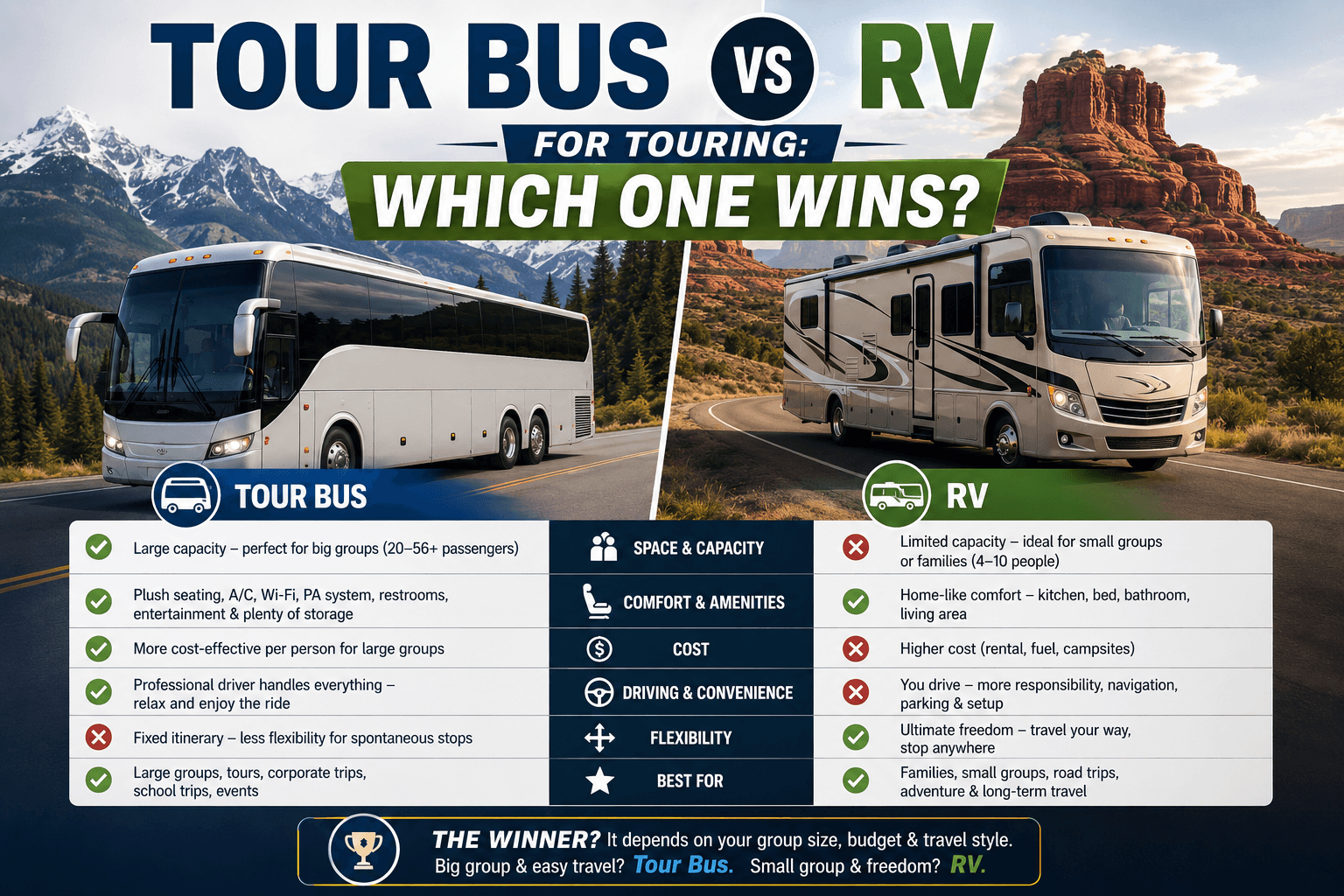
A tour bus is a 45-foot commercial motorcoach converted with 12 dedicated bunks, a galley, two lounges, and a professional CDL driver who works to federal hours-of-service limits. A recreational vehicle is a consumer motorhome built under 26,000 pounds gross vehicle weight so anybody with a standard driver’s license can operate it, sleeping up to 10 across a mix of fixed beds and convertible furniture.
Cost separates them immediately. A Class A motorhome rents for $175 to $450 per night, with the national RV average sitting near $198 per night in 2026. A converted sleeper runs $2,200 to $2,900 per day once coach, driver, and fuel are added together. On that comparison alone the RV wins by a factor of six, which is exactly why mid-level acts keep asking the question.
The comparison stops being simple as soon as you add the variables that decide whether a tour finishes on schedule: who drives after a show, where the vehicle sleeps overnight, how much backline it can carry, what the rental contract permits commercially, and how the chassis holds up across 10,000 tour miles. A Prevost H3-45 is engineered for a service life measured in the high hundreds of thousands of miles. A consumer motorhome chassis is not.
This comparison runs both options through the decisions a tour manager actually makes: nightly cost against total cost, licensing and driver fatigue, sleeping architecture, overnight parking, gear capacity, mechanical exposure, contract restrictions on commercial use, and which vehicle wins at each stage of an act’s growth.
Cost per night, and cost per tour
Nightly rates favor the motorhome by a wide margin, and honest budgeting closes some of that gap without ever eliminating it.
Class A motorhome, older unit: $175 to $275 per night.
Class A motorhome, newer unit: $350 to $450 per night.
Mileage overage: commonly billed per mile beyond an included allowance.
One-way drop fee: $150 to $500 depending on distance between locations.
Entertainer coach, all in: $2,200 to $2,900 per day including driver and fuel.
Add the lines an RV quote leaves out. Fuel sits at 8 to 12 MPG against 6 MPG for a coach, so the motorhome genuinely saves diesel. Campground fees replace venue parking on many nights. Somebody in the band absorbs the driving, which means either a hotel room after long hauls or a very tired guitarist at soundcheck.
The honest summary: on a 10-date regional run with short drives, an RV costs a fraction of a coach. On a 30-date national run with 400-mile overnight hops, the gap narrows because the coach absorbs hotel nights, and it narrows further because a coach can leave immediately after load-out while an RV crew sleeps first. Acts that make the jump usually do it once routing distance rather than budget becomes the binding constraint, and many begin with a short sleeper bus rental on the longest leg of an otherwise van-driven tour.
Who drives, and what that license allows
Licensing is the RV’s genuine structural advantage. Motorhomes built under 26,000 pounds GVW require no commercial license in most states, which is precisely why several manufacturers engineer band-focused units to stay below that threshold. Anyone in the party with a clean record can take the wheel.
Commercial use complicates it. A for-profit vehicle over 26,001 pounds triggers US DOT registration, and crossing state lines for compensation pulls the operation further into federal territory. Several RV rental agreements prohibit commercial use outright, which puts a touring band in breach the moment merchandise revenue enters the picture. Read the rental agreement before you assume a consumer contract covers professional work.
Fatigue is the part that never appears on a spreadsheet. A converted coach arrives with a driver holding a Class A or B license, a current DOT medical card, drug and alcohol clearinghouse enrollment, and an electronic logging device recording every minute of duty status. Knights Coaches requires a three-year minimum on entertainer equipment before a driver takes a tour. The band sleeps. Somebody qualified and rested drives.
In an RV, the person who just played a 90-minute set drives the 200 miles to the next city. That works at 24 and stops working somewhere around date 15.
Sleeping: dedicated bunks against convertible furniture
Sleeping architecture is where the two vehicles diverge most and where crews notice it fastest.
A coach carries fixed berths sized at 29 inches wide, 74 inches long, and 35 inches high, curtained, individually lit, climate-controlled, and stacked three high in four quadrants. Nobody converts anything. Everybody has a private space that stays made up for the entire tour.
An RV distributes sleeping across a rear queen bed, a convertible dinette, a fold-out sofa, and sometimes a cab-over bunk. Capacity reaches 10 on paper. In practice two people get a real bed and the rest sleep on furniture that has to be reassembled every morning and dismantled every night. Privacy is a curtain at best.
Motion is the other factor. Bunks in a converted coach sit low and central, and the air suspension on a Prevost chassis is tuned for overnight travel with sleeping passengers. RV suspension is tuned for daytime driving to campgrounds. Sleeping while a motorhome moves is legal in some configurations and uncomfortable in most, and belted sleeping positions are rare enough that many bands simply stop driving overnight. That decision alone costs a tour a driving day per week.
Where each vehicle sleeps overnight
Overnight parking rules push the two vehicles into different infrastructure. RVs run on shore power, dump stations, and campgrounds, which are frequently located outside city centers. A midnight arrival at a campground with a locked gate is a real and recurring problem on tour routing.
Coaches park at the venue. Production entrances, loading docks, and secured lots are built around a 45-foot bus that arrives, connects to shore power or runs its generator, and stays through load-out. Waste and water service happen on the operator’s schedule rather than the band’s.
City access cuts the other way. A 32-foot motorhome navigates urban streets and small club lots that a 45-foot coach cannot approach. Clubs with street-only parking in Boston, San Francisco, or lower Manhattan genuinely favor the smaller vehicle. Operators covering 48-state pickup and drop-off route around those constraints in advance, but the constraint is real and worth raising during advance rather than on show day.
Gear capacity and the trailer question
Cargo capacity is the RV’s quiet weakness. Motorhome storage is designed for camping equipment and clothing, not for a drum kit, three guitar rigs, a bass cabinet, lighting trusses, and merchandise. Bands touring in RVs almost always tow a trailer, which pushes combined weight toward the CDL threshold and cuts fuel economy sharply.
Coaches face the same constraint from the opposite direction. Bay space that a charter bus devotes to luggage is occupied by the generator, fresh water, waste tanks, and house batteries. Backline rides in a towed trailer capped near 10,000 pounds gross, giving roughly 5,500 pounds of payload, or in a box truck when the production package exceeds that.
The difference is coordination. Knights Coaches handles enclosed trailers, box trucks, and flatbeds through its tour trucking division, so the gear moves on one contract alongside the coach. An RV crew sources its own trailer, its own hitch rating, and its own insurance, then discovers on date three that the tongue weight is wrong.
Reliability across a full tour cycle
Mechanical exposure decides which option survives a long run. A Prevost H3-45 built on a stainless steel commercial platform stays in service 20 years or more, and an odometer reading 250,000 miles describes a coach in early middle age rather than one near retirement. Parts and service networks span the country because thousands of commercial operators depend on them.
Consumer motorhomes are built on lighter chassis for occasional recreational use, typically a few thousand miles a year. A tour puts 10,000 miles on a vehicle in five weeks. Components rated for weekend duty fail under that load, and RV service centers work to leisure timelines rather than show timelines.
Coach operators plan around failure rather than pretending it will not happen. Preventive maintenance, national repair networks, and 24/7 dispatch exist because one breakdown can cost more than the coach earns across an entire tour. When a converted coach goes down at 2:00 AM in Missouri, a dispatcher is awake. When an RV goes down, the band calls roadside assistance and misses the show.
The clause most bands read too late
Contract terms separate a professional booking from a consumer one. RV rental agreements commonly include mileage caps, geographic restrictions, prohibitions on towing above a stated rating, generator hour limits, and clauses excluding commercial activity. Break one and the insurance behind the vehicle may not respond after an incident.
Commercial coach contracts are written for touring. They itemize deadhead positioning from the operator’s base, driver per diem, hotel obligations, overdrive thresholds beyond 451 miles, tolls and permit fees around $40 per day, connectivity near $60 per day, and end-of-tour cleaning near $600. The document is longer because the work is regulated.
Longer commitments change the arithmetic again. Runs from one month to twelve months price as a long-term coach lease with a reduced daily rate, a guaranteed unit, and driver continuity across the whole cycle. No RV rental structure offers an equivalent.
Which one wins, by tour profile
Neither vehicle wins outright. The answer tracks your routing, your party size, and how much of the tour budget the transport line can absorb.
Four-piece band, 10 regional dates, drives under 250 miles: RV wins on cost and city access.
Six-person party, 20 dates, drives of 300 to 450 miles: close call, decided by whether anyone can safely drive after load-out.
Eight-plus party, 30-plus dates, national routing: coach wins on rest, reliability, and total cost once hotels are counted.
Support act on a national tour with fixed advance: coach wins because the routing is set by the headliner and cannot flex around campground hours.
Festival run with 500-plus mile hops: coach wins outright, since overnight driving is the only way to make the itinerary work.
Acts crossing that threshold usually start with a single leg on Prevost entertainer coach hire before committing to a full tour, and book from the 12-bunk Prevost coaches once they see how much routing flexibility it returns.
Is an RV cheaper than a tour bus?
Yes. A Class A motorhome rents for $175 to $450 per night against $2,200 to $2,900 per day for an entertainer coach. The gap closes on longer national runs once hotel rooms, lost driving days, and mechanical risk enter the comparison, but the RV stays cheaper on paper.
Do you need a CDL to drive an RV on tour?
No, in most cases. Motorhomes under 26,000 pounds GVW require only a standard driver’s license in most states. Commercial operation of a heavier vehicle for profit triggers US DOT registration, and some states require a non-commercial upgraded class above certain weights.
Can a band legally tour in a rented RV?
Sometimes, and often not. Many RV rental agreements prohibit commercial use, which includes touring for revenue. Breaching that clause can void the insurance behind the vehicle. Read the commercial-use and mileage sections before booking.
How many people can sleep in a touring RV?
Up to 10 people can sleep in a large Class A motorhome, using a rear bed plus convertible dinettes and sofas. Only two of those positions are usually fixed beds, so most of the party rebuilds their sleeping space every night.
What fuel economy does each vehicle get?
Motorhomes average 8 to 12 MPG; entertainer coaches average 6 MPG solo and 5 MPG with a trailer. The RV genuinely saves fuel. It carries far less gear for that mileage, which usually means towing and losing the advantage.
Can you sleep while an RV is driving?
Rarely safely. Most RV sleeping positions have no seatbelts, and passengers in unbelted positions are exposed in a collision. Coaches are engineered with bunks positioned low and central for exactly this reason, which is what makes overnight travel practical.
Where does a tour bus park overnight?
Tour buses park at the venue, in production lots or loading areas, running shore power or the onboard generator. RVs typically need a campground with hookups and a dump station, which introduces gate hours into the routing.
Is a motorhome durable enough for a national tour?
Usually not. A Prevost commercial chassis is designed for hundreds of thousands of miles across 20-plus years, while consumer motorhome chassis are built for a few thousand recreational miles annually. A five-week tour adds 10,000 miles, which is several years of normal RV use.
What happens if the vehicle breaks down mid-tour?
On a commercial coach, the carrier’s dispatch and national repair network handle it around the clock. On a rented RV, the band contacts consumer roadside assistance and works to a service center’s normal business hours, which frequently costs the show.
Which option carries backline better?
Neither carries it inside. Both require a towed trailer or a separate truck for a full backline. Coach operators coordinate trailers, box trucks, and flatbeds on the same contract; RV renters arrange towing themselves and must verify the hitch rating.
At what point should a band upgrade from an RV?
Upgrade when routing distance passes roughly 300 miles between shows on consecutive nights, or when the party exceeds six people. Both thresholds turn driver fatigue and sleep quality into show-quality problems rather than comfort problems.
Can a coach be booked for only part of a tour?
Yes. Single dates, weekend runs, and individual legs all price as standard rentals. Many acts book a coach for the long-haul portion of a routing and drive a van or RV for the regional dates around it.
The short version
Tour buses and RVs solve the same problem at opposite ends of the market. The motorhome wins on nightly rate at $175 to $450 against $2,200 to $2,900, wins on licensing by staying under 26,000 pounds, and wins on access to tight urban lots. The converted coach wins on everything the routing depends on: fixed 29-by-74-inch berths instead of convertible furniture, a qualified rested driver instead of a band member, venue parking instead of campground gate hours, coordinated trailer capacity for backline, and a commercial chassis built for hundreds of thousands of miles instead of a few thousand a year. Contract terms follow the same split, with consumer agreements capping mileage and often barring commercial use while touring contracts itemize deadhead, per diem, and overdrive.
Knights Coaches runs Prevost sleepers with CDL-certified drivers and 24/7 dispatch across every major US city. Call 855 734 5700 to price your routing both ways.