
Tour Bus Safety and Inspections: Pre-Trip Checks, Annual Inspections, and CVSA Levels
Tour bus safety inspections are the layered checks federal rules require on a passenger-carrying commercial motor vehicle, starting with the driver's daily walk-around and extending to annual inspections and enforcement exams by state officers. The Federal Motor Carrier Safety Administration (FMCSA) sets the rules in…
Knights Coaches
Knights Coaches
- Published
- Reading time
- 9 min read
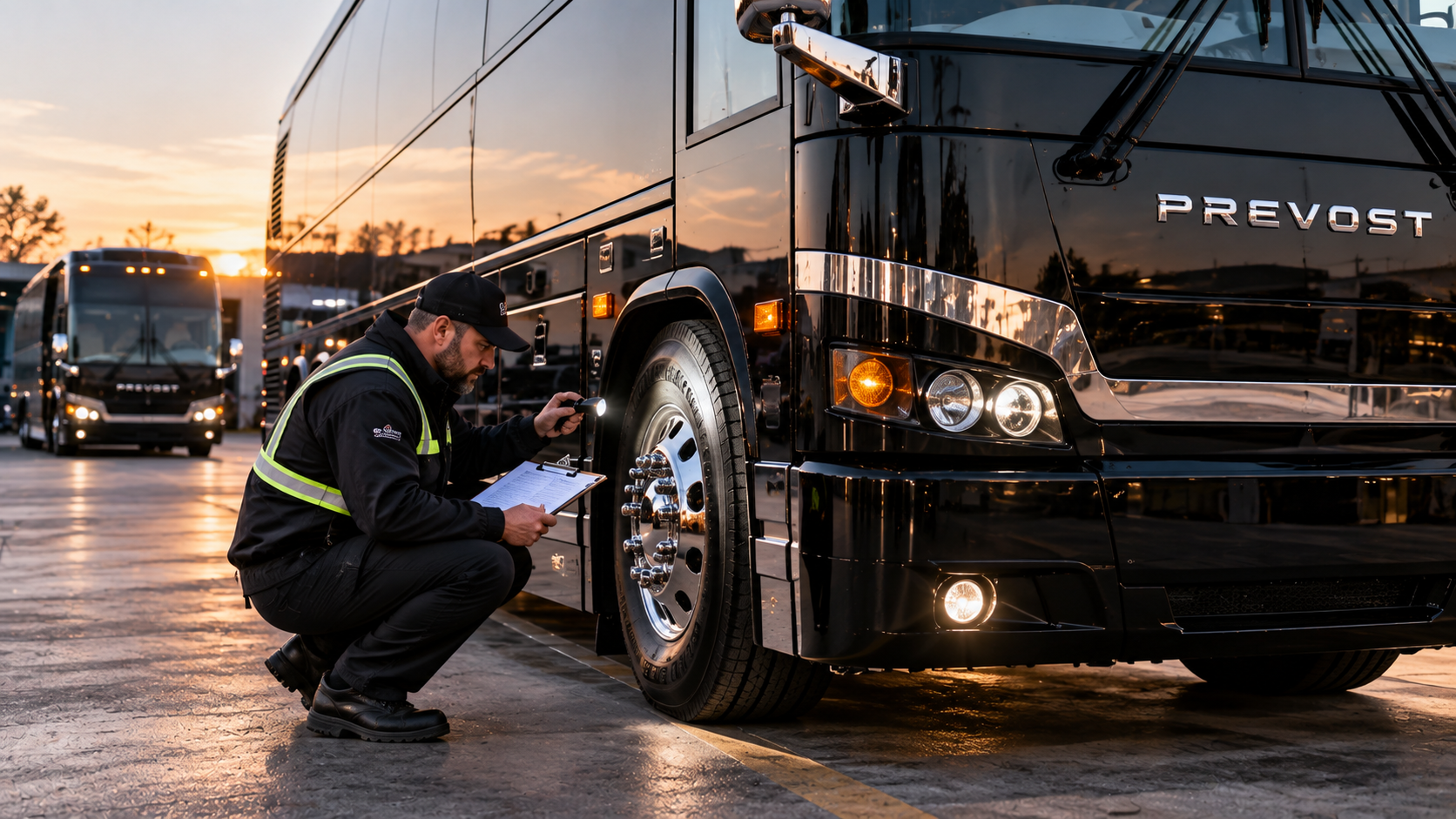
Tour bus safety inspections are the layered checks federal rules require on a passenger-carrying commercial motor vehicle, starting with the driver's daily walk-around and extending to annual inspections and enforcement exams by state officers. The Federal Motor Carrier Safety Administration (FMCSA) sets the rules in 49 CFR Parts 393 and 396, and the Commercial Vehicle Safety Alliance (CVSA) publishes the inspection procedures and out-of-service criteria officers use.
Each layer has a measurable standard. Drivers inspect before every trip. Carriers complete a driver vehicle inspection report (DVIR) whenever a defect appears and certify repairs before the next dispatch. Every coach passes a periodic inspection at least once every 12 months, and carriers keep those reports for 14 months. Officers run CVSA Level I through Level VIII inspections, with motorcoaches usually examined at terminals and destinations rather than on the highway.
Equipment rules add further requirements: fire extinguishers, three reflective warning triangles, marked emergency exits, and on newer coaches, lap and shoulder belts under the National Highway Traffic Safety Administration's (NHTSA) motorcoach seat belt rule. Entertainer coaches bring extra risks from generators, bunk areas, and slide-outs.
This guide covers the driver's pre-trip, the current DVIR rule, annual and systematic maintenance, CVSA inspection levels, destination inspections, emergency equipment, seat belts, entertainer coach hazards, passenger briefings, and how to check a carrier's record before booking.
The Driver's Pre-Trip Inspection
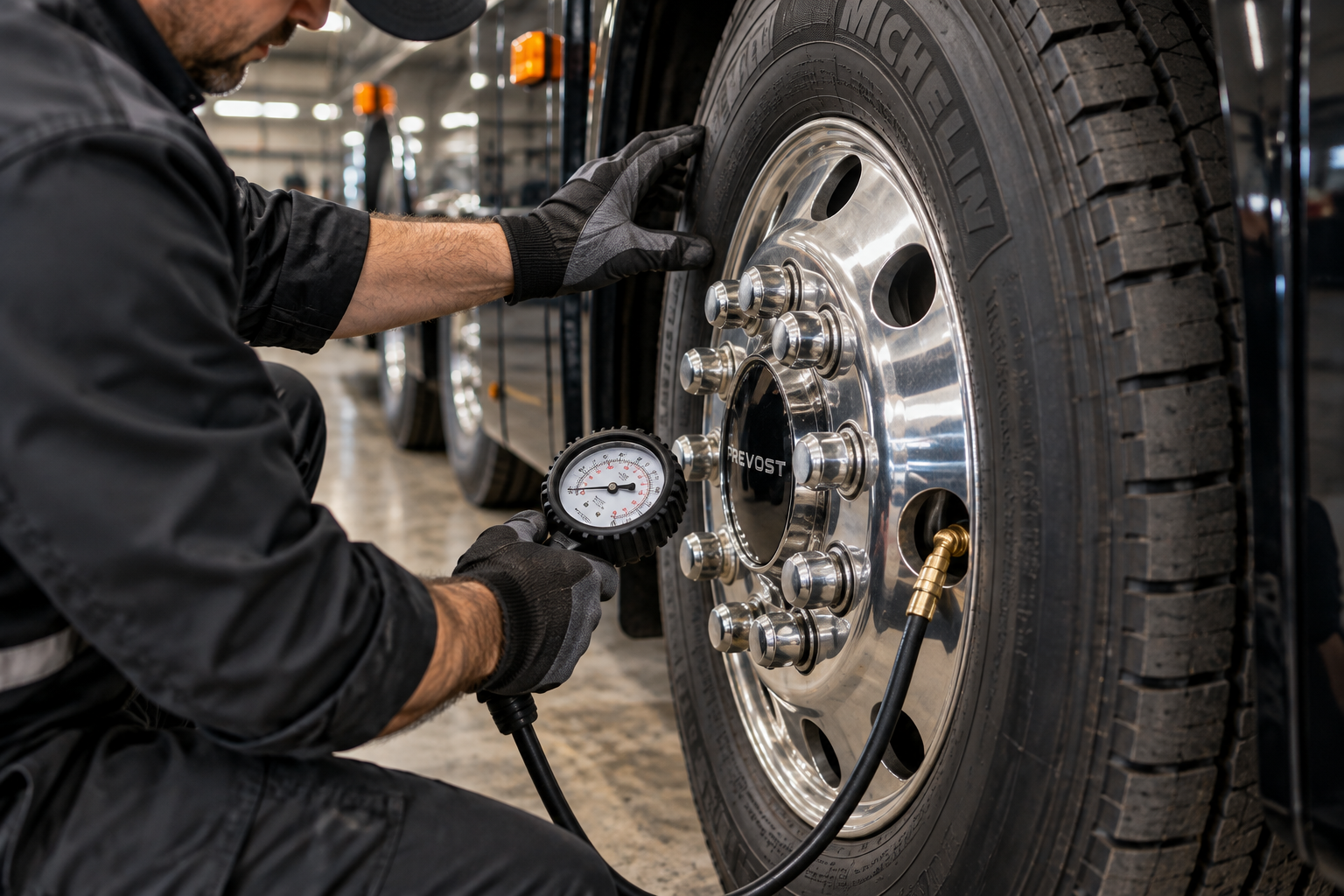
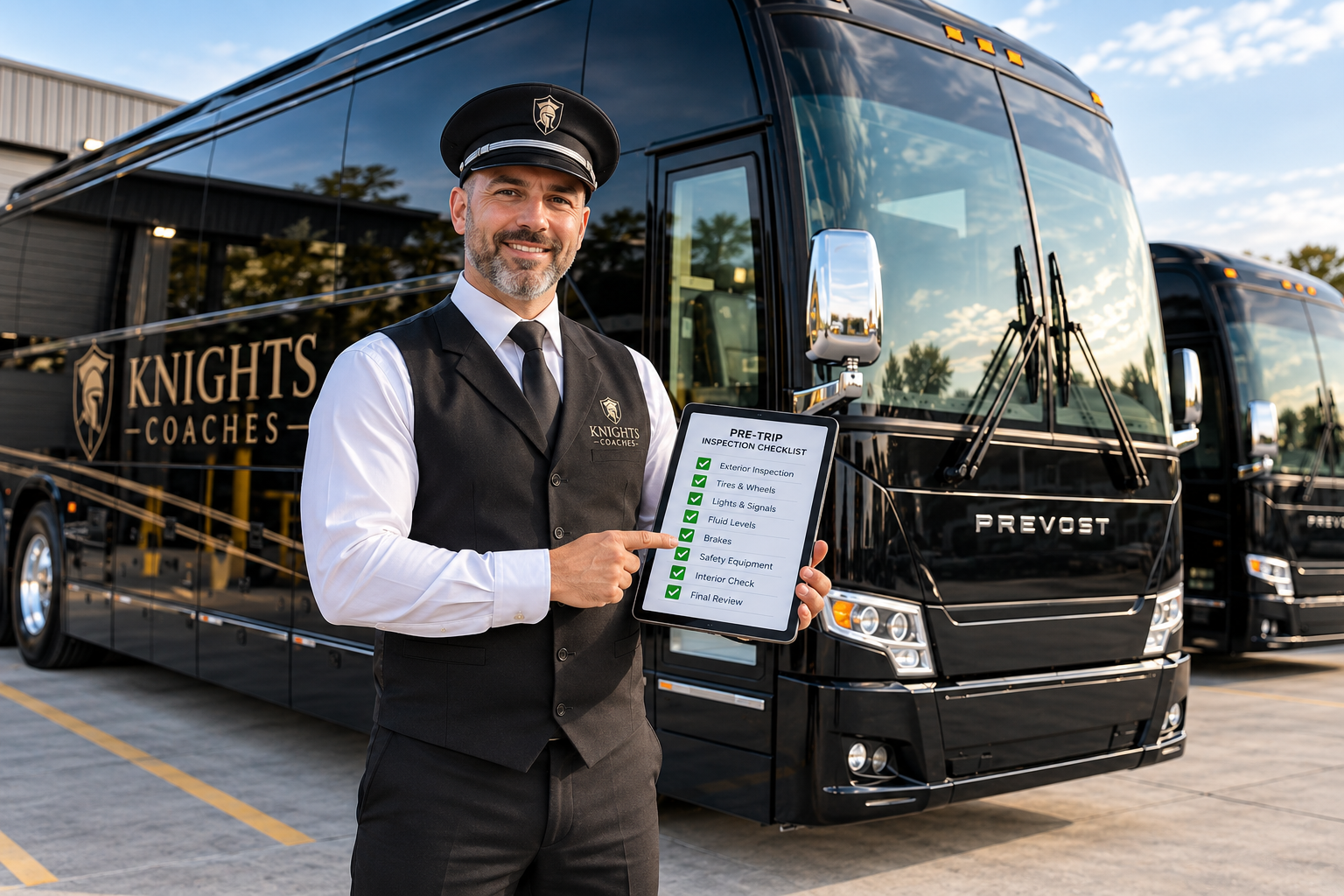
Pre-trip inspections start every duty period. Under 49 CFR 392.7 and 396.13, a driver may not operate a coach until satisfied that it's in safe condition. That includes reviewing the last DVIR and signing it if defects were repaired.
A motorcoach walk-around covers the standard truck items plus passenger equipment:
Brakes and air system, including pressure build-up, governor cut-out, and low-air warning.
Tires and wheels, checking tread depth, inflation, and lug nuts.
Lights and reflectors on every side of the coach.
Steering and suspension, including air bags and leveling valves.
Emergency exits, confirming roof hatches and window exits open and latch.
Entry door, handrails, step lights, and interior lighting.
Good drivers take 15 to 30 minutes and log it as on-duty time. Skipping it saves a few minutes and risks a breakdown on the interstate at 3:00 AM.
Driver Vehicle Inspection Reports
DVIR rules changed for bus operators on August 18, 2020. Before that date, passenger drivers had to file a report every day even when nothing was wrong. FMCSA rescinded the no-defect requirement, so drivers now file a DVIR only when they find or learn of a defect affecting safety or likely to cause a breakdown.
Plenty of guides still say bus drivers must file daily. They don't, at least not under federal law. Many carriers keep daily reports as company policy, because a consistent paper trail helps during audits and litigation.
When a defect gets reported, the carrier repairs it or certifies that repair wasn't needed before the coach runs again. Carriers keep the original report, the repair certification, and the driver's review for 3 months. A 2026 FMCSA rule also confirmed that electronic DVIRs are acceptable.
Annual Periodic Inspections
Periodic inspections under 49 CFR 396.17 happen at least once every 12 months for each coach. A qualified inspector (defined in 396.19 by training or experience) checks every component listed in Appendix G to Subchapter B, from brake lining thickness to exhaust leaks.
Proof must travel with the coach. That can be a copy of the inspection report or a decal showing the date, inspector, and carrier. Some states run their own mandatory bus inspection programs, and FMCSA accepts many of those as equivalent.
Systematic Maintenance Programs
Systematic maintenance goes beyond the annual check. Under 49 CFR 396.3, carriers must inspect, repair, and maintain every vehicle on a schedule and keep records showing what was done and when.
Records include the vehicle's identification, the type and due date of each inspection, and a log of repairs. Carriers keep them for 1 year while the coach is in service and 6 months after it leaves their control. For a Prevost coach running 100,000 miles a year on tour, that schedule usually means service intervals every few thousand miles, not once a season.
CVSA Inspection Levels
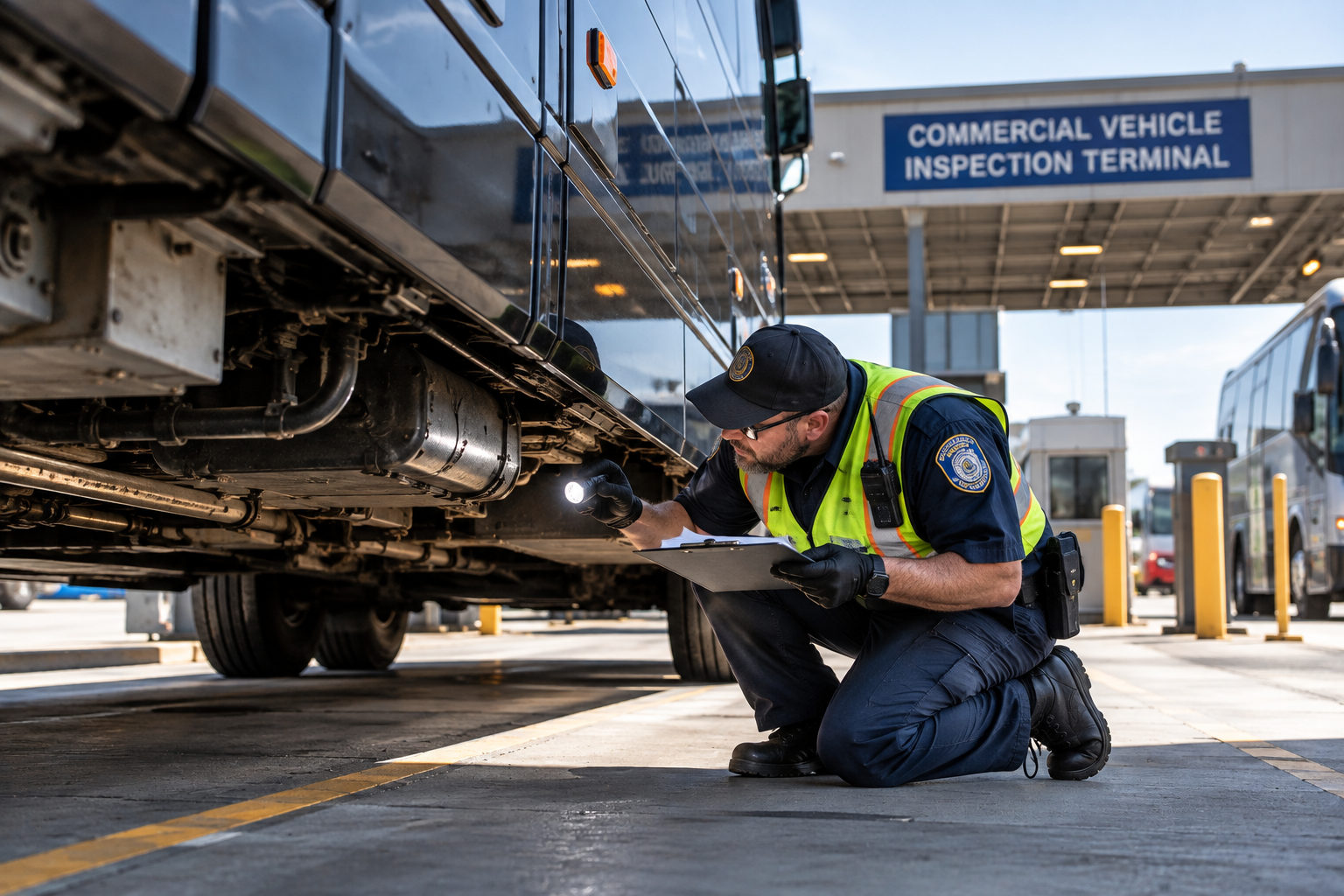
CVSA defines eight inspection levels, and bus operators see a handful most often:
Level I is the full North American Standard Inspection covering driver credentials, logs, and a complete vehicle exam including under-coach brake checks.
Level II is a walk-around driver and vehicle inspection without crawling under the coach.
Level III checks only the driver: license, medical certificate, hours of service, and endorsements.
Level V is a full vehicle inspection with no driver present, often done at a terminal.
A coach that passes Level I or Level V with no critical violations earns a CVSA decal, valid for up to 3 months. Inspectors generally let decaled vehicles pass through inspection sites during that window.
Violations Inspectors Flag Most
Certain defects show up on motorcoach inspection reports again and again:
Brake adjustment problems, where pushrod travel exceeds the limit on one or more wheels.
Air leaks in lines, chambers, or fittings that drop pressure too fast.
Tire tread below the federal minimum or visible cord damage on sidewalls.
Inoperative lamps, especially marker and clearance lights on the upper body.
Emergency exit releases that stick, or exits blocked by luggage or furniture.
Brake and tire issues carry the biggest out-of-service risk. A focused pre-trip catches most of them before an officer does.
Destination and Terminal Inspections
Motorcoaches get special handling. Federal policy bars en route inspections of buses carrying passengers unless officers see an imminent hazard or a traffic violation. Pulling 50 people onto a highway shoulder creates its own safety risk.
Instead, officers inspect at points of origin, venues, terminals, and destinations. States run concentrated operations at casinos, theme parks, and stadiums. FMCSA's annual Passenger Carrier Strike Force pairs those inspections with carrier compliance reviews, and past sweeps have removed hundreds of unsafe buses and drivers in a matter of weeks.
Emergency Equipment Requirements
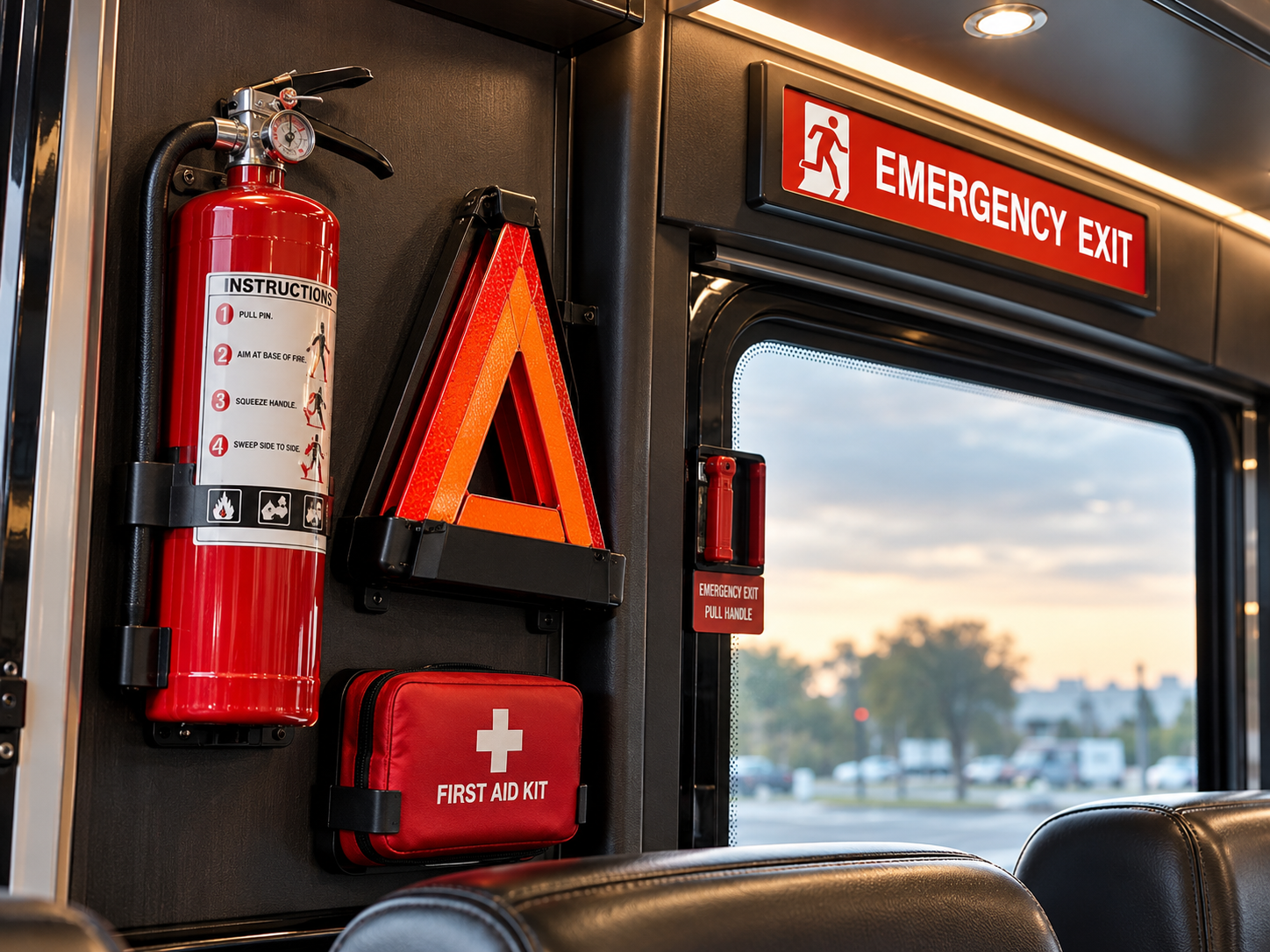
Emergency equipment under 49 CFR 393.95 must be on board and reachable:
A fire extinguisher with the required UL rating, securely mounted.
Three bidirectional reflective triangles for roadside warnings.
Spare fuses if the coach's electrical system uses them.
Emergency exits follow 49 CFR 393.62. Each exit needs clear marking, working release mechanisms, and nothing blocking it. On entertainer coaches, a rear lounge or bunk area often includes an escape hatch or window that the driver should test on every pre-trip.
Seat Belts on Motorcoaches
Seat belt rules come from two agencies. NHTSA requires lap and shoulder belts on new motorcoaches built on or after November 28, 2016. FMCSA's rule in 49 CFR 392.16 requires the driver to wear a belt whenever the coach moves.
Passenger belt use depends on state law, and several states now require it. Converted entertainer coaches with sofas and bunks follow different seating configurations, so riders should ask the driver where belted seats are before long overnight drives.
Safety Risks Specific to Entertainer Coaches
Entertainer coaches add hazards regular charter buses don't have:
Generator exhaust can push carbon monoxide into sleeping areas, so working CO detectors near the bunks matter.
Slide-outs must be fully retracted and locked before the coach moves.
Bunk curtains and bedding add fuel load near electrical wiring, making smoke detectors and extinguisher access essential.
Gear trailers add coupling, lighting, and brake checks, and they change stopping distance.
Drivers on these coaches also service the generator, holding tanks, and interior between shows, so the inspection mindset runs all day rather than only at departure.
Passenger Safety Briefings
Passenger briefings take two minutes and change outcomes in an emergency. The American Bus Association and FMCSA both encourage drivers to point out emergency exits, fire extinguisher locations, seat belt use, and how to reach the driver.
On a band bus, the briefing happens at the start of the tour and again when new crew members join. Musicians sleeping in the bunks should know how to reach the nearest exit in darkness, because that's when problems tend to show up.
How to Check a Carrier's Safety Record
Carrier records are public. The FMCSA SAFER Company Snapshot shows a carrier's USDOT number, authority status, safety rating, and out-of-service rates compared with national averages. The Safety Measurement System (SMS) adds inspection history, including results in the Vehicle Maintenance BASIC.
Knights Coaches holds a Satisfactory FMCSA safety rating and operates a fleet of more than 20 Prevost H3-45 and X3-45 coaches from Nashville, with 24/7 dispatch handling mechanical issues on the road. Tour managers can compare that record against other quotes, then check coach details on the Knights Coaches site.
How often must a tour bus be inspected?
A tour bus needs a driver inspection before every trip and a periodic inspection at least every 12 months. Systematic maintenance runs on the carrier's schedule in between.
Do bus drivers still file a DVIR every day?
No. Since August 18, 2020, bus drivers file a DVIR only when they find a defect. Many carriers still require daily reports as policy.
What is a CVSA Level I inspection?
A Level I inspection is the full 37-step North American Standard exam of the driver and vehicle, including brakes checked from under the coach.
Can police pull over a tour bus for inspection mid-trip?
Generally no. En route inspections of loaded motorcoaches are barred unless officers see an imminent hazard or a traffic violation. Inspections happen at terminals and destinations instead.
What emergency equipment must a motorcoach carry?
A motorcoach must carry a rated fire extinguisher, three reflective triangles, and spare fuses if needed. Emergency exits must be marked and working.
Do tour buses have seat belts?
Yes, on newer coaches. Motorcoaches built on or after November 28, 2016 must have lap and shoulder belts. Older and converted coaches vary.
How long does a CVSA decal last?
A CVSA decal lasts up to 3 months after a clean Level I or Level V inspection.
Which safety risks are unique to entertainer coaches?
The main extras are generator carbon monoxide, slide-out locking, bunk-area fire load, and trailer coupling. Detectors and extra pre-trip steps address them.
How long must carriers keep inspection records?
Carriers keep annual inspection reports for 14 months, DVIRs for 3 months, and maintenance records for 1 year plus 6 months after a coach leaves service.
Is a Satisfactory safety rating safer than an unrated carrier?
A Satisfactory rating shows the carrier passed a federal compliance review, while unrated means no review has happened yet. Unrated isn't unsafe, but it offers less proof.
Where can I check a bus company's inspection history?
Check the FMCSA SAFER Company Snapshot and the Safety Measurement System using the carrier's USDOT number. Both are free and public.
What gets a motorcoach placed out of service most often?
Brake defects and tire problems trigger the most vehicle out-of-service orders. Hours of service and license issues lead the driver side.
Conclusion
Tour bus safety inspections stack from the driver's daily walk-around up to federal and state enforcement. The pre-trip inspection comes first, defect-only DVIRs follow, and 12-month periodic inspections plus systematic maintenance keep each coach in shape. CVSA Level I, II, III, and V inspections take place at terminals and destinations for loaded motorcoaches. Required emergency equipment, post-2016 seat belts, and entertainer coach precautions for generators and slide-outs protect riders, while a short passenger briefing prepares them. Public SAFER and SMS records let buyers verify all of it.
Looking for a coach operator with a clean record and round-the-clock support? Request a quote from Knights Coaches for your next tour.