
Tour Budgeting: Transport as a Line Item for Bus Tours
Transport in a tour budget is the line item that covers every cost of moving the touring party and gear between shows: the coach lease, driver pay, overdrives, fuel, driver hotels, parking, permits, trailers, and weekly services. On a bus tour, it's usually one of the largest expense lines after crew salaries, and it's…
Knights Coaches
Knights Coaches
- Published
- Reading time
- 9 min read

Transport in a tour budget is the line item that covers every cost of moving the touring party and gear between shows: the coach lease, driver pay, overdrives, fuel, driver hotels, parking, permits, trailers, and weekly services. On a bus tour, it's usually one of the largest expense lines after crew salaries, and it's the one most exposed to routing decisions and fuel prices.
Industry pricing guides from 2024 put an entertainer coach at roughly $1,900 to $2,500 per day all in, or about $7.00 to $8.50 per mile when billed by distance. Broken down, coach lease rates have run around $800 to $1,400 per day, and published driver day rates around $325 to $450. Fuel is the wild card in 2026: U.S. on-highway diesel hit a record $6.285 per gallon the week of September 14, according to the U.S. Energy Information Administration (EIA).
The line item touches many entities. The coach company invoices the lease, driver, and services. Truck stops and fuel networks bill the diesel. Hotels bill driver day rooms. Cities bill parking permits. The tour's business manager and accountant track it all against settlements.
This guide breaks down each component, shows how to estimate fuel, covers driver hotels, deadhead positioning, parking and permits, trailers, payment terms, contingency, how transport fits the full budget, a worked 30-day example, and ways to control cost.
Components of the Transport Line
A complete transport line includes:
Coach lease: the daily rate for the vehicle.
Driver day rate: paid for every day the driver is with the tour.
Overdrives: extra driver pay for jumps beyond one legal shift.
Fuel: diesel for driving and generator use.
Driver hotels: day rooms on show days and rooms on off days.
Driver per diem: daily meal allowance.
Parking, permits, tolls, and dump fees.
Weekly services: generator service, linens, cleaning, and washes.
Trailer or truck costs, if used.
Positioning: getting the coach to the first show and home from the last.
Missing any one of these makes the budget look better than reality.
The Coach Lease Rate
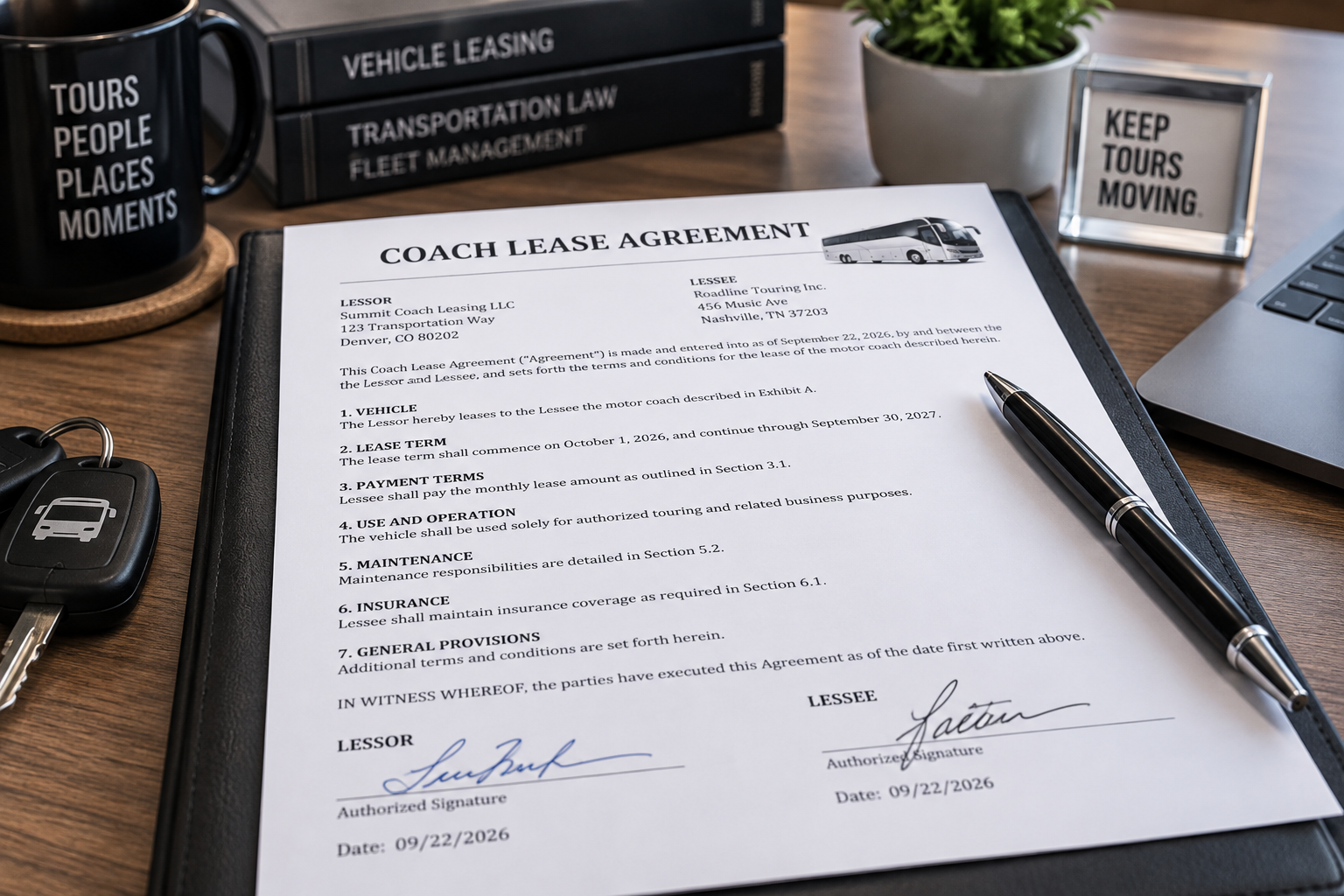
Coach lease rates depend on the coach's age, layout, and amenities. Newer coaches with slide-outs, star bedrooms, or upgraded interiors command higher rates. Older non-slide coaches cost less. Longer leases often earn a lower daily rate.
The lease is billed for every day of the tour, including off days. A 30-day tour pays 30 days of lease, whether the coach drives 600 miles or sits in a hotel lot.
Driver Costs
Driver costs start with the day rate, which is higher for artist buses and for coaches pulling trailers. Overdrives, commonly equal to one full day rate each, add up quickly on tours with long jumps.
Per diem covers the driver's meals. Some tours also cover travel costs to get the driver to the tour start and home at the end. And if the tour needs a second or relief driver, that driver brings a full cost stack of his own.
Estimating Fuel
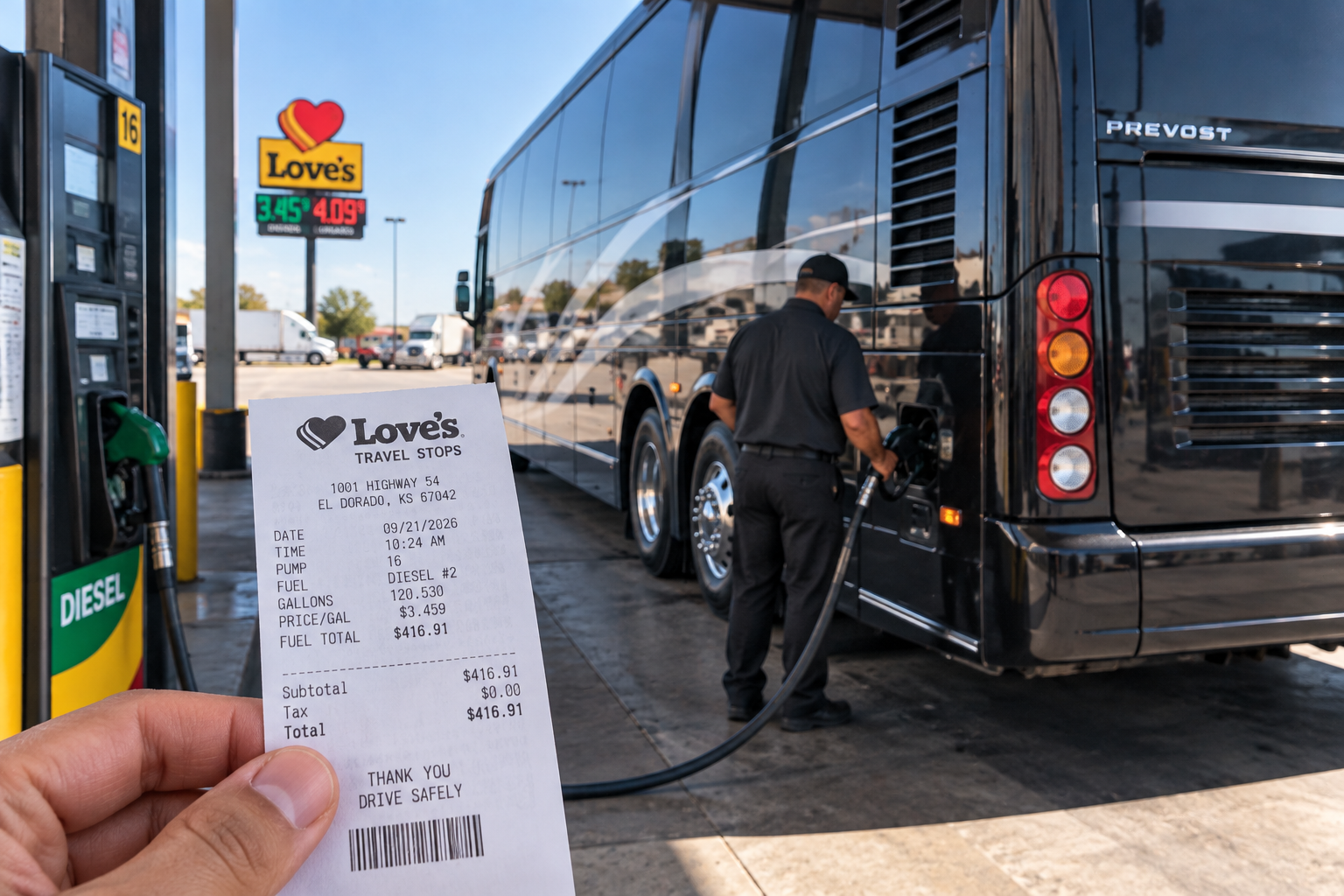
Fuel follows a simple formula: total miles divided by the coach's fuel economy, multiplied by the price per gallon. Ask the coach company for its fleet's average fuel economy rather than guessing, and pad the mileage slightly.
For illustration, assume a coach averages 6 miles per gallon. A 400-mile overnight jump uses about 67 gallons. At $6.285 per gallon, that's roughly $419 for one night's drive. Add generator fuel on days without shore power, which can be significant in summer heat.
Fuel prices move weekly. Budget with a cushion, and note that West Coast diesel has run well above the national average.
Driver Hotels
Driver hotels are non-negotiable on bus tours. The driver needs a day room after each overnight drive to sleep 8 hours or more before the next shift. Many tours also book the driver a room on off days.
U.S. hotel average daily rates reached $171.74 in July 2026, according to CoStar. Downtown rooms near arenas often run higher. Some tours negotiate day rates with hotels near venues, which can cut costs.
Deadhead and Positioning
Positioning covers the coach's trip to the tour start and back to its base. If the coach is based in Nashville and the tour starts in Los Angeles, someone pays for those miles, the driver days, and the fuel.
Coach companies usually quote positioning separately. Tours starting near the coach company's base save money, which is one reason so many tours launch from Nashville.
Parking, Permits, Tolls, and Dump Fees
Smaller fees add up over a long tour. City parking permits for street parking near venues, private lot fees on off days, bridge and highway tolls, and dump station charges all land on the transport line.
Some venues cover parking as a show cost in the contract rider. Others don't. Read each advance carefully so nothing surprises the settlement.
Trailers and Trucks
Trailers add a rental fee, a higher driver day rate, and slightly more fuel. They're often cheaper than a separate truck for club and theater tours.
Trucks bring a separate cost stack: truck lease, truck driver, fuel, and hotels. Once gear outgrows a trailer, trucks become their own line item, often called trucking.
Deposits, Payment Terms, and Cancellation
Coach companies usually require a deposit to hold coaches for tour dates, with the balance paid on a set schedule. Cancellation terms vary, and tours canceled close to the start date can owe significant fees.
Ask about damage policies too. Smoke damage, broken fixtures, and excessive cleaning often carry set charges. Knowing them upfront helps the tour manager enforce house rules.
Holding a Contingency
Contingency protects the tour from surprises: a fuel spike, an extra overdrive after a routing change, a relief driver, or a breakdown that requires a replacement coach. Many tour managers hold 5 to 10 percent of the transport line as a buffer.
In a year like 2026, when diesel has swung more than $2.50 per gallon year over year, contingency isn't optional.
How Transport Fits the Full Tour Budget
Transport sits alongside other major lines: crew salaries, band pay, per diems, hotels, production rentals, trucking, insurance, agent and management commissions, and merch costs. On bus tours, transport often replaces a large share of the hotel budget, since the touring party sleeps on the bus most nights.
That trade-off matters when comparing bus touring against flying. The coach looks expensive in isolation. Paired with the hotels and flights it replaces, it often comes out ahead.
Worked Example: A 30-Day Tour
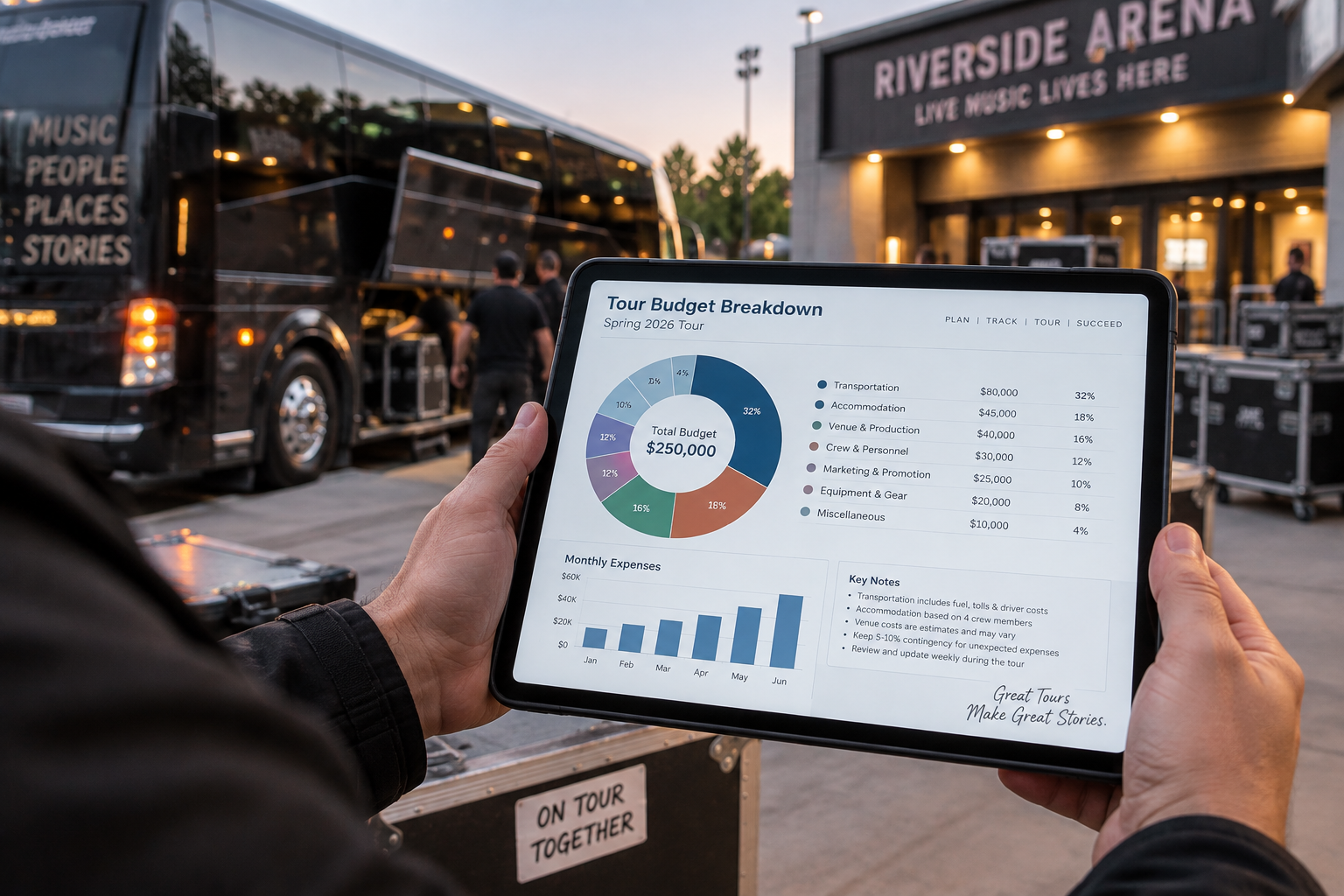
Here's an illustrative estimate for one coach on a 30-day tour covering 6,000 miles. These figures are assumptions for planning, not quotes:
Coach lease: 30 days at $1,100 = $33,000
Driver day rate: 30 days at $400 = $12,000
Overdrives: 3 at $400 = $1,200
Fuel: 6,000 miles at 6 mpg, 1,000 gallons at $6.285 = $6,285
Driver hotels: 30 nights at $172 = $5,160
Parking, permits, tolls, and dump fees: $1,500
Weekly services: 4 weeks at $250 = $1,000
That totals roughly $60,145, or about $2,005 per day, before positioning, driver per diem, and contingency. Adding a 10 percent contingency pushes it past $66,000.
Ways to Control Transport Costs
Transport costs respond to good planning:
Tighten routing so most jumps fit in one legal shift.
Place days off where parking and power are free.
Use shore power at venues to cut generator fuel.
Assign bus space smartly to avoid an unnecessary extra coach.
Book early, since peak-season coaches cost more and sell out.
Negotiate longer leases for lower daily rates.
Each one trims the line without cutting safety or rest.
Common Transport Budget Mistakes
Tour budgets go wrong in predictable ways:
Forgetting positioning miles and driver days to reach the first show.
Budgeting fuel at last year's price, a costly error in 2026.
Skipping driver hotels on off days.
Underestimating overdrives when routing includes long jumps.
Leaving out generator fuel for hot-weather days without shore power.
Ignoring damage policies that turn one smoking incident into a large charge.
Each mistake is small on paper. Together, they can blow the transport line by thousands of dollars.
Tracking Transport Costs During the Tour
Tracking keeps the budget honest once the tour starts. Tour managers log fuel receipts, overdrives, hotel nights, and fees daily, then compare them against the budget each week. Differences show up early, while there's still time to adjust routing or cut costs elsewhere.
Most coach companies invoice weekly or at set milestones. Matching each invoice against the daily log catches billing errors before settlement, and it gives the business manager clean numbers for the tour's final accounting.
How Knights Coaches Quotes a Tour
Knights Coaches quotes tours based on the coach, bunks, slides, and routing, with a CDL driver included on every booking. Its 24/7 dispatch reviews routing for overdrives before the contract, which helps tour managers budget accurately from the start.
Tour managers can request a detailed quote on the Knights Coaches.
How much does a tour bus cost per day?
Industry guides put an entertainer coach at roughly $1,900 to $2,500 per day all in, though 2026 fuel prices can push that higher.
What is included in a tour bus quote?
A quote usually includes the coach lease and driver day rate, with fuel, overdrives, hotels, and fees listed separately.
How do you estimate tour bus fuel costs?
Divide total miles by the coach's fuel economy, then multiply by the price per gallon. Ask the coach company for its fleet average.
Who pays for the driver's hotel?
The tour pays for the driver's day rooms and off-day rooms.
What is positioning on a tour bus invoice?
Positioning covers the coach's trip to the first show and back to its base.
Is a trailer cheaper than a truck?
Usually yes for smaller tours. A trailer costs less than a separate truck until gear outgrows it.
How much contingency should a tour hold for transport?
Many tour managers hold 5 to 10 percent of the transport line.
Do you pay for the bus on off days?
Yes. The coach lease and driver day rate apply every day of the tour.
Why is diesel such a big factor in 2026?
U.S. diesel hit a record $6.285 per gallon in mid-September 2026, raising fuel costs sharply.
Which costs more, a bus tour or flying and hotels?
It depends on routing and headcount. Bus touring often wins on dense routing, since it replaces most hotel nights.
How can a tour lower transport costs?
Tighter routing, shore power, smart bus assignments, early booking, and longer leases all reduce cost.
What is the most common tour transport budget mistake?
Forgetting positioning costs and underestimating fuel are the most common errors, especially with 2026 diesel prices.
Does generator fuel count in the transport budget?
Yes. Generator fuel belongs in the transport line, especially on hot days without shore power.
How often do coach companies invoice a tour?
Most invoice weekly or at set milestones. Match each invoice against daily cost logs before settlement.
Conclusion
Tour budgeting treats transport as a full line item: coach lease, driver day rate, overdrives, fuel, driver hotels, and positioning. Fuel follows a simple formula but moves with record 2026 diesel prices. Driver day rooms, parking and permit fees, trailers, and payment terms fill out the picture, and a 5 to 10 percent contingency protects against surprises. Transport also replaces much of the hotel budget, which the worked example shows clearly. Tight routing and smart planning keep the number in check.
Want an accurate transport number before your tour goes on sale? Request a quote from Knights Coaches.