
How Many Buses Does a Tour Need? Headcount, Bunks, and Bus Types Explained
How Many Buses Does a Tour Need? Headcount, Bunks, and Bus Types Explained The number of buses a tour needs equals the touring headcount divided by usable bunks per coach, adjusted for sleep schedules, artist privacy, and gear space. A standard entertainer coach sleeps 12 in stacked bunks. A condo-bunk coach sleeps 8 .…
Knights Coaches
Knights Coaches
- Published
- Reading time
- 9 min read
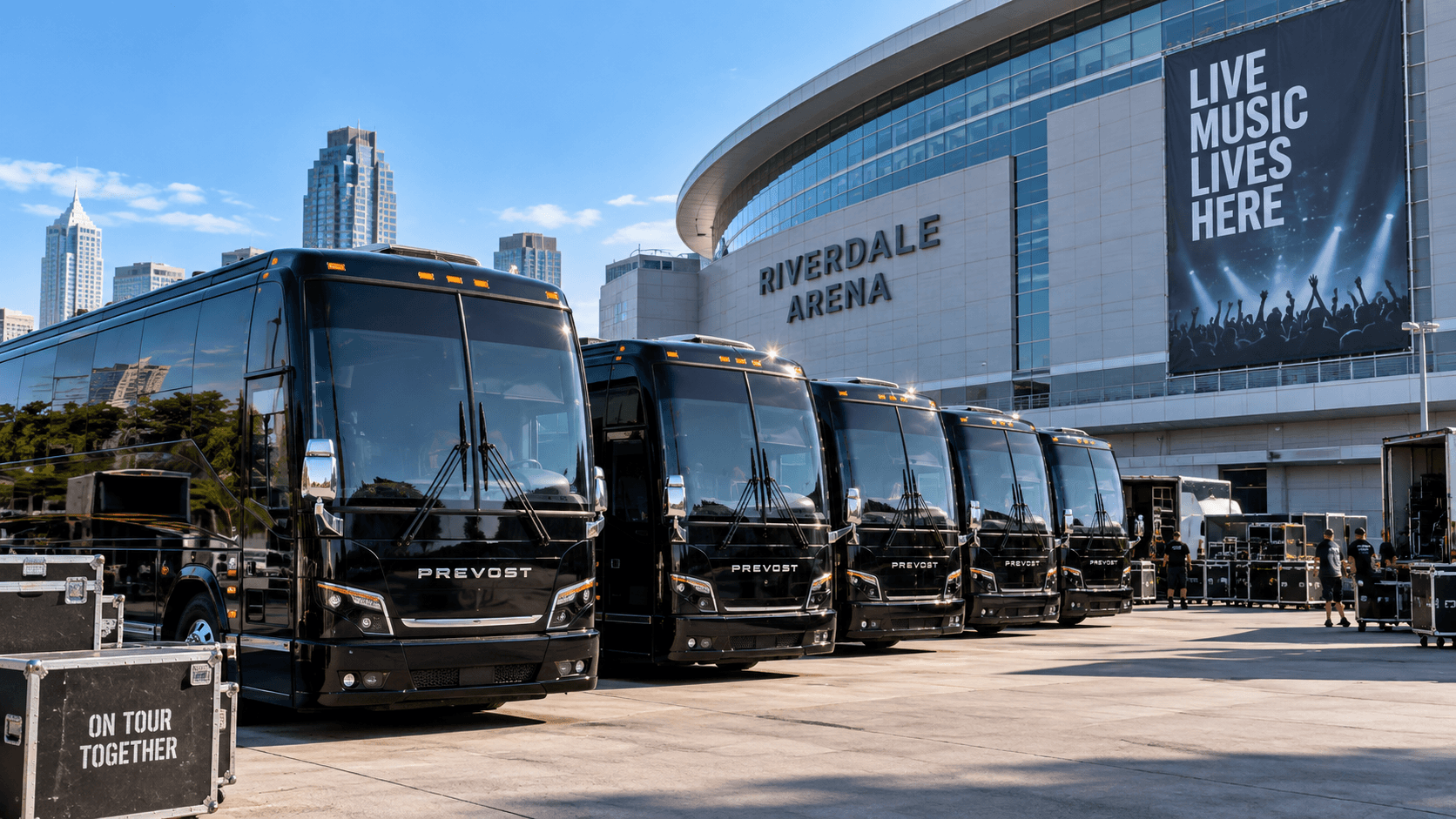
How Many Buses Does a Tour Need? Headcount, Bunks, and Bus Types Explained
The number of buses a tour needs equals the touring headcount divided by usable bunks per coach, adjusted for sleep schedules, artist privacy, and gear space. A standard entertainer coach sleeps 12 in stacked bunks. A condo-bunk coach sleeps 8. A star coach with a private rear bedroom sleeps fewer. So a 20-person touring party usually needs two buses, and a 40-person party needs four or more.
Scale varies enormously across the industry. A club tour might run one coach and a trailer. An arena tour can run a small fleet: Hemphill Brothers, a Nashville coach company, supplied 19 buses for Beyoncé's 2016 tour, and major rock acts have long used seven or eight sleeper buses to carry crews.
The decision connects several entities. The tour manager sets the headcount and budget. The coach company supplies layouts, drivers, and pricing. The production manager decides how much gear rides in bus bays or trailers versus trucks. Federal hours of service rules shape how many drivers each coach needs.
This guide explains how to start from headcount, bunks per coach, bus types by role, why sleep schedules split buses, artist privacy, gear and trailers, typical tour sizes, cost effects, hybrid bus-and-fly setups, scaling mid-tour, and a worked example.
Start With the Headcount
Headcount includes everyone who sleeps on a bus. List every person by role: artist, band members, tour manager, production manager, audio and lighting engineers, backline techs, merch, security, and anyone else traveling full time.
Then separate people who travel differently. Some artists fly between shows. Local crew hired per venue don't ride. Guests and family visits come and go. The number left is your base headcount.
Bunks Per Coach
Bunk count depends on layout:
Standard 12-bunk coaches stack three bunks high on each side, with a front lounge, galley, bathroom, and rear lounge.
Condo 8-bunk coaches stack two high with more headroom, often used for smaller or senior touring parties.
Star coaches replace the rear lounge with a private bedroom for the artist, cutting total bunks.
Plan to leave one or two bunks empty as junk bunks for luggage and gear. So a 12-bunk coach realistically carries 10 or 11 people comfortably over a long tour.
Bus Types by Role
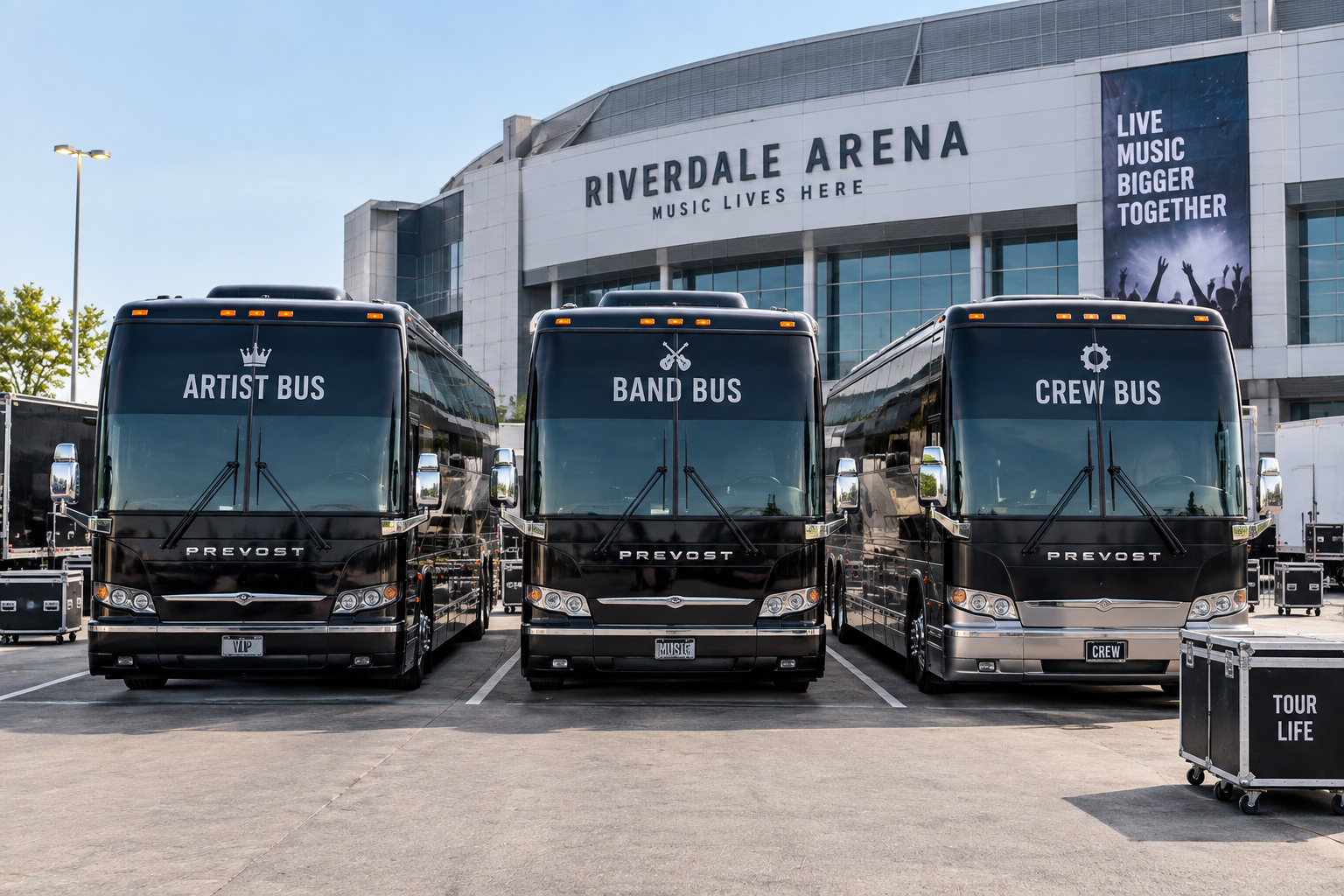
Larger tours assign buses by role:
Artist bus: the headliner, sometimes family or management, often a star coach.
Band bus: musicians and the tour manager, usually a 12-bunk coach.
Crew bus: audio, lighting, video, backline, and stage crew.
Production or management bus: production staff, security, and office work on bigger runs.
Role-based buses make daily life easier. People with similar schedules and needs share space, which cuts friction.
Why Sleep Schedules Split Buses
Schedules drive the split more than headcount alone. Crew often load in at 8:00 AM and load out after midnight. Band members may sleep until noon and stay up after the show. Artists may need early press calls.
Putting those groups on one bus means someone is always being woken up. Separate buses let each group keep its own rhythm, and separate buses can even leave at different times when the crew bus has to arrive early for load-in.
Privacy and Artist Needs
Privacy often decides whether the artist gets a separate coach. Headliners do interviews, meet guests, rest their voices, and need quiet before shows. A star coach gives them a bedroom and private bathroom, while the band bus keeps the social energy.
Some artists travel with family, including children. That usually means a dedicated bus with a layout suited to kids, since a standard crew bus isn't built for them.
Gear, Bays, and Trailers
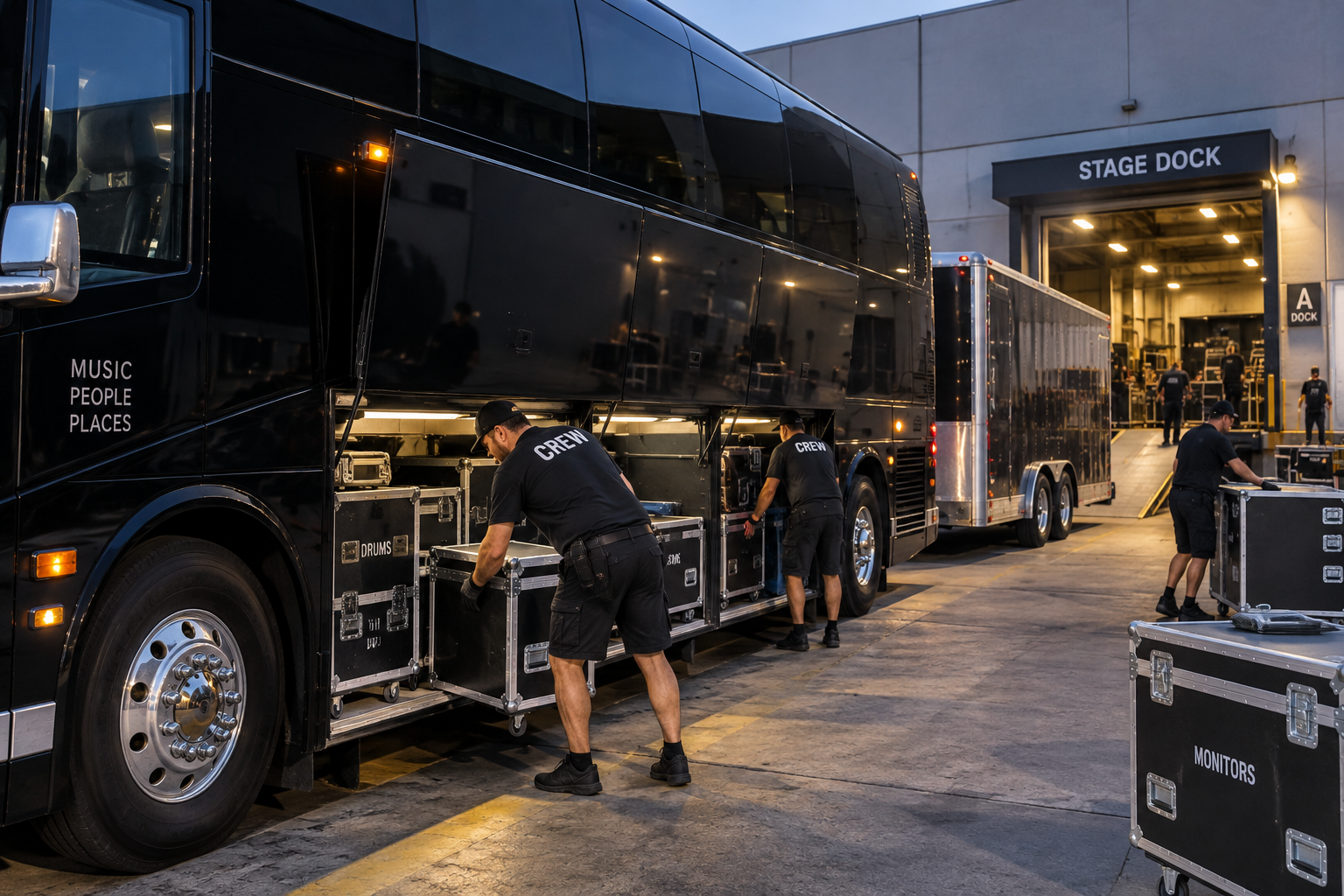
Gear capacity shapes the plan too. A Prevost H3-45 offers roughly 460 cubic feet of underfloor storage in its bays. That holds luggage, merch, and some backline for a small tour.
Beyond that, tours add options:
A trailer behind the band bus for backline and merch on club and theater tours.
A box truck or semi for production gear on larger runs.
Multiple trucks on arena tours carrying lighting, audio, video, and staging.
Trailers raise the driver's day rate and change the CDL class needed, so factor them into both the bus count and the budget.
Typical Tour Sizes
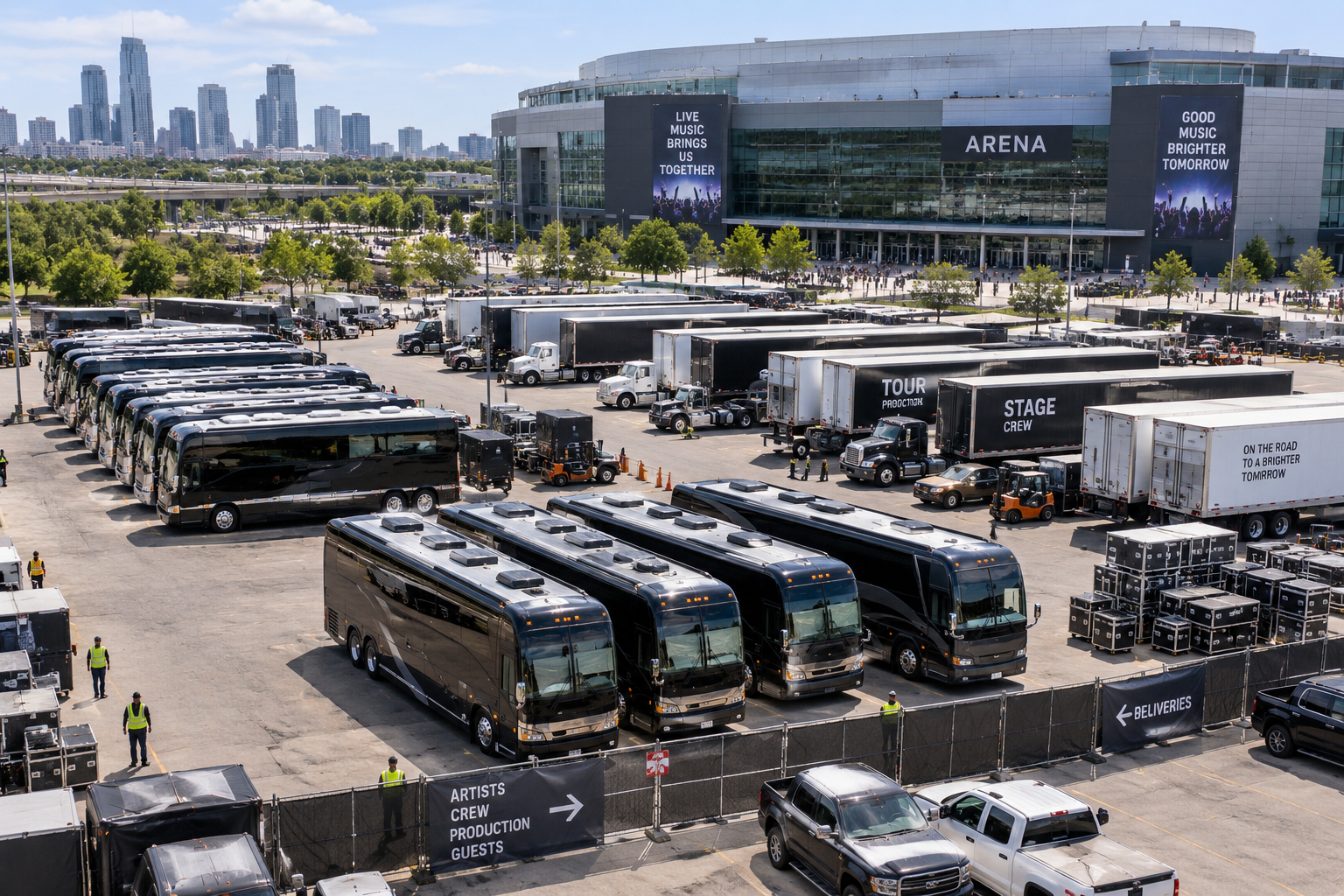
Common setups look roughly like this, though every tour differs:
Solo or duo acts often use a van, a small coach, or a single shared bus.
Club tours with a 4 or 5 piece band and a small crew run one 12-bunk coach, often with a trailer.
Theater tours usually run two buses: band and crew.
Arena tours run four to ten or more buses, plus several trucks.
Stadium tours can run dozens of buses and trucks.
Opening acts usually bring their own bus or share one with another support act.
Cost Implications
Every coach adds a full cost stack: the coach's daily rate, the driver's day rate, fuel, the driver's hotel rooms, per diem, parking, and weekly services. With diesel at a record $6.285 per gallon nationally the week of September 14, 2026, fuel alone makes each extra coach a significant line item.
So squeezing a party onto fewer buses saves money, but only up to a point. Overcrowded buses lead to poor sleep, tension, and people quitting mid-tour. Most tour managers set a firm ceiling of about 10 to 11 people per 12-bunk coach.
Hybrid Setups: Bus Plus Flights
Hybrid setups mix buses and flights. The crew and band ride the bus while the artist flies to select shows. Or the whole party flies on long jumps while the buses deadhead empty to the next city.
Hybrid plans help when routing includes a coast-to-coast gap or when the artist has TV appearances in between shows. They add complexity, though, so they work best with an experienced tour manager.
Scaling Up or Down Mid-Tour
Needs change during a tour. A festival run might add guest musicians. Family visits might require an extra coach for a weekend. A production scale-down for smaller rooms might cut a bus.
Coach companies with larger fleets can add or swap coaches more easily. Build that flexibility into the contract early, since last-minute coaches in peak season can be hard to find.
Worked Example
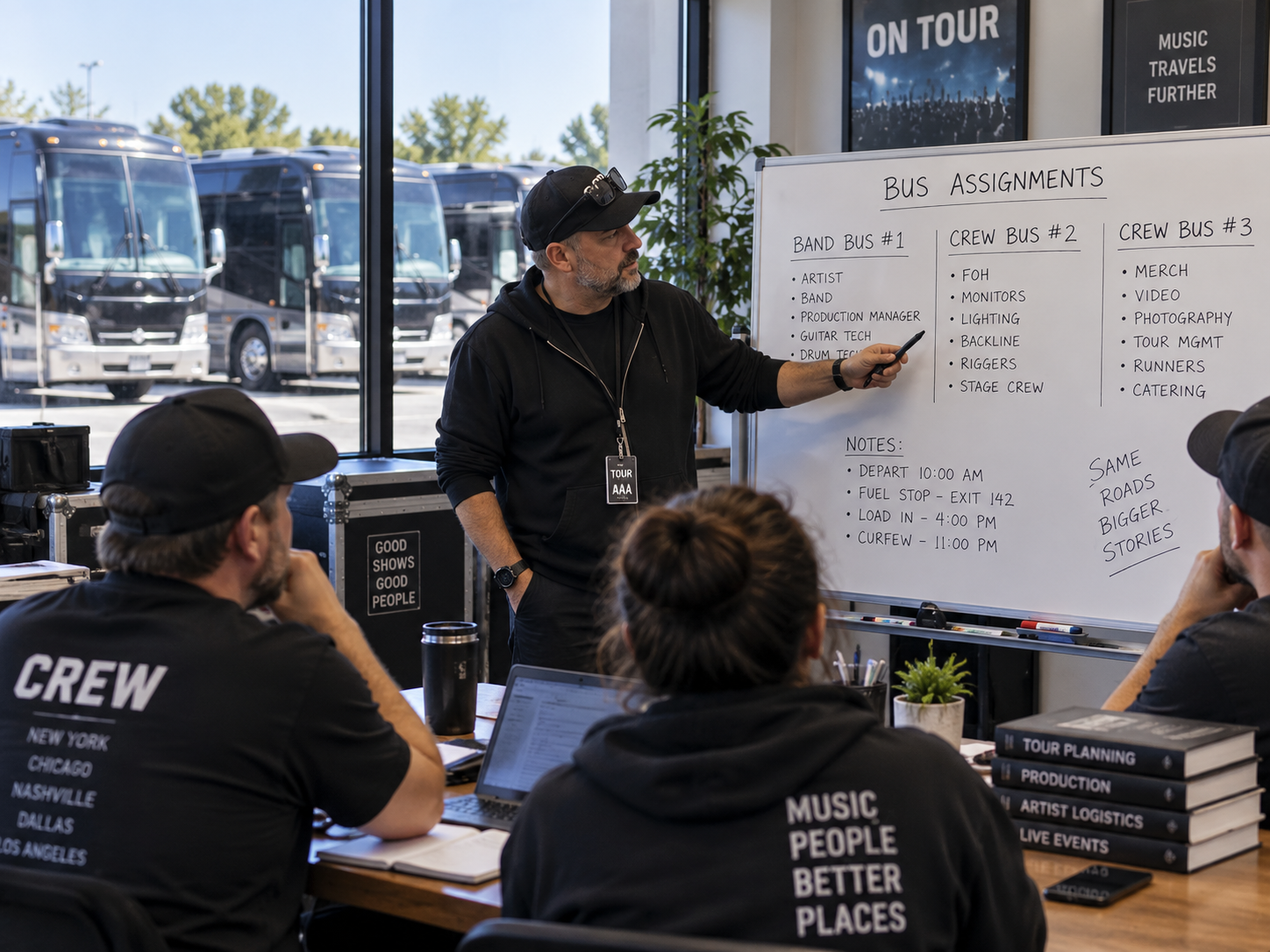
Say a theater tour carries 18 people: artist, 5 band members, tour manager, production manager, 4 audio and lighting crew, 3 backline techs, merch, security, and a wardrobe assistant.
Bus one (band bus): artist, 5 band members, tour manager, and security, 8 people.
Bus two (crew bus): production manager, 4 audio and lighting crew, 3 backline techs, merch, and wardrobe, 10 people.
Both buses have room for junk bunks, and each group keeps its own schedule. A trailer on the crew bus carries backline, avoiding the cost of a separate truck.
Drivers and Bus Count
Every coach needs its own driver, and sometimes two. That affects the plan in ways that don't show up in bunk math. Drivers usually sleep in hotel day rooms rather than bunks, so they don't count against headcount, but they do add a day rate, per diem, and a hotel room for each coach.
Long jumps may require a second driver on each bus. So a four-bus tour with frequent long jumps might need six or eight drivers on certain nights. Plan that with the coach company early.
Questions to Ask Before Choosing a Bus Count
Answer these before signing a coach contract:
How many people sleep on a bus every night of the tour?
Who needs privacy, and does the artist want a separate coach?
How different are the band's and crew's schedules?
Where does gear ride: bays, a trailer, or trucks?
Will guests or family join for parts of the run?
What budget ceiling does transport have?
The answers usually point to a clear number.
Reviewing Bus Count After the First Week
The first week reveals whether the bus plan works. Crowded lounges, fights over bunks, and crew losing sleep to band noise all signal that the split needs adjusting. So do empty bunks that could have saved a coach.
Tour managers should review the setup after about a week and talk to the coach company if changes are needed. Swapping a coach layout or adding a bus mid-tour is far easier than managing a burned-out crew for two more months.
How Knights Coaches Supplies Multi-Bus Tours
Knights Coaches operates more than 20 Prevost coaches from Nashville, so it can supply matched coaches for band, crew, and artist buses on the same tour. Each coach comes with a CDL driver, and 24/7 dispatch coordinates multiple buses across all 48 contiguous states.
Tour managers can size their fleet and request pricing on the Knights Coaches homepage or check city pickups through the tour bus rental service.
How many people fit on a tour bus?
A standard coach sleeps 12, but most tours carry 10 or 11 to keep junk bunks for storage.
How many buses does a band need?
A club band usually needs one bus, a theater tour two, and an arena tour four or more.
What is a star coach?
A star coach is an entertainer coach with a private rear bedroom for the artist, with fewer bunks.
Should the crew and band share a bus?
On small tours, yes. On bigger tours, separate buses work better because the groups keep different sleep schedules.
What is a junk bunk?
A junk bunk is an empty bunk used for luggage and gear storage.
Can a tour bus carry the band's gear?
Yes, partly. A coach has about 460 cubic feet of bay storage, and a trailer adds more.
When does a tour need trucks instead of trailers?
Tours need trucks when production gear exceeds what a trailer can carry, common from theater level upward.
Which costs more, one extra bus or flights for a few people?
It depends on routing. Flights can cost less for a few people on long jumps, while buses win on dense routing.
How many buses do arena tours use?
Arena tours typically run four to ten or more buses, and the largest tours run far more.
Can you add a bus in the middle of a tour?
Yes, if the coach company has a coach and driver available. Plan ahead for peak season.
Do opening acts get their own bus?
Usually yes. Opening acts bring their own bus or share one with another support act.
Does each tour bus need its own driver?
Yes. Every coach needs at least one CDL driver, and long jumps may require two.
Do drivers sleep in the bunks?
Usually not. Drivers sleep in hotel day rooms, so they don't take a bunk from the touring party.
When should a tour review its bus count?
Review it after about the first week. Crowding, lost sleep, or empty bunks all signal that the setup should change.
Conclusion
The number of buses a tour needs starts with headcount and bunks per coach: 12 on a standard layout, 8 on condo, fewer on a star coach, with junk bunks held back. Bus types by role keep artist, band, and crew separated, while different sleep schedules and privacy needs often decide the split. Bay space, trailers, and trucks handle gear. Typical sizes run from one bus for club tours to fleets for arenas, and every coach adds a full cost stack. Hybrid bus-and-fly plans, mid-tour scaling, and a clear worked plan finish the picture.
Need matched coaches for band, crew, and artist? Request a quote from Knights Coaches for your tour.