
FMCSA Hours of Service for Tour Bus Drivers: The 10, 15, and 60/70 Hour Rules Explained
FMCSA hours of service for tour bus drivers are the federal limits in 49 CFR 395.5 that cap how long a passenger-carrying commercial driver may drive and stay on duty before mandatory rest. The Federal Motor Carrier Safety Administration (FMCSA), an agency of the U.S. Department of Transportation, writes and enforces…
Knights Coaches
Knights Coaches
- Published
- Reading time
- 9 min read
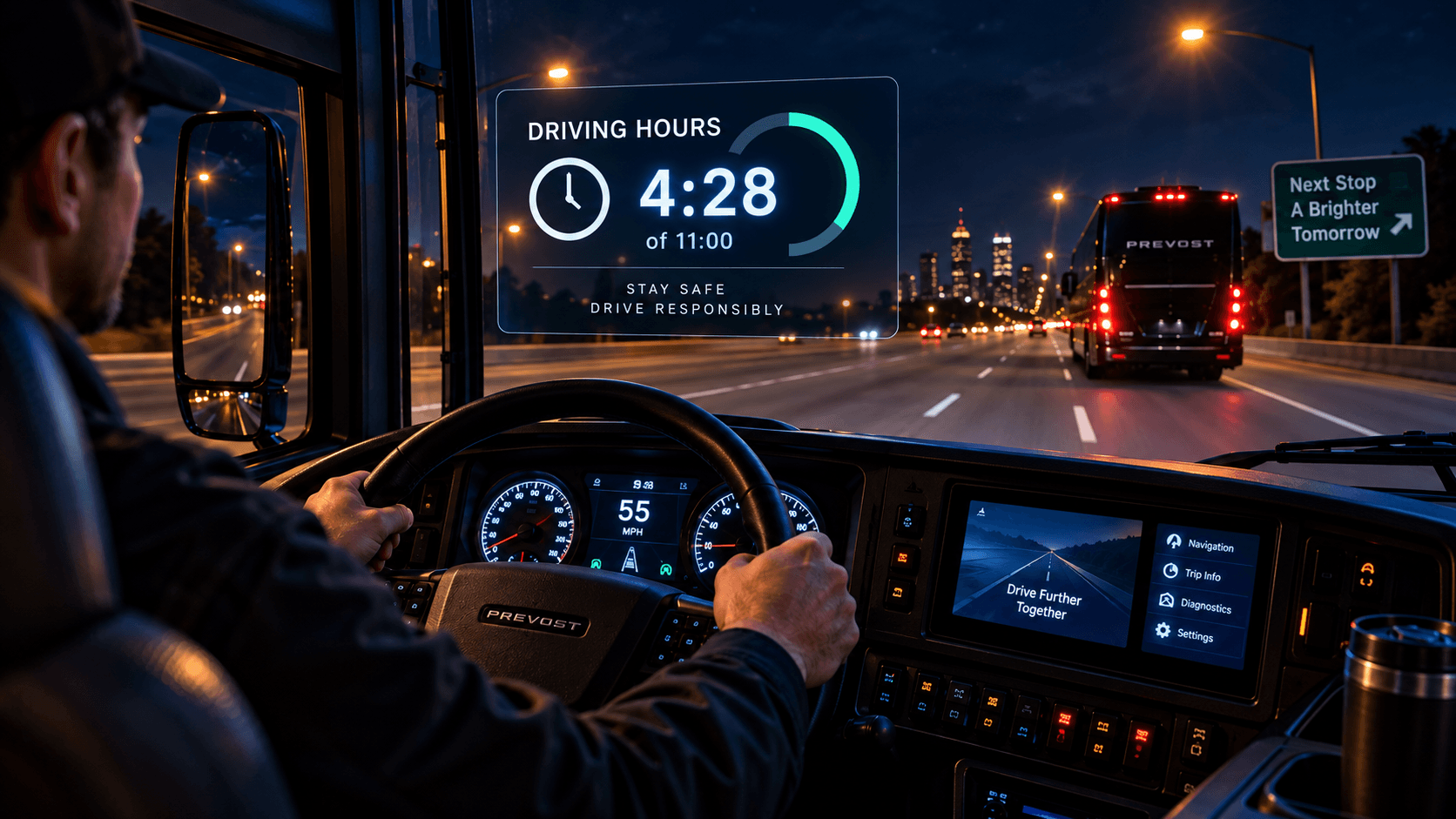
FMCSA hours of service for tour bus drivers are the federal limits in 49 CFR 395.5 that cap how long a passenger-carrying commercial driver may drive and stay on duty before mandatory rest. The Federal Motor Carrier Safety Administration (FMCSA), an agency of the U.S. Department of Transportation, writes and enforces them. They apply to entertainer coaches, charter motorcoaches, and sightseeing buses that cross state lines.
Three numbers run the whole system. A tour bus driver may drive 10 hours after 8 consecutive hours off duty, may not drive after reaching 15 hours on duty, and may not drive after 60 hours in 7 days or 70 hours in 8 days. Those figures differ from the trucking rules most people know (11, 14, and a 34-hour restart), and mixing them up is the most common logging error on band and crew buses.
Several connected rules sit around the core limits: the sleeper berth provision, the adverse driving conditions exception, the 150 air-mile short-haul exception, and the electronic logging device (ELD) that records every minute. Roadside enforcement follows the Commercial Vehicle Safety Alliance (CVSA) out-of-service criteria, and violations feed a carrier's Hours-of-Service Compliance BASIC score.
This guide answers the questions tour managers and new coach drivers ask most. Who falls under the passenger rules? How does a 400-mile overnight jump fit inside 10 hours? What counts as on-duty time at a venue? Can a driver split sleep in the bunk? The sections below cover each limit in order, then show how routing works on a real multi-city tour.
Who the Passenger-Carrying Rules Cover
Passenger-carrying rules apply to any interstate commercial motor vehicle designed or used to carry 9 or more passengers for compensation or 16 or more passengers without compensation, including the driver. Vehicles over 10,001 pounds fall under Part 395 as well. A Prevost H3-45 entertainer coach clears every one of those thresholds.
The real question is whether the operation carries passengers or property. An empty coach repositioning between tours still runs on passenger rules if the carrier's operation is passenger service.
Intrastate trips follow state rules, which often mirror the federal numbers. Tours almost always cross state lines, so the federal standard applies.
The 10-Hour Driving Limit

Driving time tops out at 10 hours in a single duty period. The clock only counts time behind the wheel with the coach in motion. Once a driver hits 10, the next move is 8 straight hours off duty or in the sleeper berth.
Here's what that looks like in miles. At an average of 55 to 60 mph including city traffic and fuel stops, 10 hours covers roughly 550 to 600 miles. Nashville to Atlanta (about 250 miles) fits easily. Nashville to Dallas (about 665 miles) does not fit in one legal shift for a single driver.
Tour routing either splits long jumps across two nights, schedules a day off in between, or adds a second driver.
The 15-Hour On-Duty Limit
On-duty time includes every minute a driver is working or required to be ready to work. That covers driving, pre-trip inspections, fueling, washing the coach, dumping tanks, waiting at a venue under dispatch, and paperwork. A driver may not drive after accumulating 15 on-duty hours following 8 consecutive hours off.
The passenger version works differently from the trucking version in one important way. Off-duty breaks during the day do not count toward the 15 hours. A truck driver's 14-hour window keeps running during a lunch stop. A coach driver's 15-hour total pauses.
That difference matters on show days. If the driver arrives at 4:00 AM, parks, and goes to a hotel room until load-out at 11:30 PM, the hotel time is off duty. The 15-hour count picks up again only when the driver returns to work.
The 60/70-Hour Weekly Limit
Weekly limits cap cumulative on-duty time over a rolling period. A carrier that doesn't operate every day uses 60 hours in 7 consecutive days. A carrier operating every day of the week may use 70 hours in 8 consecutive days.
Passenger carriers get no 34-hour restart. That's a trucking-only provision in 49 CFR 395.3. A coach driver regains hours only as older days roll off the back of the 7 or 8 day window.
In practice, a driver who logs 12 hours a day for six straight days hits 72 hours and is out of weekly time on the 70-hour clock. Tour managers who build in a genuine day off every week or so keep drivers legal without last-minute relief scrambles.
Sleeper Berth Rules on Entertainer Coaches
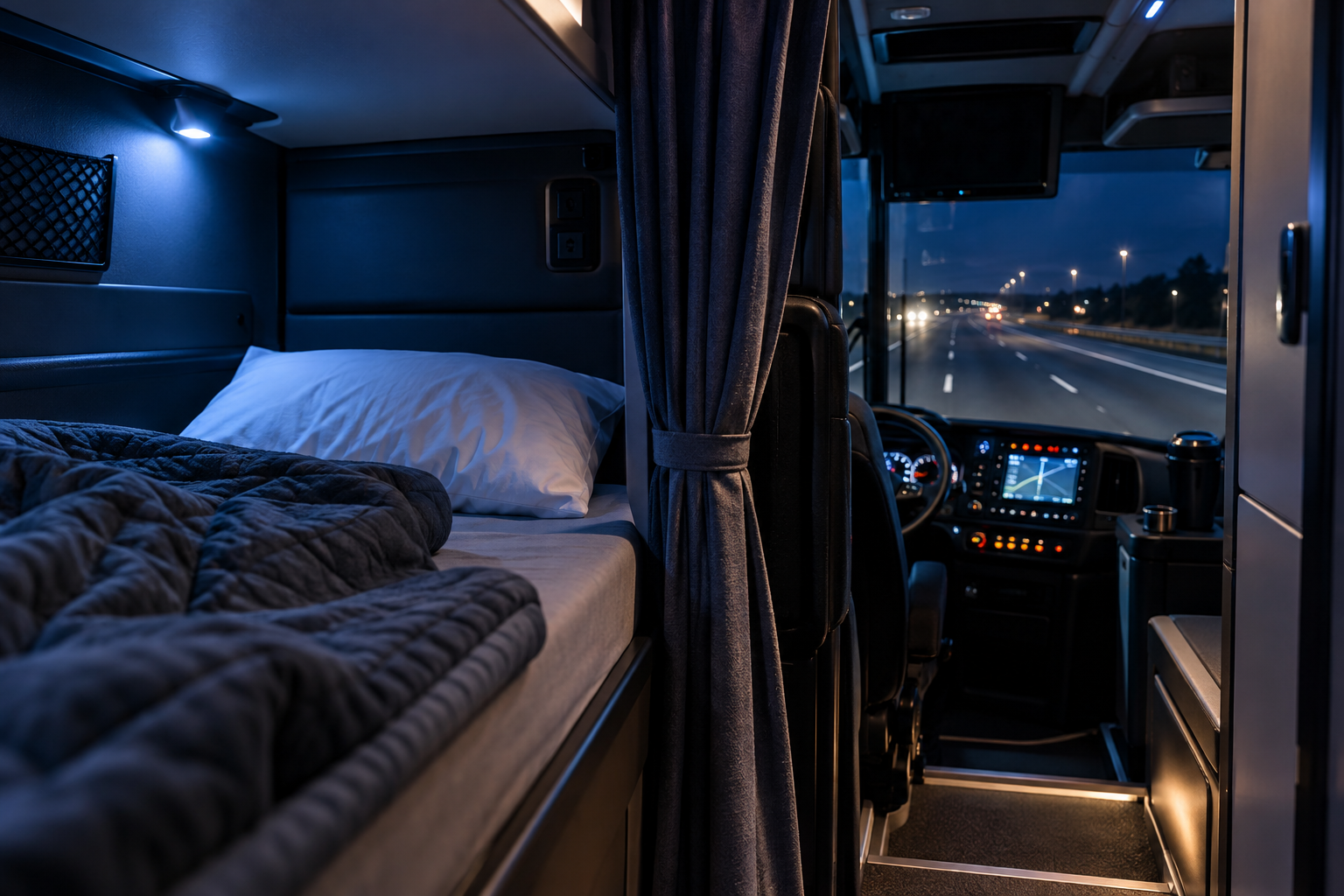
Sleeper berth rules for passenger drivers require at least 8 hours in the berth to reset the daily limits. That time may be split into two periods, as long as neither period is shorter than 2 hours and the pair adds up to 8 or more.
Many coach drivers sleep in a hotel day room instead of the bunk. A driver's berth, when a coach has one, typically sits behind the cockpit and must meet the dimension and ventilation rules in 49 CFR 393.76.
The split option helps on awkward schedules. A driver might take a 3-hour berth period at a truck stop during a long overnight, then finish with 5 hours after arrival. Both periods count, and the ELD pairs them automatically when the driver logs status correctly.
Adverse Driving Conditions and the Short-Haul Exception
Adverse driving conditions extend the 10-hour driving limit and the 15-hour on-duty limit by up to 2 hours each. The exception covers snow, sleet, fog, ice, and unusual road or traffic conditions that the driver and dispatcher couldn't reasonably have known about before the trip started.
A forecasted blizzard doesn't qualify. A sudden interstate closure after a crash does. The driver must annotate the ELD with the reason, because inspectors will ask.
The short-haul exception works for local shuttle work rather than touring. A driver who stays within 150 air miles of the normal work reporting location and returns within 14 hours may skip the ELD and keep a time record instead. Tour buses rarely qualify, since each night ends in a different city.
How HOS Shapes an Overnight Tour Route
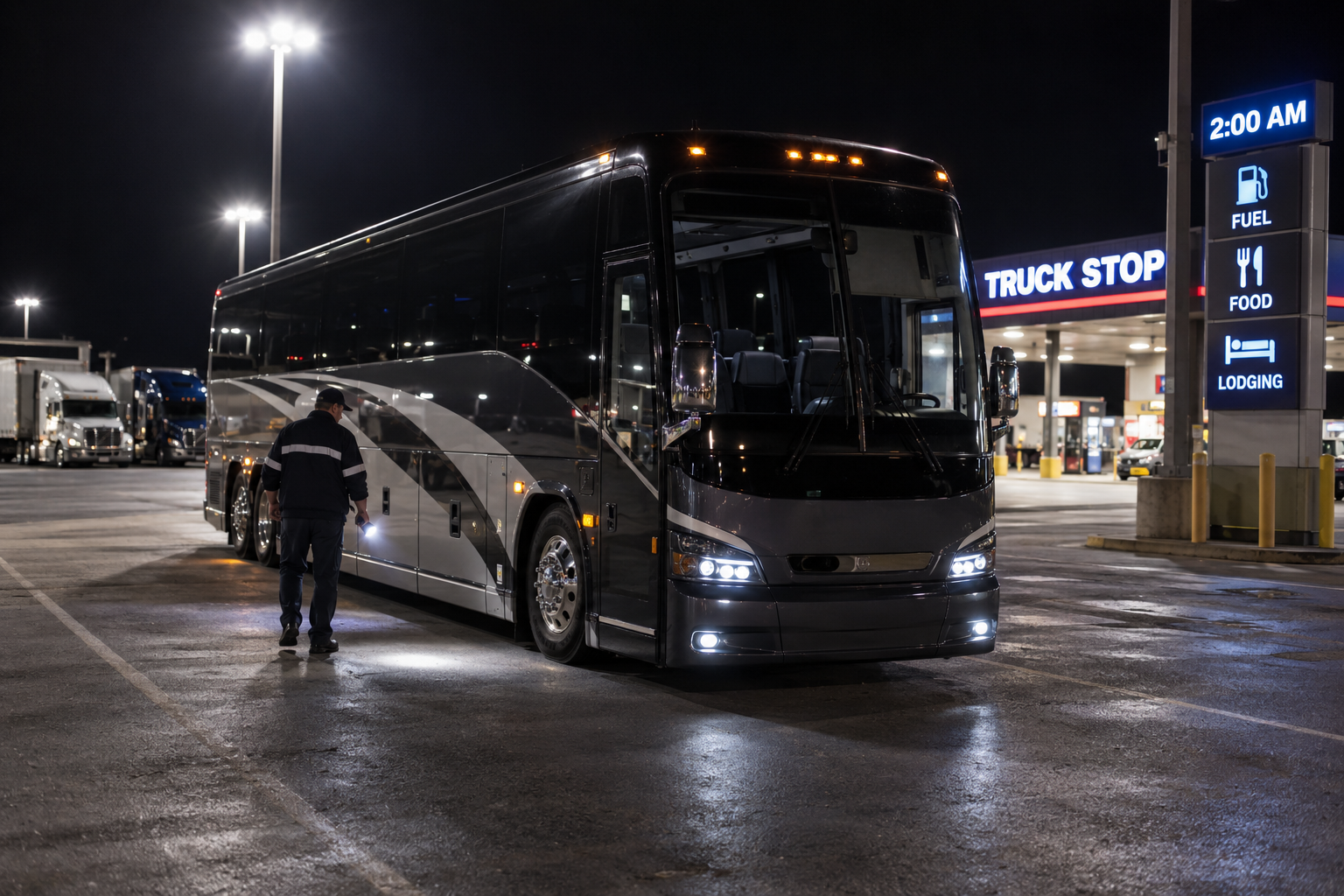
Overnight routing starts with the load-out time. Say a show ends at 11:00 PM and the bus rolls at 1:00 AM. If the driver was off duty all day in a hotel, the full 10 driving hours and 15 on-duty hours are available from that moment.
A typical legal night looks like this:
Roll from the venue at 1:00 AM after a 15-minute pre-trip inspection.
Drive 5 hours, then stop for fuel and a 30-minute break.
Finish a second driving block of 3.5 hours, arriving around 10:30 AM.
Park at the next venue or hotel and log off duty.
That route uses 8.5 hours of driving and about 10 hours on duty, leaving margin for traffic. Most entertainer coach companies call anything beyond one legal shift an "overdrive" and price it separately, because it either needs a second driver or a layover day.
Two-driver setups (a "team") let a coach run 18 to 20 hours straight while each driver stays within his own limits. The off-duty driver must be logged correctly, and a moving bus berth counts as sleeper time only if it meets federal berth specifications.
Penalties and Out-of-Service Orders
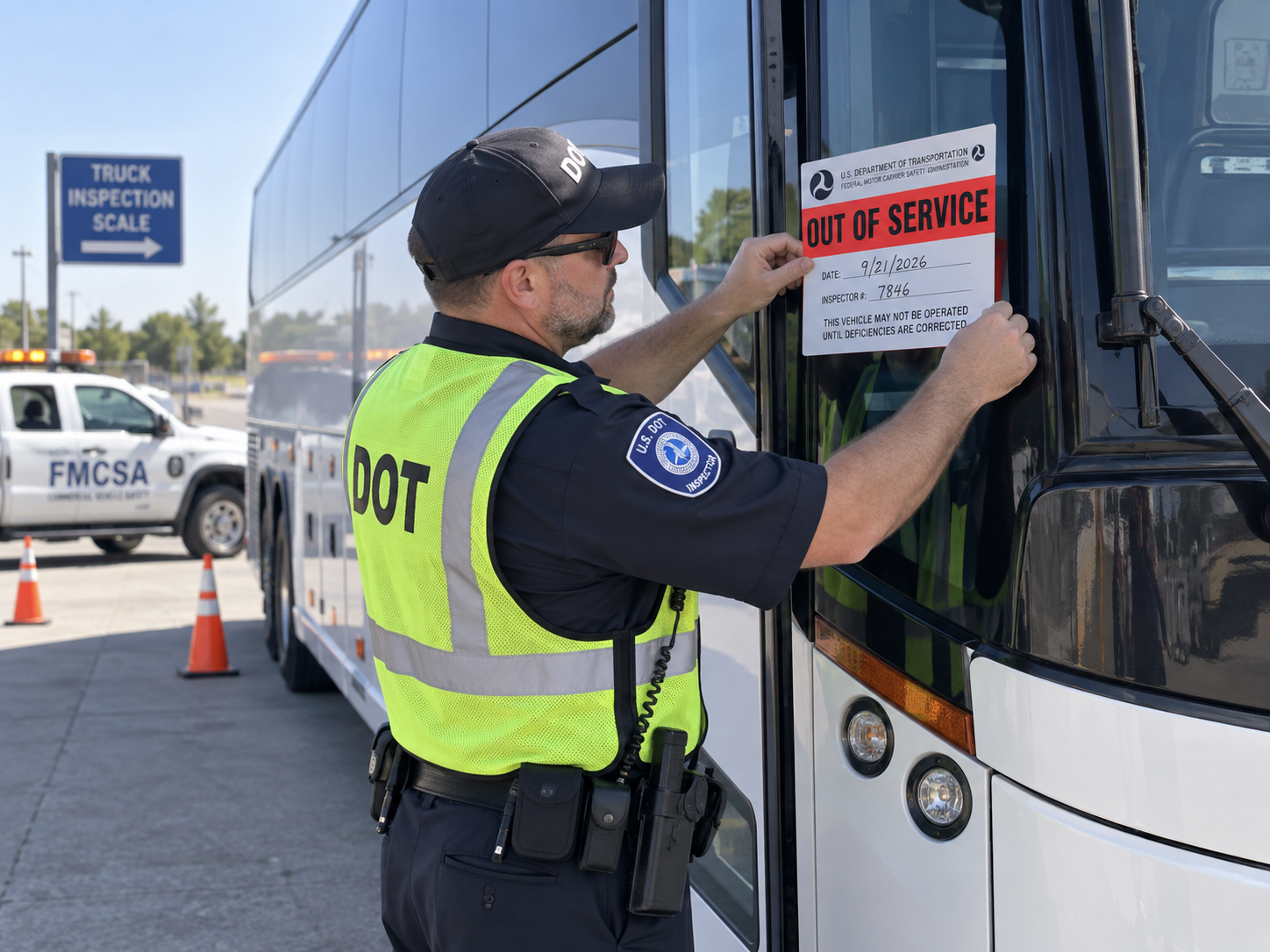
Out-of-service orders are the immediate consequence at roadside. A passenger-carrying driver found over the 10, 15, or 60/70 limit is placed out of service until he has enough rest to be legal again. A driver with no record of duty status at all is held for 8 consecutive hours, which mirrors the passenger off-duty requirement.
Carrier-level consequences follow. Violations raise the Hours-of-Service Compliance BASIC in FMCSA's Compliance, Safety, Accountability (CSA) system, which can trigger a compliance review and a downgraded safety rating. Civil penalties apply per violation, and a pattern of false logs can lead to a federal shutdown order.
How Knights Coaches Plans Tours Around HOS
Knights Coaches routes every tour against the driver's legal clock before a contract is signed. Its fleet of more than 20 Prevost coaches runs out of Nashville, and every booking includes a CDL driver with at least three years on entertainer coaches. The company holds a Satisfactory FMCSA safety rating.
The 24/7 dispatch desk flags overdrives, schedules relief drivers when a jump runs long, and books driver hotel rooms around show-day timing. That planning keeps artists on schedule and keeps logs clean at every destination inspection.
Tour managers comparing options can review the full fleet on the Knights Coaches entertainer coach rental page or check city pickup coverage through the tour bus rental service across 48 states.
How many hours can a tour bus driver drive in a day?
A tour bus driver may drive 10 hours after 8 consecutive hours off duty. Adverse driving conditions can stretch that to 12 hours when the delay was unforeseeable at dispatch.
Do tour bus drivers follow the same rules as truck drivers?
No. Passenger drivers use a 10-hour driving limit, a 15-hour on-duty limit, and 8 hours off, while truckers use 11, 14, and 10. Bus drivers also have no 30-minute break requirement and no 34-hour restart.
Does a 34-hour restart apply to motorcoach drivers?
No. The 34-hour restart is a property-carrier provision only. Coach drivers recover weekly hours as older days drop off the rolling 7 or 8 day window.
What counts as on-duty time for an entertainer coach driver?
On-duty time is any time spent working or on call for the carrier, including driving, inspections, fueling, cleaning the coach, and waiting at a venue under dispatch. Time released to a hotel room counts as off duty.
Can a coach driver split the 8-hour sleeper berth period?
Yes. The driver may split sleeper time into two periods of at least 2 hours each that total 8 hours or more. Both periods must be spent in a berth that meets federal specifications.
Which exceptions apply to passenger-carrying drivers?
Four main exceptions apply: adverse driving conditions, the 150 air-mile short-haul exception, personal conveyance, and emergency relief declarations. Tour buses use adverse conditions most often, since short-haul rarely fits multi-city routing.
Is a single driver or a two-driver team better for long tour jumps?
A two-driver team is better for jumps beyond roughly 550 miles, because each driver stays inside his own 10-hour limit while the coach keeps moving. A single driver costs less but needs a layover day on long runs.
What happens if a tour bus driver runs out of hours mid-route?
The driver must stop and take 8 consecutive hours off before driving again. Carriers either send a relief driver or reroute the coach to the nearest safe parking.
Are the 2026 FMCSA hours of service pilot programs open to bus drivers?
No. The Flexible Sleeper Berth and Split Duty Period pilots target property-carrying truck drivers. Passenger-carrying rules remain unchanged from the 2020 final rule.
How are hours of service tracked on a tour bus?
Hours are tracked with an FMCSA-registered electronic logging device wired to the engine. The ELD records driving automatically and stores the current day plus the previous 7 days for inspectors.
Do HOS rules apply when the coach is empty between tours?
Yes. A deadhead or repositioning trip is still commercial driving and counts toward all three limits. Personal conveyance applies only to limited off-duty movement, such as driving to nearby lodging.
Conclusion
FMCSA hours of service for tour bus drivers come down to three passenger-carrying limits: 10 hours of driving, 15 hours on duty, and 60/70 hours across a rolling week, all reset by 8 consecutive hours off. The rules cover every interstate entertainer coach, the weekly clock runs without a 34-hour restart, and the sleeper berth allows a two-part split. Adverse driving conditions add 2 hours when surprises hit, while short-haul relief rarely fits touring. Overnight routing, team drivers, and day rooms turn those numbers into a workable schedule, and out-of-service orders at destination inspections show what happens when the math fails.
Planning a tour and want the logs handled before the first show? Talk to Knights Coaches about a Prevost coach with a CDL driver and 24/7 dispatch.