
Entertainer Coach vs Charter Bus: Key Differences That Change Your Booking
A charter bus is a 45-foot motorcoach fitted with 47 to 56 forward-facing reclining seats , a lavatory, and a full row of underfloor luggage bays, built to move large groups between two points in a single day. An entertainer coach uses a near-identical exterior shell and replaces that seating with 8 to 18 sleeping…
Knights Coaches Admin
Knights Coaches
- Published
- Reading time
- 11 min read
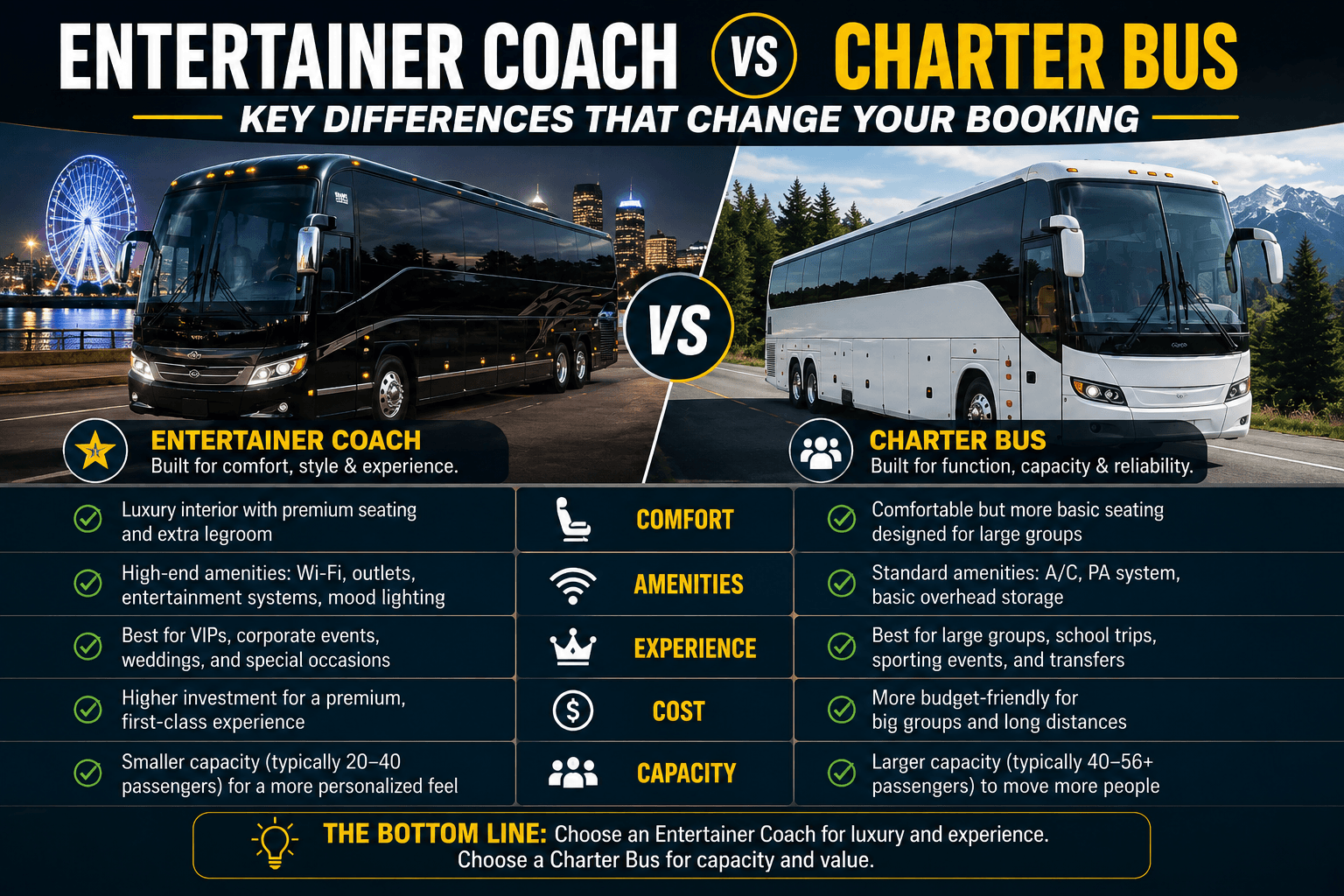
A charter bus is a 45-foot motorcoach fitted with 47 to 56 forward-facing reclining seats, a lavatory, and a full row of underfloor luggage bays, built to move large groups between two points in a single day. An entertainer coach uses a near-identical exterior shell and replaces that seating with 8 to 18 sleeping bunks, a galley kitchen, front and rear lounges, and a shower, so a crew can sleep while the vehicle covers ground overnight.
From the curb the two look the same. Both usually sit on a Prevost H3-45, an MCI J4500, or a Van Hool chassis, and both appear on the same tour bus rental enquiry forms. Both run a Detroit or Volvo diesel through an Allison transmission. Both carry a driver holding a commercial license and both fall under Federal Motor Carrier Safety Administration hours-of-service rules that cap driving at 10 hours after 8 consecutive hours off duty.
Everything that matters happens behind the door. Capacity drops from 56 to roughly 12. Nightly hotel spend drops toward zero. Cargo moves from underfloor bays into a towed trailer. Day rate rises from about $1,100 to $1,900 for a charter unit to $2,200 to $2,900 for a converted sleeper. Per-mile pricing rises from roughly $4.00 to $6.20 up to $7.00 to $8.50.
This comparison walks the differences that actually change a booking decision: interior layout, seated capacity against berth capacity, day travel against overnight travel, storage architecture, cost per day and per mile, the regulatory picture that applies to both, privacy and security specification, and a decision framework for matching the vehicle to the job.
Same shell, two entirely different interiors
Interior architecture is the fault line. A charter coach devotes its full floor plan to seating rows, with a rear lavatory and overhead parcel racks. Aisle width, seat pitch, and window spacing are set by the manufacturer and rarely modified.
An entertainer conversion strips that floor plan to bare metal. Converters such as Featherlite, Millennium, Marathon, Liberty, and Emerald then build a front lounge behind the driver, a bunk corridor through the middle, and a rear lounge or stateroom at the back. The galley sits between the front lounge and the bunks, with refrigeration, microwave, sink, and counter space.
Slide-outs mark the other visible difference. Charter coaches have none. Converted sleepers commonly run single, double, or triple slide-outs that widen the lounges when parked. Every unit in the Knights Coaches Prevost coach lineup runs at least one slide-out and lists its bunk count and rear configuration on the specification card.
Capacity: 56 seats against 12 berths
Capacity is the first number that eliminates one option. A full-size charter coach seats up to 56 and can move an entire football roster, a wedding party, or a corporate offsite in one vehicle. Nobody sleeps in those seats, and nobody is meant to.
A converted sleeper carries 12 bunks as the North American standard, six per side, stacked three high in four quadrants. Passenger count is capped by berth count, not by seat count, because everyone on board needs somewhere to sleep. Even a coach configured with 14 berths using a rear bed kit rarely travels with more than 10 people, since surplus bunks absorb luggage, cases, and coats.
The practical rule: if your group exceeds 14 and travels by day, you need a charter unit. If your group is under 12 and travels overnight, you need a sleeper. Groups that fall between those two profiles usually split across a sleeper plus coast to coast tour bus coverage on a second unit rather than compromising on one vehicle.
Day travel against overnight travel
Travel pattern decides more than capacity does. Charter work is point-to-point and daylight-weighted: pick up at 7:00 AM, arrive by lunch, wait, return the same evening. Passengers sleep in hotels. The bus parks overnight.
Sleeper work inverts that. Load-out finishes at 11:30 PM, the crew boards, the driver rolls at midnight, and the coach arrives in the next market by breakfast. Nobody books a hotel room except the driver, who legally must sleep off the clock and is provided a minimum three-star room each night of the tour.
That single behavioral difference is the entire economic case for a converted coach. A 10-person crew booking hotel rooms at $180 per night on a 30-date run spends over $30,000 on accommodation and still pays for day transport. Moving those nights onto the coach folds lodging into the transport line. It also removes the check-in window from the routing, which is why tours with 300-mile hops between markets almost always ride a sleeper.
• Charter bus scenario: school field trip, wedding shuttle, corporate campus transfer, single-day sightseeing route, airport group move.
• Entertainer coach scenario: 20-date club tour, festival run across three states, political campaign week, film unit moving between locations, comedy theater circuit.
Storage: luggage bays against a towed trailer
Storage architecture separates the two categories more sharply than most operators explain. Charter coaches carry a continuous underfloor bay running most of the wheelbase, sized for 56 suitcases. Loading is fast and everything travels inside one vehicle.
Converted sleepers surrender much of that bay volume to the generator, water tanks, waste tanks, and house batteries that make overnight living possible. Remaining bay space holds personal luggage and a few small cases. Backline, lighting, staging, and merchandise ride behind the coach in a trailer or in a separate box truck.
Trailer capacity is bounded by law and by the operator. Trailers pulled behind a 45-foot coach are commonly restricted to 10,000 pounds gross, which yields around 5,500 pounds of usable payload. Heavier production packages move to a box truck. Knights Coaches coordinates enclosed trailers, box trucks, and flatbeds through its production gear trucking service so gear and crew travel on one contract rather than two.
Pulling a trailer also changes operating numbers. Fuel economy drops from 6 MPG to roughly 5 MPG, the driver’s rate increases by about $75 per day, and exterior wash charges rise. Budget those three lines whenever a trailer is on the hitch.
Cost comparison per day and per mile
Pricing separates cleanly once you compare like for like.
• Charter coach, 50 to 56 seats: roughly $1,100 to $1,900 per day, or $4.00 to $6.20 per mile on mileage-based quotes.
• Entertainer coach, all in: roughly $2,200 to $2,900 per day, or $7.00 to $8.50 per mile.
• Coach component alone: roughly $800 to $1,400 per day before driver and fuel.
• Driver component: $350 to $500 base per day, plus around $55 per diem and a hotel room nightly.
• Fuel component: total miles divided by MPG, multiplied by diesel price per gallon.
Secondary lines follow a predictable pattern on sleeper contracts and are usually absent from charter quotes: tolls, permits, IFTA and DOT fees around $40 per day; satellite and connectivity around $60 per day; engine service assessed at roughly $0.35 per mile; end-of-tour interior cleaning near $600; and overdrive charges once daily mileage passes the industry threshold of 451 miles.
Charter quotes are simpler because the vehicle does less. Sleeper quotes are longer because the vehicle replaces a hotel, a green room, and a crew lounge at the same time. When a sleeper proposal looks expensive against a charter proposal, check whether the charter figure includes lodging. It never does.
A 30-date run costed both ways
Worked numbers settle the argument faster than feature lists. Take a 10-person party running 30 tour dates across 35 days and 9,000 miles.
On a charter coach at $1,500 per day, transport lands near $52,500 across 35 days. Add 10 hotel rooms nightly at $180 for 34 nights and lodging reaches $61,200. Total exposure sits around $113,700, and the routing still loses two hours daily to check-in and check-out.
On an entertainer coach at $2,600 per day all in, transport lands near $91,000 for the same 35 days. Lodging drops to one driver room per night, roughly $6,100, plus per diem. Add end-of-tour cleaning at $600 and a trailer at $125 daily for the gear that a charter coach would have carried in its bays. Total exposure sits around $102,100.
The sleeper comes out lower on this profile and buys back drive-time flexibility on top. Flip the inputs and the answer flips too: a group of 30, or a routing with fewer than 100 miles between shows, or a run where the venue supplies dressing rooms and the band lives locally, all push the math back toward seated equipment. Run your own itinerary through both structures before assuming either result. The break-even usually sits somewhere between six and eight travelers.
The rules that apply to both
Regulation does not distinguish between the two categories in any way that helps a client. Both vehicles are commercial passenger carriers. Both require a Class A or B commercial driver’s license. Both operate under US DOT registration with an FMCSA safety rating attached to the carrier.
Hours of service bind both equally. A driver may drive 10 hours after 8 consecutive hours off duty, within a 15-hour on-duty window, and electronic logging devices record every minute. No operator can legally let a client’s own staff member take the wheel, regardless of that person’s license class, because driver qualification files sit with the carrier.
Where the categories diverge is trade membership. Entertainer operators join the Entertainer Motorcoach Council, which sets service and safety expectations above the DOT floor for touring work specifically. Knights Coaches holds EMC membership, US DOT registration, and a satisfactory FMCSA safety rating, and staffs coaches with drivers carrying a three-year minimum on entertainer equipment.
Privacy, security, and the artist factor
Privacy specification is the one area where a charter coach cannot substitute at any price. Entertainer conversions carry blacked-out or mirrored glazing that lets passengers see out while blocking the view in. Bunks close with curtains and carry individual lighting, climate control, and charging.
Venue access differs too. Production entrances and secured lots are built around a coach that parks and stays, with shore power or generator running, acting as the artist’s dressing room and the crew’s base. A charter coach drops and leaves.
That combination is why management books a sleeper for talent even on short runs where the mileage would not justify one. The vehicle is not only transport. It is the private room attached to the venue. Tours running more than four weeks usually convert that logic into a monthly entertainer coach lease at a reduced daily rate with the same unit and the same driver held for the duration.
Is a charter bus cheaper than an entertainer coach?
Yes. A charter coach costs roughly $1,100 to $1,900 per day against $2,200 to $2,900 for an entertainer coach. The gap narrows once hotel rooms enter the comparison, because a sleeper removes overnight accommodation for the entire traveling party except the driver.
How many people can sleep on an entertainer coach?
Twelve people can sleep on a standard entertainer coach, using six bunks per side stacked three high. Most tours travel with 8 to 10 and use the spare berths for luggage. A rear bed kit raises the count to 14.
Can a charter bus be used for an overnight tour?
Technically yes, practically no. Charter coaches have reclining seats rather than beds, so passengers still need hotel rooms at every stop. Using one for a multi-city tour adds lodging cost and check-in time to every routing day.
Which vehicle types fall between the two?
The middle ground includes minibuses at 15 to 35 passengers, splitter vans at 4 to 9 seats with a gear bulkhead, and Class A motorhomes sleeping up to 10. Each trades either sleeping capacity or gear capacity against the full-size sleeper.
Do both vehicles require a CDL driver?
Yes. Both categories are commercial passenger vehicles requiring a Class A or B commercial license, DOT medical certification, and drug and alcohol clearinghouse enrollment. Carriers cannot accept an outside driver on either type.
Where does the gear ride on each?
Gear rides in underfloor bays on a charter coach and in a towed trailer or box truck alongside an entertainer coach. Sleeper bays lose capacity to the generator, water tanks, and batteries, leaving room for personal luggage only.
How far can either bus travel in a single day?
Both are capped at 10 hours of driving after 8 consecutive hours off duty, producing roughly 450 to 550 highway miles. Operators bill an overdrive beyond the 451-mile industry threshold or add a second driver for longer legs.
Does an entertainer coach have a bathroom and shower?
Yes on both counts for most units. Entertainer coaches carry a mid-coach bathroom and an onboard shower, while charter coaches carry a lavatory with no shower. Confirm shower availability in the contract, since a small number of older non-slide units omit it.
Which is better for a corporate group of 40?
A charter coach wins outright. Forty passengers exceeds the berth capacity of any single sleeper, and a daytime corporate transfer gains nothing from bunks. Book a sleeper only when the same small group needs to travel and rest overnight.
Can I get both vehicles from one operator?
Often, yes. Many carriers run mixed fleets, though entertainer specialists usually stay focused on converted coaches. Knights Coaches runs 20-plus Prevost sleepers and coordinates trucking on the same contract rather than seated charter equipment.
How much notice does a booking need?
Peak touring season books months ahead, and specific floor plans go first. Short-notice work is still possible: dispatch operates 24/7 and can position a coach when fleet availability allows. Give the full itinerary at the first inquiry and the quote comes back accurate rather than provisional.
Does the exterior wrap differ between the two?
Wraps apply to both, but entertainer coaches carry them far more often. Campaign tours and album cycles use the coach as mobile signage, and wrap production is quoted as a one-time cost separate from the daily rate.
The short version
Charter buses and entertainer coaches share a shell, a chassis, a diesel drivetrain, and a regulatory framework, then diverge completely inside. Seating for 47 to 56 becomes 12 bunks with a galley and two lounges. Daylight point-to-point travel becomes overnight city-to-city travel that removes hotel nights from the routing. Continuous underfloor bays become a towed trailer, because generators, water, and batteries occupy the space cargo used to fill. Day rates move from roughly $1,100 to $1,900 up to $2,200 to $2,900, and per-mile figures move from $4.00 to $6.20 up to $7.00 to $8.50. Hours-of-service rules bind both identically, while privacy glass, curtained bunks, and venue-side parking belong only to the converted coach.
Knights Coaches operates Prevost H3-45 and X3-45 sleepers with CDL-certified drivers and round-the-clock dispatch in every major US city. Call 855 734 5700 or book entertainer coach rental and dispatch replies within the hour.