
How Much Does an Entertainer Coach Cost to Buy? A 2026 Price Guide
An entertainer coach costs between $50,000 and $1.28 million to buy used , and $1 million to $2 million new . That spread covers the same basic vehicle: a 45-foot Prevost, MCI, Van Hool, or Eagle motorcoach converted with sleeping bunks, a galley, front and rear lounges, and a bathroom. What moves a coach from one end…
Knights Coaches
Knights Coaches
- Published
- Reading time
- 11 min read
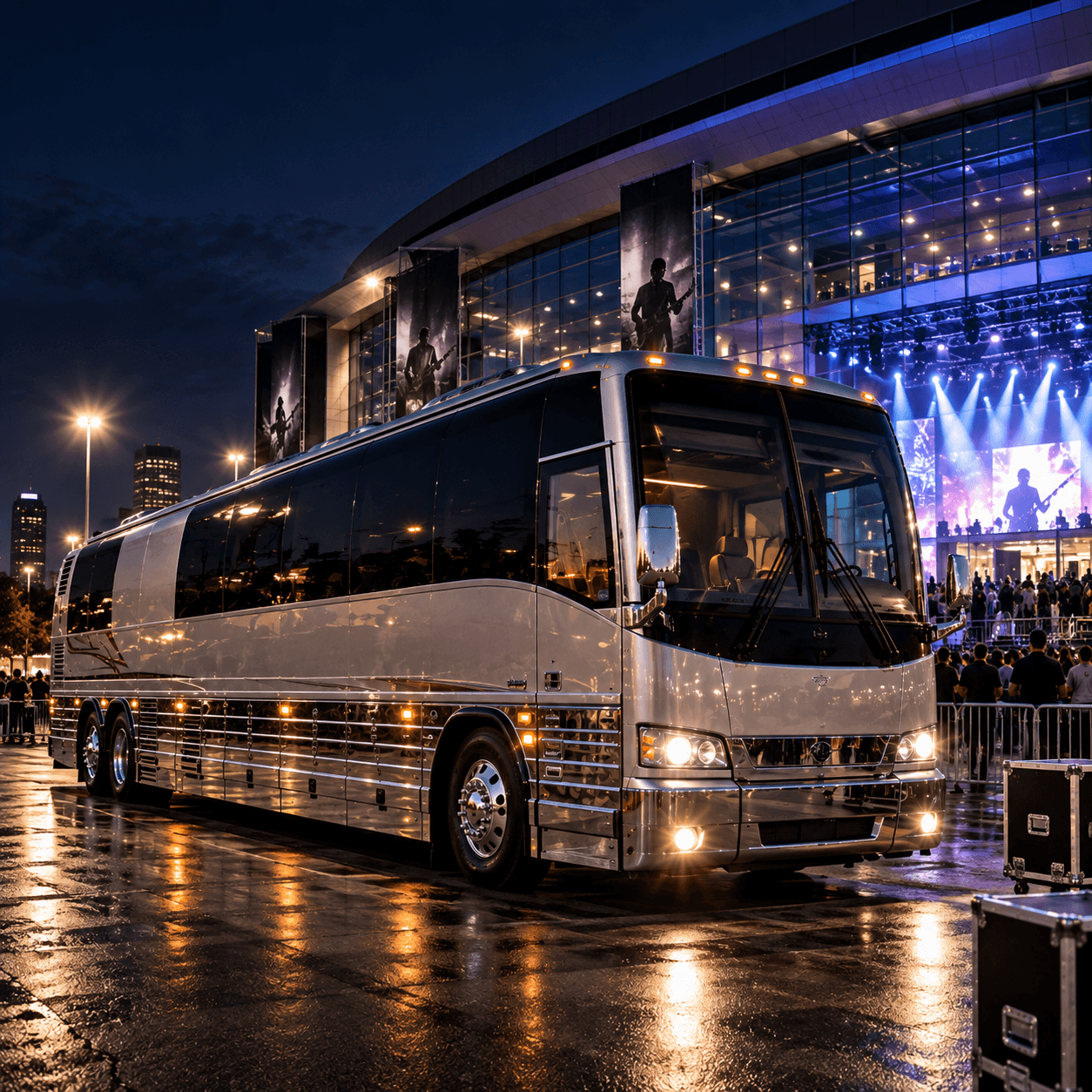
An entertainer coach costs between $50,000 and $1.28 million to buy used, and $1 million to $2 million new. That spread covers the same basic vehicle: a 45-foot Prevost, MCI, Van Hool, or Eagle motorcoach converted with sleeping bunks, a galley, front and rear lounges, and a bathroom. What moves a coach from one end of that range to the other is model year, chassis, slide-out count, conversion house, engine condition, and interior age.
Current market listings show the tiers clearly. Older band buses start near $50,000. A 2002 Featherlite H3-45 double slide trades around $265,000. A 2012 H3-45 with a remanufactured Volvo D13 and a 12-bunk layout lists at $375,000. A 2013 Millennium H3-45 triple slide reaches $888,888, and a 2019 Millennium H3-45 double slide reaches $1,285,000.
Mileage reads differently on this equipment than on any consumer vehicle. A Prevost H3-45 sits on a stainless steel commercial platform engineered for a service life in the high hundreds of thousands of miles, so an odometer showing 250,000 miles describes a coach in early middle age. Buyers who price by mileage alone consistently misjudge the market.
This guide covers what each budget band actually buys, the seven specifications that set the number, what the conversion house names signal, new build pricing, the pre-purchase inspection that protects the transaction, the costs that arrive after closing, where these coaches trade, and what the same capital leases instead.
Price by tier: what each budget buys
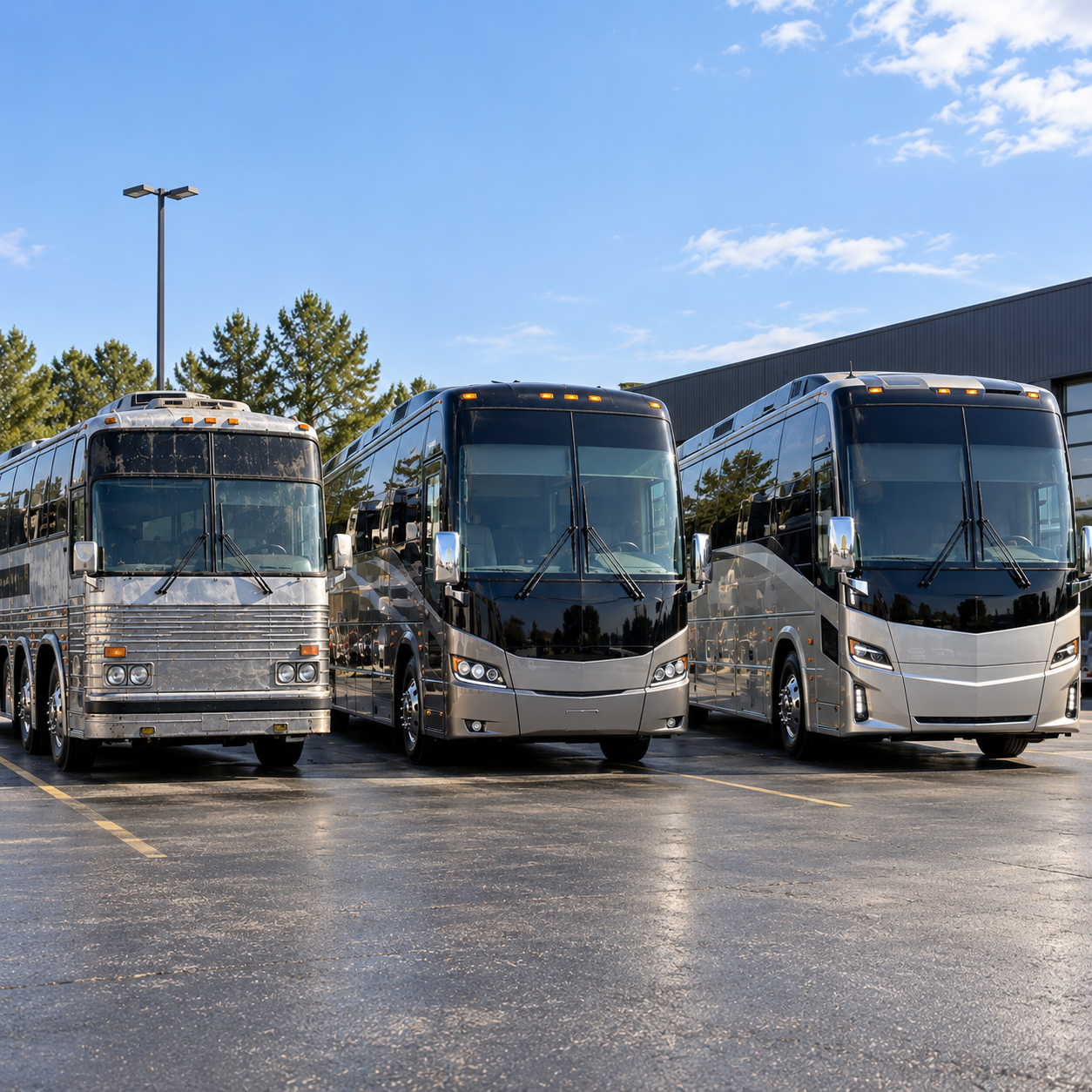
Budget tiers map to distinct classes of equipment, and knowing which tier you are shopping prevents wasted inspection trips.
$50,000 to $150,000. Older non-slide band buses, commonly Prevost XL, XLII, MCI, or Eagle from the 1990s and early 2000s. Expect high mileage, dated interiors, mechanical deferral, and immediate spend on tires, batteries, and seals. Recorded sales in this band include a Prevost H3-45 passenger coach at $30,000 and non-slide XL45 units under $60,000.
$150,000 to $300,000. Early to mid-2000s conversions with single or double slides. A 2002 Featherlite H3-45 double slide at $265,000 sits in this band, as do many Liberty and Royale conversions of similar vintage. Sound touring equipment when service history is documented.
$300,000 to $550,000. The working entertainer tier. A 2007 XLII at $335,000, a 2012 H3-45 12-bunk with a remanufactured engine at $375,000, a 2005 Liberty H3-45 double slide near $430,000, and premium entertainers around $525,000. Most fleet purchases happen here.
$550,000 to $900,000. Late-model conversions with triple slides and current interiors. A 2013 Millennium H3-45 triple slide at $888,888 anchors this band.
$900,000 to $1.3 million. Recent premium conversions. A 2019 Millennium H3-45 double slide at $1,285,000 represents the top of the used market.
Aggregate market data adds context. Across all Prevost listings, including motorhome conversions rather than entertainers alone, the average recorded price sits near $139,859, with a low of $30,000 and individual sales past $335,000. Entertainer-specific inventory prices above that average because bunk conversions serve a commercial market.
The seven specifications that set the price
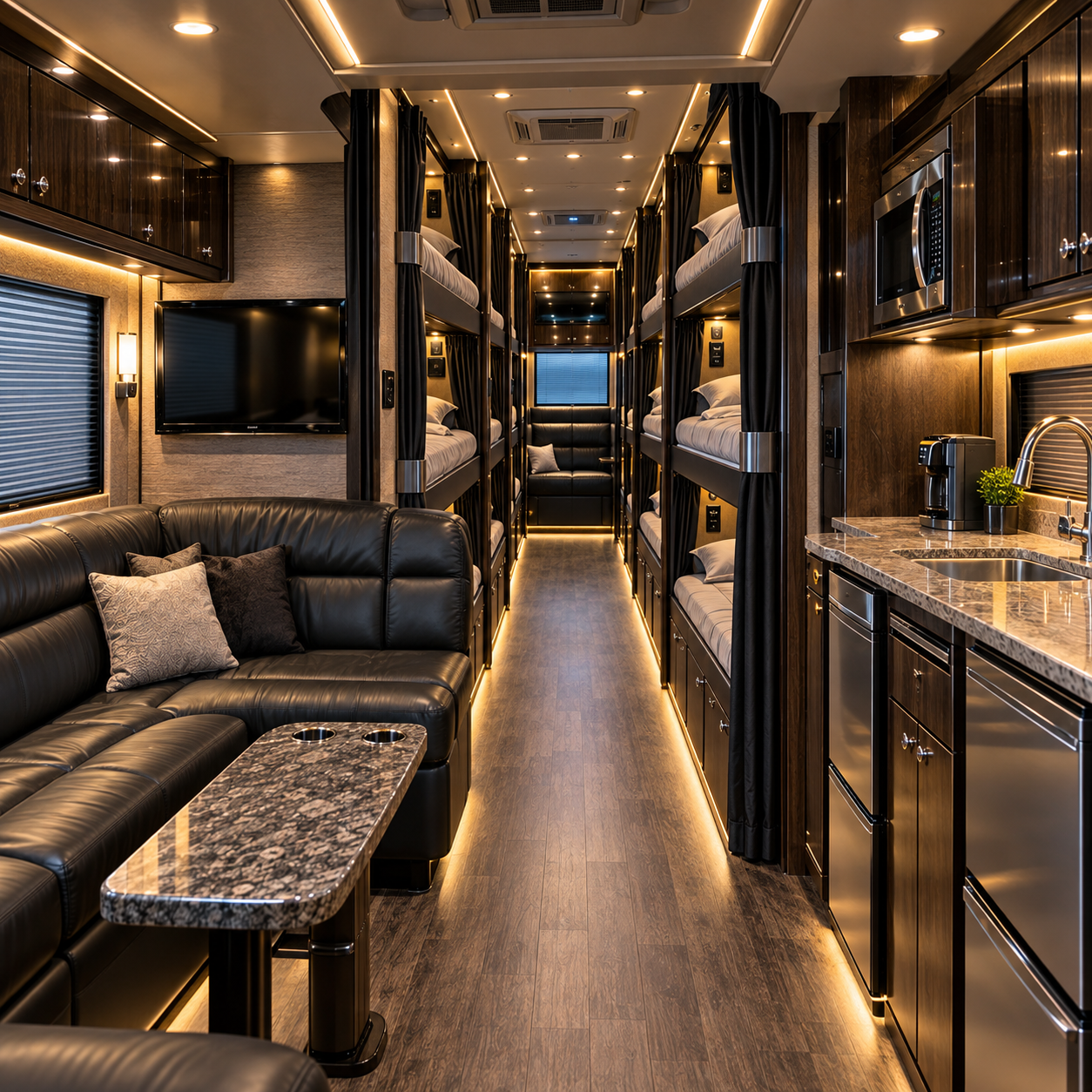
Pricing follows a consistent set of variables. Change any one and the number moves in a predictable direction.
Model year. The single strongest driver. Each five-year step typically doubles the entry point within the same chassis family.
Chassis. H3-45 and X3-45 command the most. XLII, XL, and XL45 sit below them. MCI and Eagle price under Prevost at equivalent age.
Slide-out count. Non-slide units price lowest. Single, double, triple, and quad slides each add value, since slides widen the lounges where crews spend waking hours.
Bunk count and layout. Twelve-bunk configurations sell fastest because they match standard North American touring. Star configurations with rear staterooms price above them, and non-bunk conversions price outside the entertainer market entirely.
Engine and drivetrain status. A remanufactured Detroit Series 60 or Volvo D13 adds substantial value. Allison automatic transmissions are standard, and documented service records matter more than the hours.
Conversion house. The builder’s name carries real weight in resale, covered in the next section.
Interior age. Flooring, upholstery, galley appliances, entertainment systems, and connectivity date faster than mechanicals and are what buyers actually inspect first.
Mileage sits deliberately outside that list. It matters, but only as a modifier read against service history and platform. Two H3-45 coaches with identical odometers can differ by $200,000 based on the six variables above.
What the converter names signal
Conversion houses function like coachbuilders, and their names appear in every listing for a reason. Featherlite, Millennium, Marathon, Liberty, Emerald, Royale, Parliament, Vantare, and Country Coach each built to different specifications and price tiers.
Millennium and Marathon conversions consistently occupy the upper price bands. Featherlite and Liberty sit through the middle and upper-middle, and appear most frequently in entertainer inventory. Royale, Parliament, and Angola units trade lower and often reflect earlier build years rather than lower build quality.
For a buyer, the practical value of the name is comparability. Two 2008 H3-45 coaches from different houses are different products with different cabinetry standards, electrical layouts, and slide mechanisms. Parts availability and technician familiarity follow the same lines.
Knights Coaches operates its entire Prevost coach fleet on H3-45 and X3-45 platforms with single slide-outs layouts, and lists bunk count and rear configuration for every unit so tour managers can compare specifications the way buyers do.
New build pricing and lead time
New coach pricing sits between $1 million and $2 million depending on converter and specification, and it has not softened. Build cost rose across chassis, materials, and labor, and manufacturers have not reduced content to hold price.
That firmness props up used values from below. When replacement cost climbs, a well-kept 10-year-old conversion becomes more attractive rather than less, which is why the used market has stayed strong rather than depreciating on a normal curve.
Lead time is the other consideration. A new entertainer conversion is built to order after the chassis is allocated, and the combined wait is measured in months rather than weeks. Acts with a tour on the books cannot buy their way onto the road quickly, which is a large part of why touring parties book a Prevost sleeper coach rental while a purchase is still in build.
What to inspect before you transfer funds
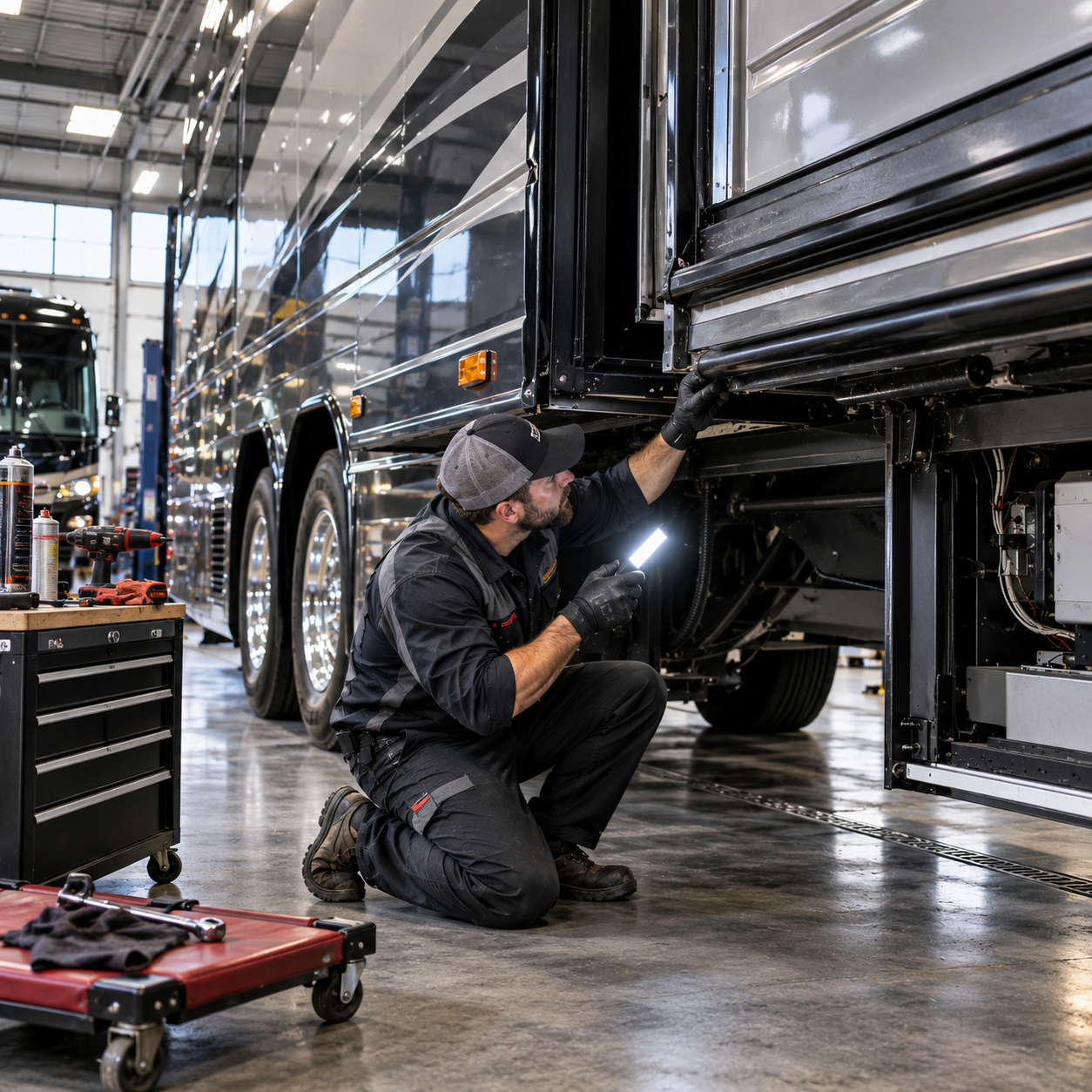
Inspection protects the transaction more than negotiation does. Commission a pre-purchase inspection from a technician who works on commercial coaches rather than motorhomes, and cover these areas specifically.
Verify chassis and frame condition, including stainless steel structure, bay floors, and any corrosion around the wheel wells and rear cap.
Test every slide-out through full extension and retraction, and inspect seals, which run around $2,400 each plus labor to replace.
Check tire date codes across all eight positions. Replacement runs roughly $850 per tire, so a full set is close to $6,800.
Load-test the house battery bank, typically four batteries at around $550 each.
Run the generator under load for an extended period, since house systems depend on it overnight.
Document engine and transmission service history, and confirm whether an engine has been remanufactured and at what mileage.
Inspect air suspension components, including bags and brake chambers, which price around $2,500 and $650 respectively in parts and labor.
Confirm title status, lien release, and whether the coach carries a clean commercial history.
Sellers who resist a technician inspection are telling you something. Buses are shown by appointment at most dealers precisely because a serious buyer brings a serious inspector.
Costs that land after the purchase
Acquisition cost extends well past the sale price, and first-time buyers routinely underestimate the first year.
Immediate spend commonly includes tires, house batteries, slide seal service, and a full fluid and coolant service, which together can add $15,000 to $25,000 on an older unit. Coolant service alone runs around $300 in materials plus six hours of labor.
Ongoing costs begin the day you take delivery. Scheduled maintenance on a two-slide coach at 10,000 miles a year totals roughly $5,800 annually across tires, batteries, air bags, brake chambers, slide seals, coolant, and small items. Fuel runs 6 MPG solo and 5 MPG with a trailer, which at $5.50 per gallon costs about $0.92 per mile. Engine service is commonly assessed at $0.35 per mile.
Then come the lines that exist only because the coach is commercial: passenger-carrier insurance, apportioned registration across operating states, IFTA quarterly filing, US DOT registration, driver qualification files, drug and alcohol clearinghouse enrollment, electronic logging devices, and covered storage for the months the coach is parked. Backline still needs separate trucking, because bay space on a sleeper is occupied by generator, water, and tanks.
Where entertainer coaches actually trade
Inventory concentrates in a small number of channels. Nashville and Goodlettsville, Tennessee host the largest cluster of entertainer dealers in the country, which reflects the city’s role as the center of the touring industry. Atlanta and the Mid-Atlantic hold secondary concentrations.
Specialist listing sites carry the bulk of the visible market, alongside dealer inventories that publish stock numbers, slide configuration, engine, and transmission for every unit. Auctions appear periodically, typically with no-reserve listings priced below private-party retail, and they carry correspondingly higher inspection risk.
Broker relationships matter at the upper tiers, where premium conversions frequently sell before public listing. If you are shopping above $500,000, the coach you want may never reach a website.
What the same capital leases instead
Comparing purchase to lease reframes the number. A coach leases at $800 to $1,400 per day on its own, or $2,200 to $2,900 per day all in with driver and fuel. Long-term structures from one to twelve months reduce the daily rate and hold a specific unit for the term.
Sixty touring days a year on a sleeper bus charter at an all-in $2,600 costs $156,000 annually. A $400,000 purchase carries financing, $5,800 in scheduled maintenance, fuel, insurance, apportioned plates, storage for the 300-plus idle days, and a driver’s full-season pay. Ownership generally competes only past roughly 120 to 150 touring days a year, or when the coach earns revenue for other clients between your tours.
That utilization requirement is why carriers, not artists, are the buyers in this market. Fleet operators reach the threshold by rotating coaches across many tours with coverage in 48 states behind them. A single act touring six weeks a year cannot.
How much does a used entertainer coach cost?
Used entertainer coaches run from about $50,000 to $1.28 million. Working touring equipment concentrates between $300,000 and $550,000, with mid-2000s conversions from $150,000 to $300,000 and premium late-model units above $900,000.
How much does a new tour bus conversion cost?
New entertainer conversions cost $1 million to $2 million depending on the converter and specification. Build cost has held firm across chassis, materials, and labor, and lead times run months rather than weeks once the chassis is allocated.
Is 250,000 miles high for a Prevost?
No. A Prevost H3-45 at 250,000 miles is in early middle age, since the stainless steel commercial platform is engineered for the high hundreds of thousands of miles. Service records, slide condition, and interior age predict value far better than the odometer.
Which conversion houses build entertainer coaches?
The recognized names are Featherlite, Millennium, Marathon, Liberty, Emerald, Royale, Parliament, Vantare, and Country Coach. Millennium and Marathon units concentrate in the upper price bands, while Featherlite and Liberty appear most frequently in mid-tier entertainer inventory.
What is the cheapest entertainer coach worth buying?
Entry inventory starts near $50,000 for older non-slide band buses on Prevost, MCI, or Eagle platforms. Budget an additional $15,000 to $25,000 immediately for tires, batteries, slide seals, and fluid service before the coach carries passengers.
Do slide-outs affect the price much?
Yes, significantly. Non-slide units price lowest, and each additional slide adds value, moving through single, double, triple, and quad configurations. Slides widen the lounges where crews spend waking hours, which is why the market pays for them.
What are the annual running costs after purchase?
Expect roughly $5,800 in scheduled maintenance at 10,000 miles a year, plus fuel at about $0.92 per mile, engine service at $0.35 per mile, commercial insurance, apportioned registration, and storage. Touring mileage raises the fuel and service lines sharply.
Where do people buy entertainer coaches?
Nashville and Goodlettsville, Tennessee hold the largest dealer concentration, with secondary clusters in Atlanta and the Mid-Atlantic. Specialist listing sites carry most public inventory, and premium units above $500,000 frequently sell through brokers before listing.
Does buying a coach mean I can operate it commercially?
Not by itself. Commercial passenger operation requires US DOT registration, an FMCSA safety rating, driver qualification files, clearinghouse enrollment, electronic logging, and IFTA filing. Ownership of the vehicle is one component of a much larger compliance obligation.
How many bunks should I look for?
Twelve bunks matches North American touring standards and resells fastest, arranged as six per side stacked three high. Condo layouts drop to eight taller berths for artist use, and a rear bed kit takes a standard coach to 14 at the cost of rear lounge space.
Should I buy or lease for a single tour?
Leasing is the practical route for a single tour. A purchase cannot be inspected, serviced, insured, staffed, and registered fast enough for a tour already on the books, and new builds take months. Rentals and one to twelve month leases exist for exactly this gap.
What is the resale outlook on a Prevost entertainer?
Strong relative to the category. Fleet operators consistently rate Prevost resale as the best in the industry, and the H3-45 leads North American coach sales. Rising new-build cost between $1 million and $2 million supports used values from below.
The short version
Entertainer coach pricing runs from $50,000 for an older non-slide band bus to $1.28 million for a recent premium conversion, with new builds between $1 million and $2 million. Model year, chassis family, slide-out count, bunk layout, drivetrain condition, converter name, and interior age set the number, while mileage functions only as a modifier because a Prevost at 250,000 miles sits in early middle age. Pre-purchase inspection should cover frame, slides and their $2,400 seals, tire date codes across eight $850 positions, the house battery bank, generator load performance, and documented engine history. Post-purchase spend arrives fast: $15,000 to $25,000 of immediate service on an older unit, roughly $5,800 annually in scheduled maintenance, fuel near $0.92 per mile, plus commercial insurance, apportioned plates, DOT registration, and storage.
Knights Coaches operates 20-plus Prevost sleepers with CDL-certified drivers and 24/7 dispatch, available as short rentals or as a one to twelve month coach lease. Call 855 734 5700 to compare a lease against a purchase for your touring calendar.