
ELDs and Driver Logs on Tour Buses: Rules, Exemptions, and Inspection Tips
An electronic logging device (ELD) on a tour bus is an FMCSA-registered unit wired to the coach's engine that automatically records driving time, engine hours, vehicle miles, and location to produce the driver's record of duty status (RODS). The Federal Motor Carrier Safety Administration requires ELDs under 49 CFR…
Knights Coaches
Knights Coaches
- Published
- Reading time
- 9 min read
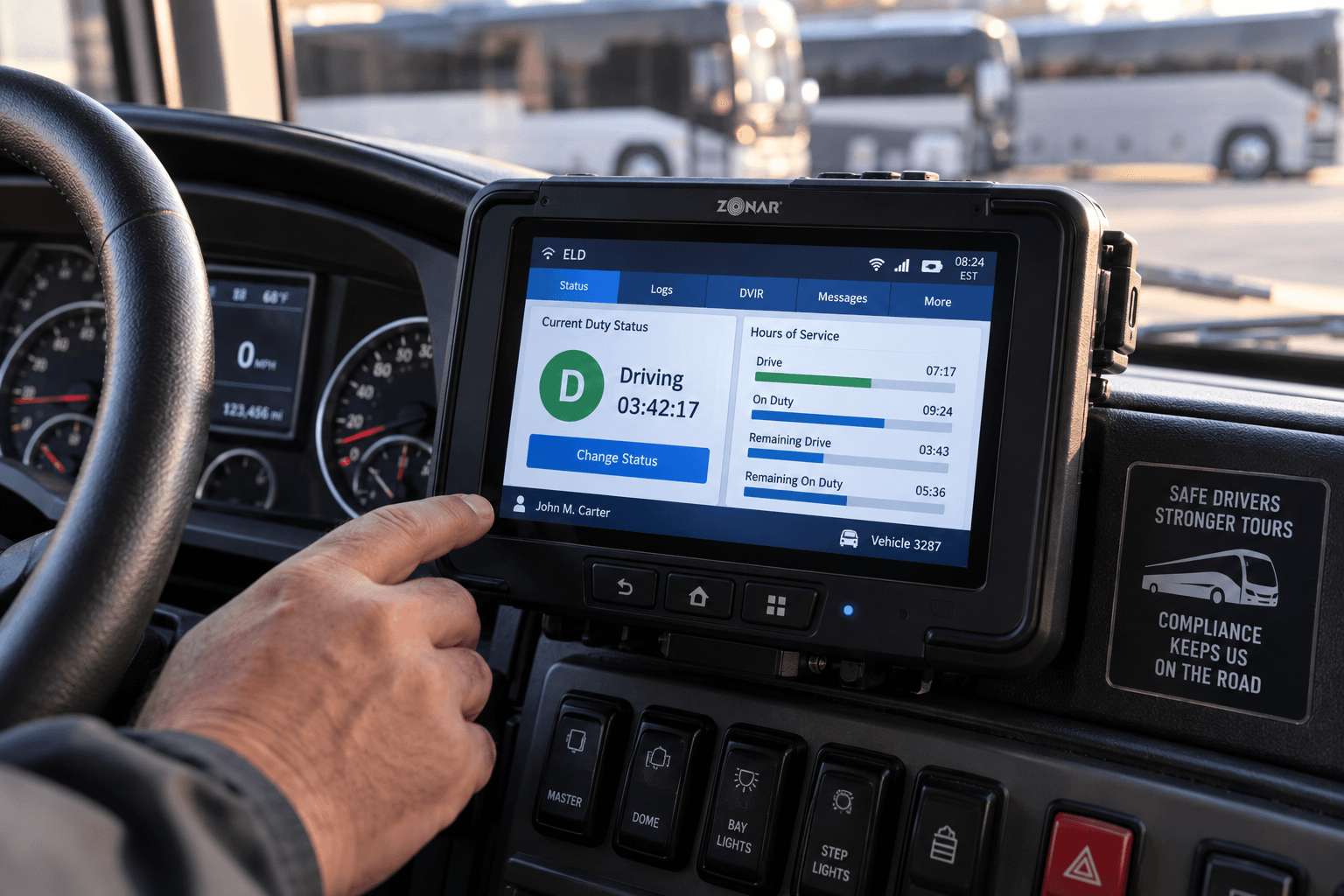
An electronic logging device (ELD) on a tour bus is an FMCSA-registered unit wired to the coach's engine that automatically records driving time, engine hours, vehicle miles, and location to produce the driver's record of duty status (RODS). The Federal Motor Carrier Safety Administration requires ELDs under 49 CFR Part 395 Subpart B, and the mandate reached full enforcement on December 16, 2019.
Driver logs on a coach track four duty statuses: off duty, sleeper berth, driving, and on duty not driving. The device must hold the current day plus the previous 7 days for roadside review, and carriers keep ELD records and supporting documents for 6 months. When a device fails, the driver notifies the carrier within 24 hours and switches to paper, and the carrier has 8 days to repair or replace it.
Several entities shape how logs work on the road. The Commercial Vehicle Safety Alliance (CVSA) sets out-of-service criteria. FMCSA keeps a public list of registered and revoked devices at eld.fmcsa.dot.gov. The hours of service limits for passenger drivers (10 driving, 15 on duty, 8 off) supply the rules the ELD measures against.
This guide covers who must run an ELD on a coach, which exemptions matter for older converted buses, how to log each duty status, what inspectors look for, how supporting documents and malfunctions work, what happens when FMCSA revokes a device, and the log mistakes seen most often on entertainer coaches.
Who Must Use an ELD on a Tour Bus
ELD rules follow the RODS requirement. Any driver who must keep a record of duty status under Part 395 must use a registered ELD unless an exemption applies. That covers interstate drivers of coaches designed for 16 or more passengers, vehicles carrying 9 or more for compensation, and anything over 10,001 pounds.
A band's tour bus meets all three. So does a sightseeing motorcoach or a charter coach headed to another state. The only drivers who skip ELDs are those who fit a specific exemption, and each exemption has conditions that end the moment the trip changes.
ELD Exemptions That Matter for Coaches
Four exemptions show up in coach operations:
Pre-2000 engines qualify for the exemption based on the engine's model year, not the chassis. A 2003 coach with a rebuilt 1998 engine can qualify. A 1998 shell with a newer engine can't.
Limited RODS use covers drivers who keep logs 8 days or fewer in any rolling 30-day period. Paper logs still apply on those days.
Short-haul operations within 150 air miles that return to base within 14 hours use time records instead of logs.
Driveaway-towaway applies when the coach itself is the delivered product, such as a new coach driven from the factory.
Older converted entertainer coaches sometimes use the pre-2000 engine exemption. FMCSA has reviewed that exemption, so owners of vintage coaches should watch for rule changes before relying on it long term.
Logging the Four Duty Statuses
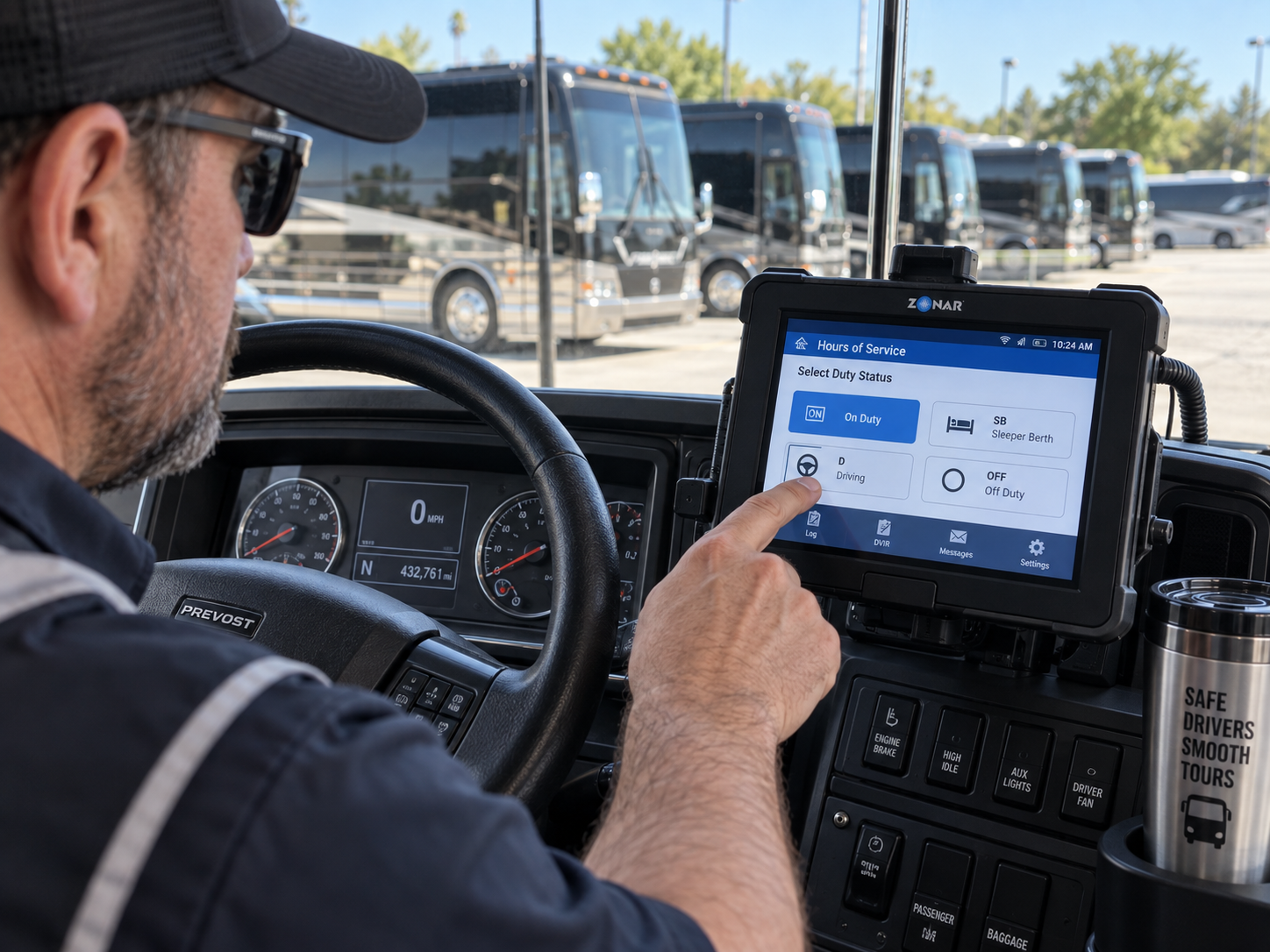
Duty status choices drive every calculation. Getting them right is the driver's job, even though the ELD records motion automatically.
Driving logs itself once the coach passes 5 mph.
On duty not driving covers pre-trip inspections, fueling, washing, tank service, and waiting under dispatch.
Sleeper berth applies only when the driver rests in a berth that meets federal specifications.
Off duty covers hotel rest, meals, and any time the carrier has released the driver from all responsibility.
Two special categories sit beside them. Personal conveyance lets an off-duty driver move the coach for personal reasons, like reaching the nearest safe parking or a hotel, without counting it as driving. Yard move lets a driver reposition the coach inside a venue lot or terminal as on-duty time rather than driving. Both require annotation, and both draw scrutiny when misused.
What Inspectors Check
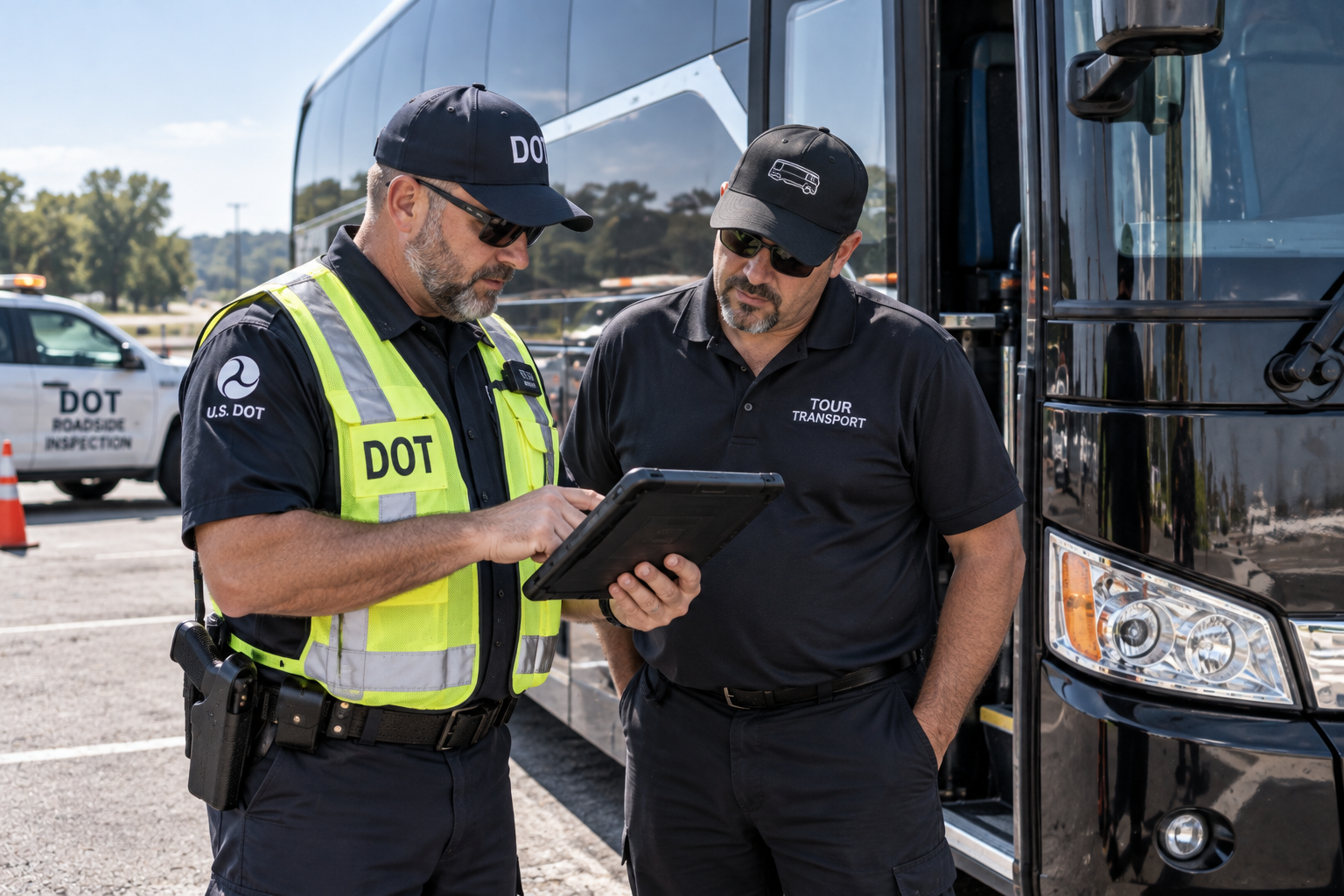
Inspections for motorcoaches usually happen at venues, terminals, and destinations rather than on the shoulder. When an officer asks for logs, the driver must display them on the device screen or transfer them electronically.
The officer reviews several items:
Registration status of the device on FMCSA's list.
Eight days of records, meaning today and the prior 7 days.
Malfunction or diagnostic indicators on the screen.
Unassigned driving events not claimed by any driver.
Limit compliance against the 10, 15, and 60/70 hour rules.
Data transfer happens through telematics (web services or email) or local methods (Bluetooth or USB). The driver should know which method the carrier's device supports before the officer asks. Fumbling with menus during a destination inspection wastes everyone's time and invites a closer look.
Required Items in the Cab
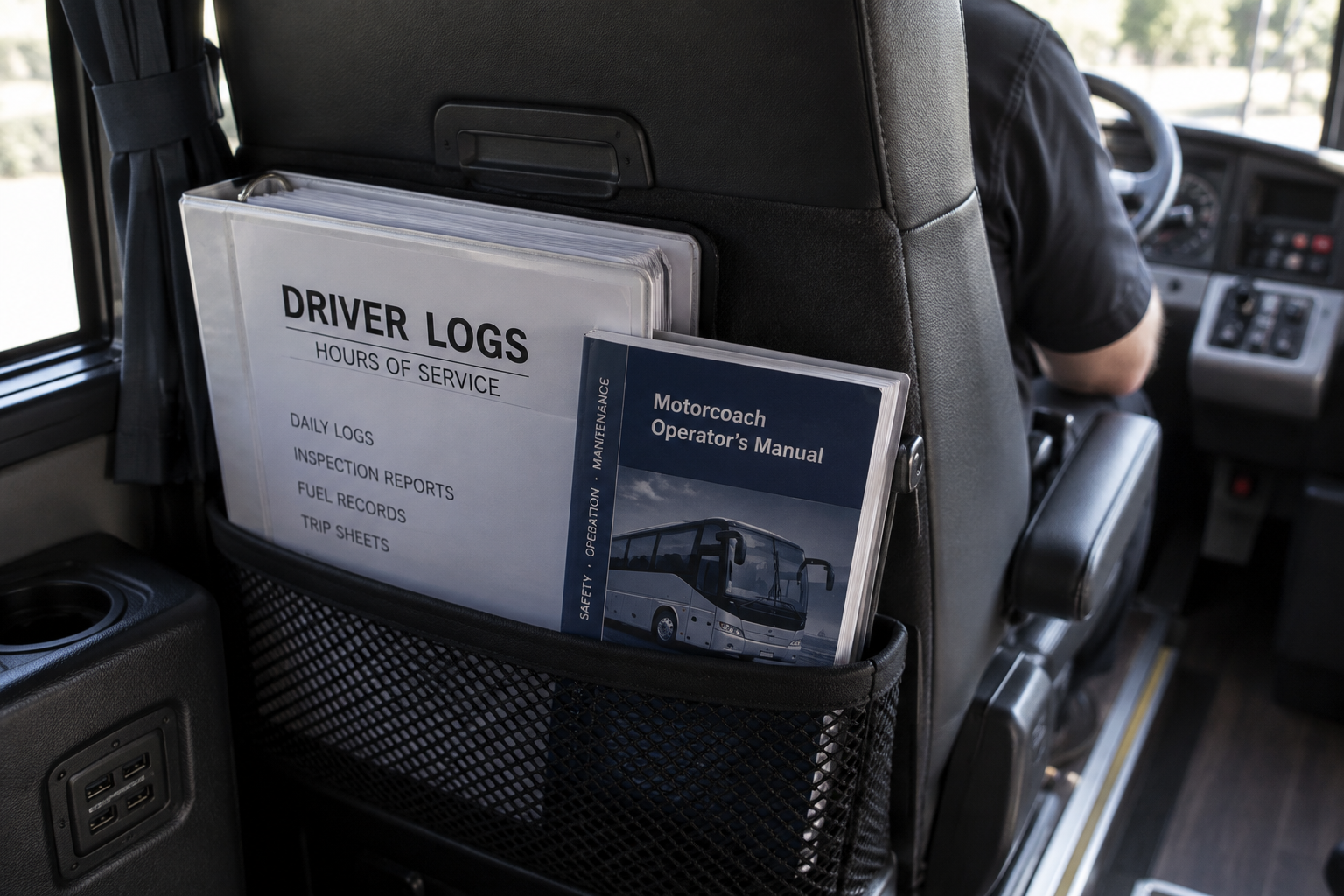
Four items must ride in the coach with the ELD:
A user manual describing how to operate the device.
An instruction sheet explaining data transfer to officers.
A malfunction sheet covering reporting and paper log procedures.
Blank paper logs covering at least 8 days for backup.
Many carriers keep all four in the device's app, which is legal as long as the driver can show them on request. Paper copies in a binder behind the driver's seat still work well when phone signal drops in rural venues.
Supporting Documents and Record Retention
Supporting documents let auditors verify that logs match reality. For passenger carriers, the categories include trip itineraries and dispatch records, expense receipts for fuel, tolls, and lodging, electronic communication records from dispatch, and payroll records.
Carriers keep up to 8 supporting documents per 24-hour period for each driver, along with the ELD records, for 6 months. A fuel receipt in Tulsa at 3:40 AM should line up with a log showing the coach in Tulsa at 3:40 AM. When they don't match, auditors treat it as falsification.
ELD Malfunctions and Paper Backup
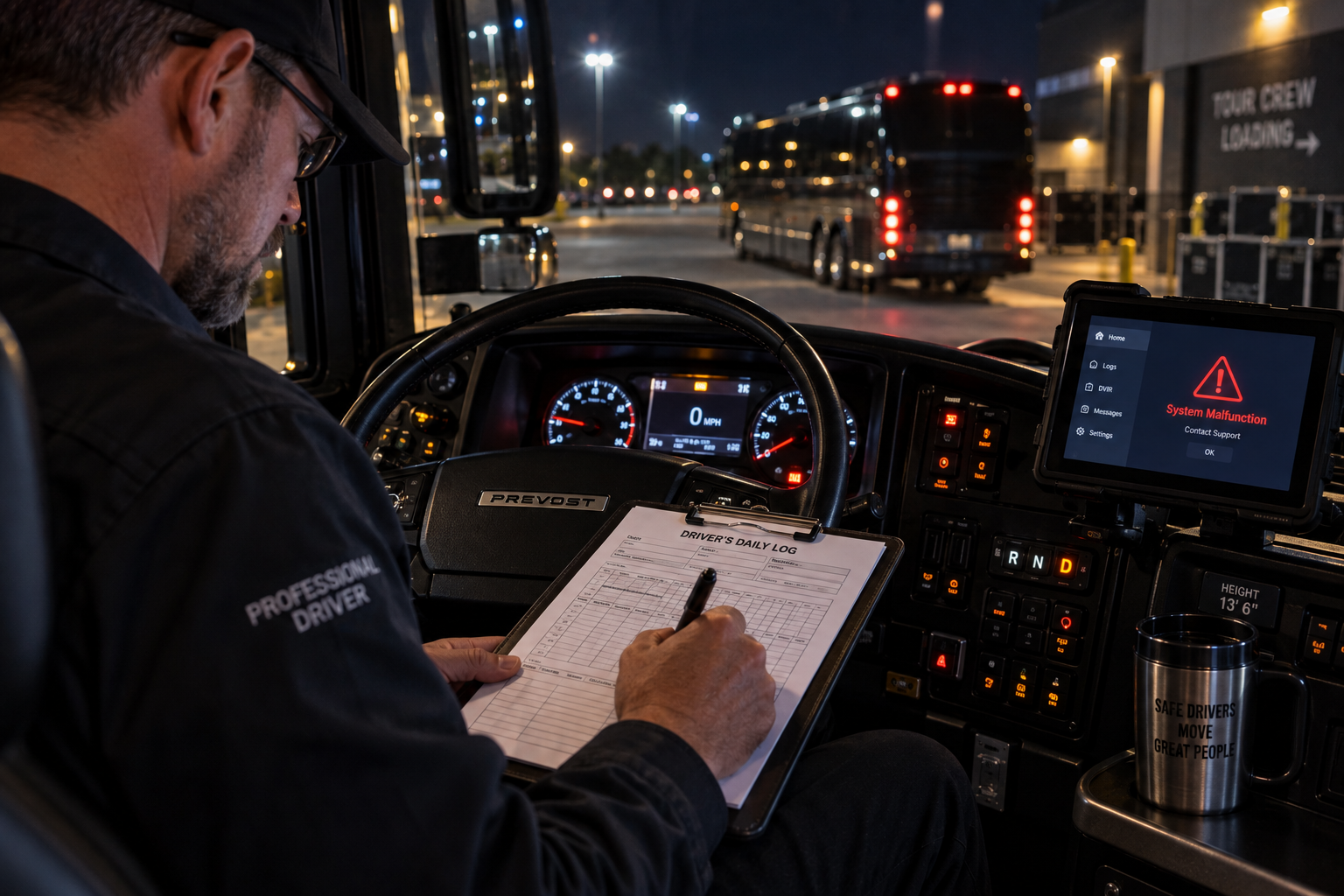
Malfunctions happen more often than people expect, especially on older coaches with complex electrical systems. When the ELD shows a malfunction indicator, the driver follows a fixed sequence:
Notify the motor carrier in writing within 24 hours.
Reconstruct the current day and prior 7 days on paper, unless the records are still retrievable.
Continue logging on paper until the device is repaired.
The carrier must repair or replace the device within 8 days of discovery. If parts or service can't meet that deadline, the carrier requests an extension from the FMCSA division office in its state within 5 days of the driver's notice.
Revoked Devices
Revoked devices are ELDs FMCSA has removed from the registered list for failing technical standards. When a device lands on the revoked list, carriers get 60 days to switch to a compliant unit. After the enforcement date, using the old device counts as having no log at all.
This isn't theoretical. FMCSA removed three devices on December 8, 2025, with a replacement deadline of February 7, 2026, and more removals followed in early 2026. Carriers should check the revoked list monthly, not just at purchase.
Log Edits and Unassigned Driving
Edits must leave an audit trail. A driver can correct his own log, and a carrier can propose edits, but the driver must accept carrier edits before they take effect. The original record stays visible, and each change needs an annotation explaining why.
Unassigned driving appears when the coach moves with no driver logged in. The carrier must either assign it to a driver or explain it, such as a mechanic moving the bus in the shop. Unexplained unassigned miles are one of the first things auditors question.
Common Log Mistakes on Entertainer Coaches
Entertainer coach schedules create unique logging traps:
Hotel time logged as on duty because the driver forgot to change status after parking.
Pre-trip inspections skipped on the log, which makes the first driving entry start from nowhere.
Personal conveyance stretched into a short relocation that advanced the tour route.
Team drivers sharing a login, which merges two people's hours into one record.
Generator service at 2:00 PM left off the log, even though it counts as work.
Most of these come from habit rather than intent, but inspectors don't grade on intent.
Choosing an ELD for a Motorcoach Fleet
Device choice matters for coaches. Look for a unit that supports passenger-carrying rule sets by default, handles team driver logins cleanly, and offers telematics transfer for destination inspections. Older coaches may need an adapter cable for the engine connection, so confirm compatibility before buying.
How Knights Coaches Handles Logs
Knights Coaches assigns Class A or B CDL drivers with at least three years on entertainer coaches to every Prevost unit in its Nashville-based fleet. Its 24/7 dispatch watches drive time, plans routes around legal hours, and keeps malfunction backups ready so a device failure doesn't stall a tour.
Artists and production managers can review coach specs and request quotes on the Knights Coaches
Do tour buses need ELDs?
Yes. Interstate tour buses need an FMCSA-registered ELD unless the driver qualifies for a pre-2000 engine, short-haul, limited-use, or driveaway exemption.
How many days of logs must a coach driver show at inspection?
A driver must show the current day plus the previous 7 days. The ELD stores and displays that full period.
Which old coaches are exempt from ELDs?
Coaches with an engine model year before 2000 are exempt. The engine data plate decides eligibility, not the chassis or VIN year.
What should a driver do when the ELD malfunctions?
The driver must notify the carrier within 24 hours and switch to paper logs. The carrier then has 8 days to repair or replace the device.
What is the difference between personal conveyance and a yard move?
Personal conveyance is off-duty movement for personal reasons, while a yard move is on-duty repositioning inside a venue lot or terminal. Neither can advance the trip.
How long must carriers keep ELD records?
Carriers keep ELD data and supporting documents for 6 months. Supporting documents are capped at 8 per driver per 24-hour period.
Which items must be kept in the coach with the ELD?
Four items: the user manual, data transfer instructions, malfunction instructions, and 8 days of blank paper logs. Digital copies on the device are acceptable.
Is a revoked ELD still legal to use?
No, not after the enforcement date. Carriers get 60 days after revocation to replace the device; after that, it counts as no log.
Can a carrier edit a driver's log?
Yes, but the driver must approve every carrier edit. The original entry stays visible with an annotation explaining the change.
Are paper logs or ELDs better for tour bus drivers?
ELDs are better for accuracy and inspection speed, since they record driving automatically. Paper logs remain legal only for exemptions and malfunction periods.
Does generator maintenance count as on-duty time?
Yes. Servicing the generator, holding tanks, or interior is on duty not driving, even when the coach is parked at a venue.
Do team drivers on a coach need separate ELD logins?
Yes. Each driver must log in under his own account, and the co-driver logs sleeper or off-duty time separately. Shared logins merge two records and count as falsification.
Conclusion
ELDs and driver logs on tour buses turn engine data into the record of duty status that inspectors read. Interstate coach drivers must run a registered device unless a pre-2000 engine, limited-use, short-haul, or driveaway exemption fits. Accurate duty statuses, including personal conveyance and yard moves, feed the 8-day inspection display. Four required cab items, 6 months of retained records and supporting documents, and the 24-hour, 8-day malfunction process keep the system honest. Revoked devices and unassigned miles need regular checks, and entertainer coach drivers should watch the habit-driven mistakes that trip up logs most.
Want a coach whose driver and dispatch handle every log detail? Get a quote from Knights Coaches for a Prevost coach with an experienced CDL driver.