CDL Passenger Endorsement Requirements: Training, Tests, and Rules for Bus Drivers
The CDL passenger endorsement (code P ) is a federal credential added to a commercial driver's license that authorizes the holder to operate a vehicle designed to transport 16 or more passengers, including the driver . It's defined in 49 CFR 383.93 and issued by each state's driver licensing agency under standards set…
Knights Coaches
Knights Coaches
- Published
- Reading time
- 9 min read
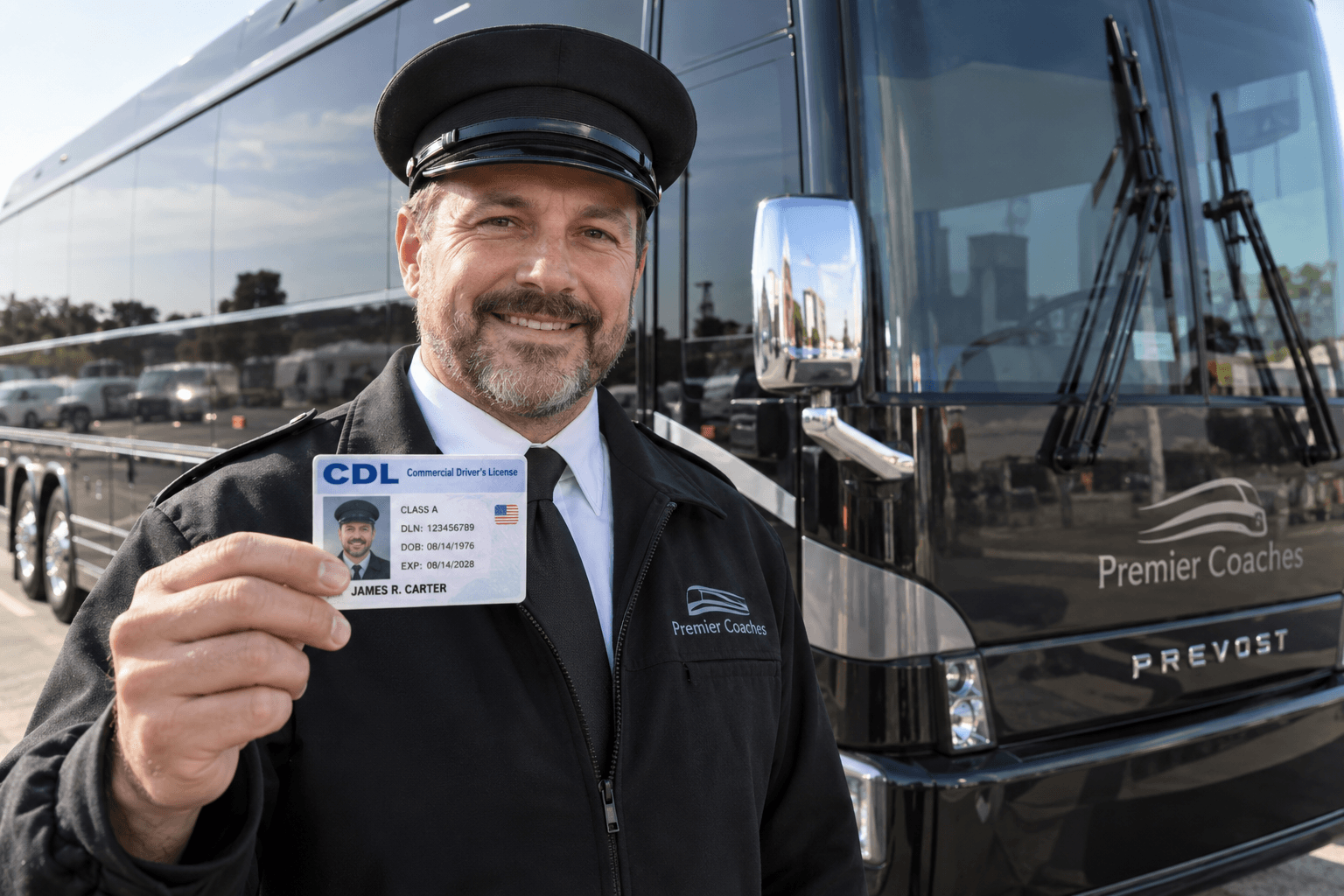
The CDL passenger endorsement (code P) is a federal credential added to a commercial driver's license that authorizes the holder to operate a vehicle designed to transport 16 or more passengers, including the driver. It's defined in 49 CFR 383.93 and issued by each state's driver licensing agency under standards set by the Federal Motor Carrier Safety Administration (FMCSA).
Getting it takes four things: a valid Class A, B, or C CDL or learner's permit, completed Entry-Level Driver Training (ELDT) from a provider on the FMCSA Training Provider Registry, a passed 20-question knowledge test, and a passed skills test in a representative passenger vehicle. Unlike the tanker or doubles endorsements, P requires both a written and a road exam.
The endorsement connects to a wider set of driver qualification rules. Interstate bus drivers must be at least 21 years old, carry a DOT medical examiner's certificate, clear the Drug and Alcohol Clearinghouse, and meet the English language proficiency standard in 49 CFR 391.11(b)(2). The school bus endorsement (S) sits on top of P and can't stand alone.
This guide covers who needs the endorsement, what the base CDL requires, how ELDT works for passenger candidates, what the knowledge and skills tests include, which license restrictions to avoid, and what entertainer coach companies expect beyond the legal minimum.
What the Passenger Endorsement Authorizes
Passenger authority covers any commercial vehicle built for 16 or more occupants counting the driver. That includes charter motorcoaches, transit buses, airport shuttles rated for 16 or more, church buses, and entertainer coaches whose original design capacity meets the threshold.
The endorsement attaches to any CDL class:
Class A with P covers a coach pulling a trailer over 10,000 pounds, common on band tours hauling a gear trailer.
Class B with P covers a single motorcoach over 26,001 pounds, the standard setup for charter and tour work.
Class C with P covers smaller passenger vehicles under 26,001 pounds that still seat 16 or more.
A school bus driver needs both P and S. A charter or tour driver needs only P. Drivers of 15-passenger vans usually need no CDL at all, although some states set their own rules for for-hire van operators.
Base CDL Requirements Before Adding P
Base eligibility comes first. A driver must hold a commercial learner's permit (CLP) or CDL in the state of domicile, and the state checks the Commercial Driver's License Information System (CDLIS) and the National Driver Register before issuing anything.
Age rules split by trip type. States can license drivers at 18 for intrastate work, but interstate passenger driving requires 21. Every tour that crosses a state line falls under the higher number.
Medical fitness is mandatory. The driver passes a DOT physical with a certified examiner listed on the National Registry of Certified Medical Examiners, and the resulting certificate lasts up to 24 months. Conditions like insulin-treated diabetes or reduced vision can shorten that period or require a variance.
Residency rules tightened in 2026. An FMCSA final rule narrowed which non-citizens can hold a non-domiciled CDL, and states now verify immigration status more strictly at every issuance and renewal.
Entry-Level Driver Training for Passenger Candidates
Entry-Level Driver Training has applied since February 7, 2022. Any driver adding P for the first time after that date must finish ELDT before testing. Drivers who held the endorsement before the compliance date are grandfathered.
ELDT for passenger splits into two parts. Theory covers vehicle inspection, passenger loading and unloading, emergency exits, railroad crossing procedures, and passenger management. Online theory courses are widely available, and some cost as little as $20. Behind-the-wheel training happens on a range and public roads in an actual bus.
The training provider reports completion straight to the Training Provider Registry. The state licensing agency confirms that record before scheduling the test. No certificate on file means no test date.
The Passenger Knowledge Test
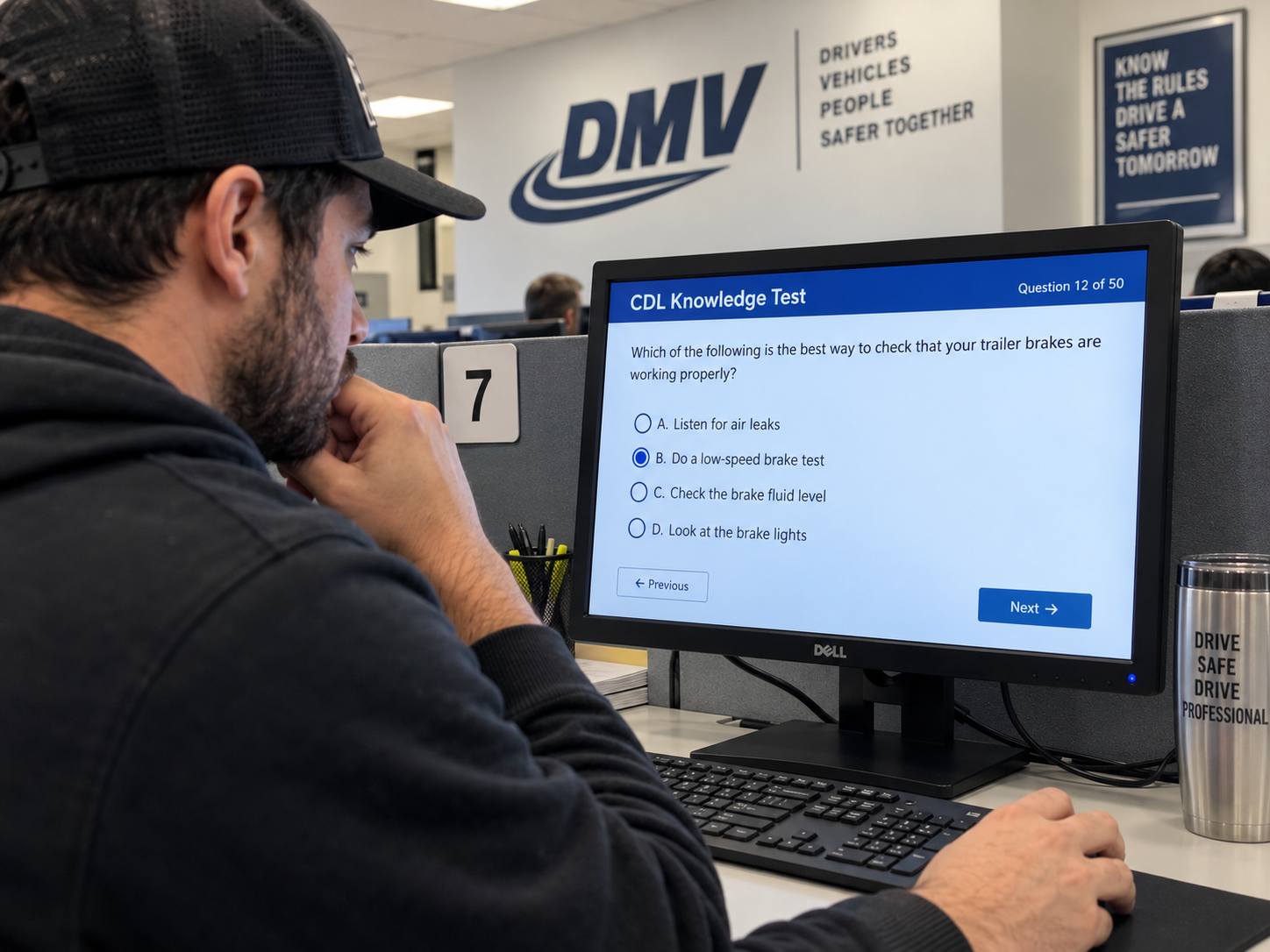
Knowledge testing happens at the state DMV or licensing office. The exam has 20 multiple-choice questions, and the passing score is 80 percent, or 16 correct answers.
Questions come from the passenger section of the state CDL manual, which follows the national AAMVA model. Expect topics like these:
Pre-trip checks of emergency exits, handholds, rails, and the first-aid kit.
Loading rules covering standee lines, aisles, and baggage placement.
Prohibited hazmat such as tear gas and irritating materials that may never ride on a bus.
Railroad crossings, where buses must stop 15 to 50 feet from the nearest rail.
Drawbridge stops and post-trip walk-throughs for sleeping or left-behind passengers.
Passing the test adds the P endorsement to the learner's permit. The driver then holds the CLP for at least 14 days before scheduling the skills test.
The Passenger Skills Test
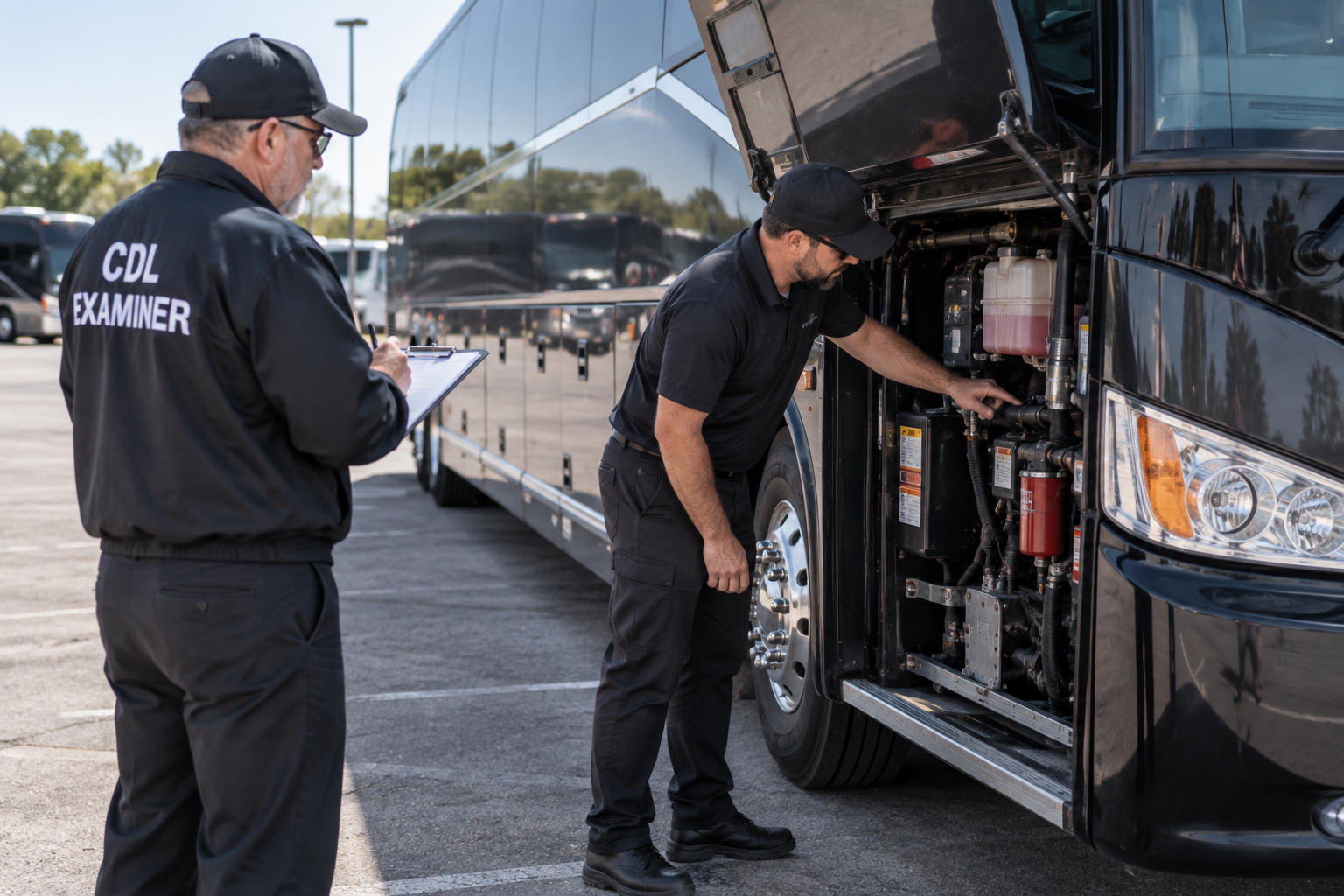
Skills testing takes place in a representative passenger vehicle, meaning a bus that matches the class the driver wants. A Class B motorcoach test won't qualify someone for Class A with a trailer.
The exam has three parts. The pre-trip inspection adds passenger items to the standard list: emergency exits, entry door, passenger seating, and interior lighting. Basic control skills include straight-line backing, offset backing, and parking maneuvers. The road test checks turns, lane changes, intersections, railroad crossings, and a simulated passenger stop.
While practicing on a CLP with P, the learner may not carry passengers other than trainers, examiners, and other trainees. That rule prevents anyone from running paid charters on a permit.
License Restrictions That Limit Bus Work
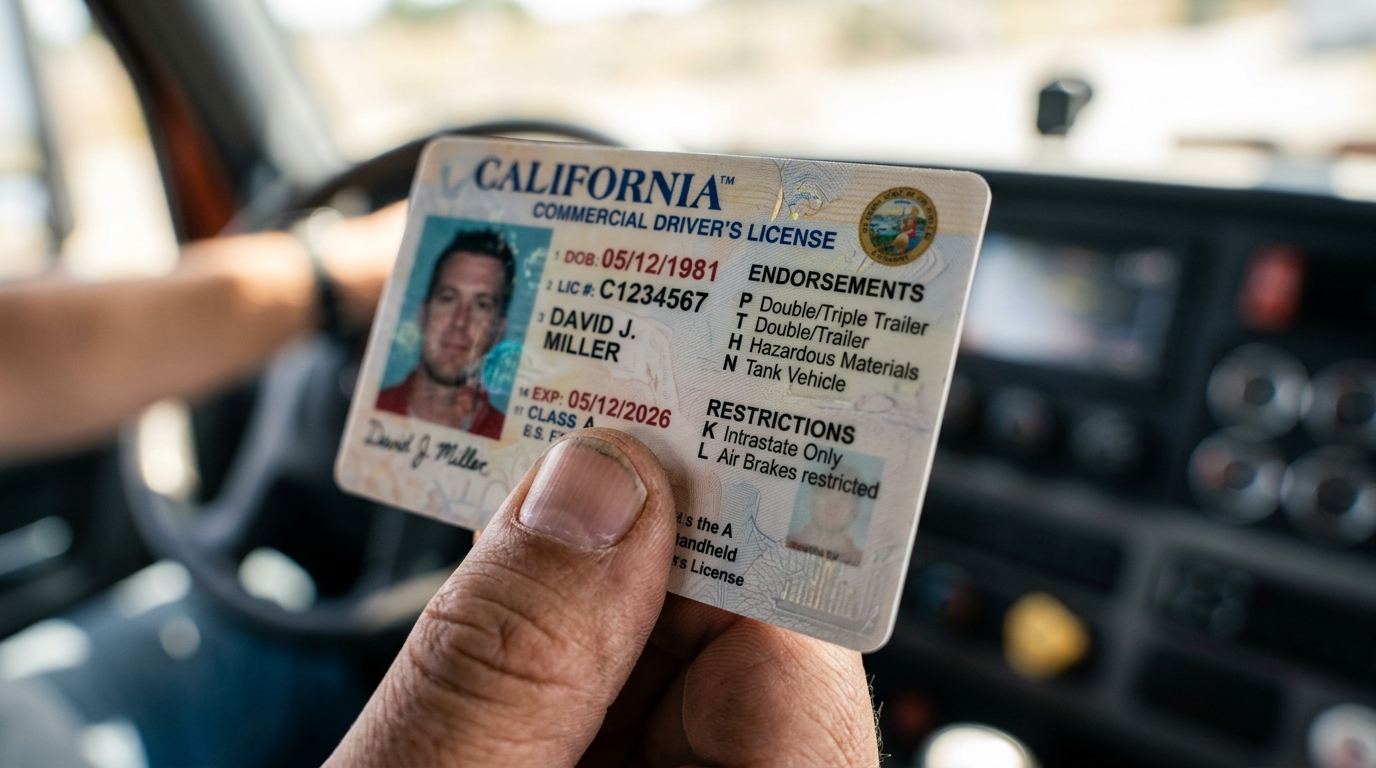
Restrictions print on the license and follow the driver into every hiring decision. Three matter most for motorcoach jobs:
L restriction appears when the driver tests without air brakes or fails the air brake knowledge test. Almost every motorcoach uses air brakes.
E restriction means no manual transmission. Most modern Prevost and MCI coaches use automatics, so this one matters less than it used to.
Z restriction limits the driver to air-over-hydraulic brakes, which rules out full air brake coaches.
Testing in the right vehicle avoids all three. A driver who plans to run entertainer coaches should test in an air-brake bus with the same class rating as the target job.
Drug, Alcohol, and English Proficiency Rules
Drug and alcohol testing under 49 CFR Part 382 applies to every CDL passenger driver. Employers run a pre-employment query in the FMCSA Drug and Alcohol Clearinghouse, conduct random tests during employment, and test after certain crashes.
Since November 18, 2024, states must downgrade the CDL of any driver with a "prohibited" Clearinghouse status. A failed or refused test now removes commercial driving privileges until the return-to-duty process ends.
English proficiency became an enforcement issue again in 2025. Since June 25, 2025, a driver who can't communicate in English with officers, read highway signs, or answer inspection questions can be placed out of service at roadside. For bus drivers who announce safety instructions to passengers, the skill is part of the job anyway.
Costs and Timeline
Costs vary by state and training path. Expect separate charges for the CLP, the knowledge test, the skills test, the license issue fee, the DOT physical, and ELDT. Behind-the-wheel training costs the most, since it needs a bus and an instructor.
A motivated candidate with a CDL already in hand can often add P in three to six weeks: one week for theory, the 14-day CLP wait, and a skills test appointment. Drivers starting from scratch take longer, because the base CDL comes first. Many charter and transit operators pay for training in exchange for a work commitment.
Transfers between states add a wrinkle. A driver who moves must apply for a new CDL in the new home state within 30 days, and the P endorsement carries over once the state confirms the driving record and medical status.
What Entertainer Coach Companies Expect Beyond the License
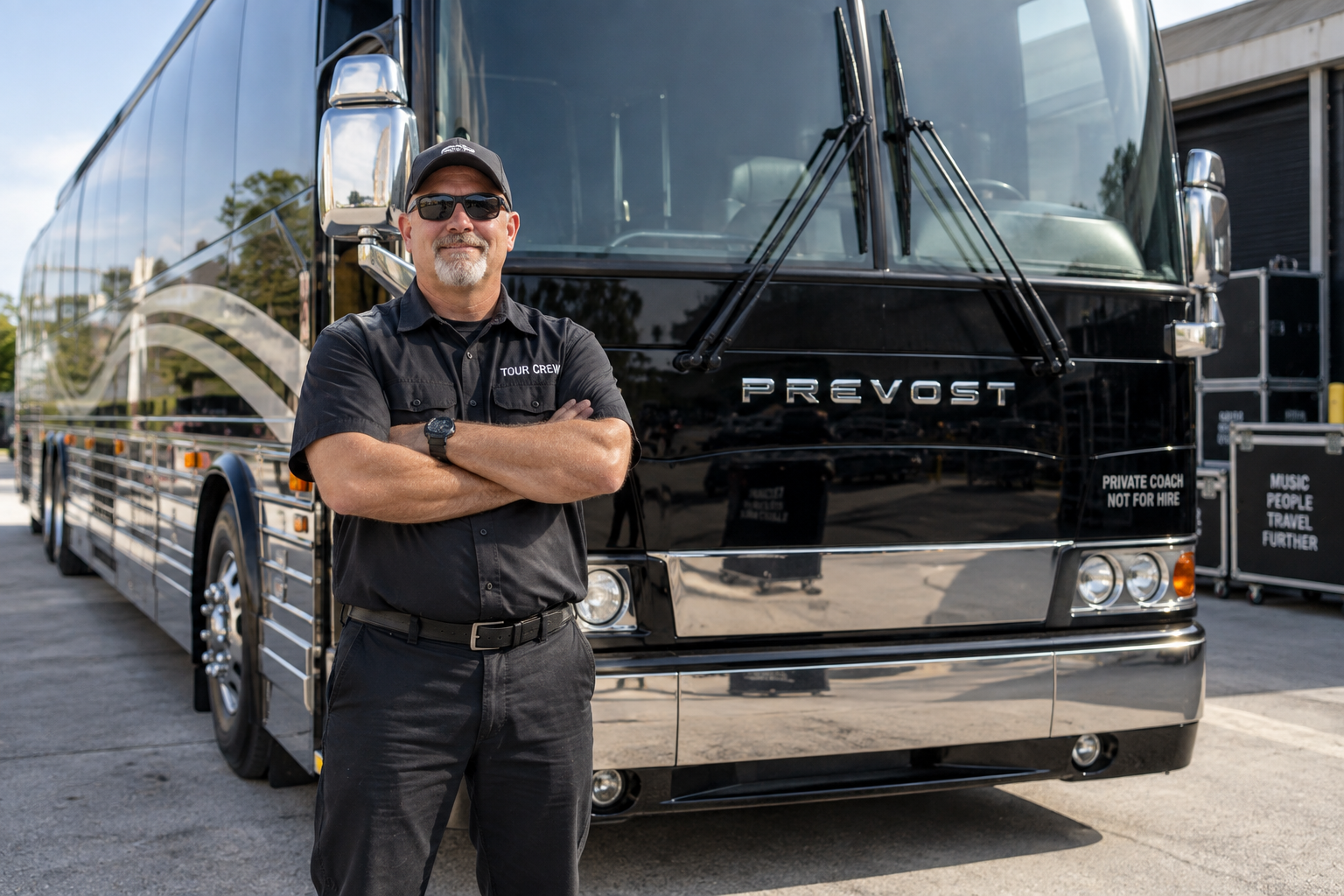
Entertainer coach companies treat the P endorsement as the entry ticket, not the qualification. Most want years of motorcoach experience, a clean motor vehicle record, and a history of overnight driving before handing someone a coach worth over a million dollars.
Knights Coaches, for example, puts Class A or B CDL drivers with at least three years on entertainer coaches behind the wheel of its Prevost H3-45 and X3-45 fleet. Those drivers also handle generator care, holding tank service, and bunk-area checks that no DMV test covers.
Artists and tour managers can see how that standard shows up on the road through the Knights Coaches tour bus rental page.
Do you need a passenger endorsement to drive a tour bus?
Yes. Any tour bus designed for 16 or more occupants including the driver requires the P endorsement on a Class A, B, or C CDL.
What is the difference between the P and S endorsements?
The P endorsement covers all passenger vehicles for 16 or more, while S adds school bus authority on top of P. A school bus driver needs both; a charter driver needs only P.
How many questions are on the CDL passenger test?
The knowledge test has 20 questions with an 80 percent passing score. The skills test is separate and happens in a bus.
Is ELDT required for the passenger endorsement?
Yes, for anyone adding P for the first time after February 7, 2022. Both theory and behind-the-wheel training must come from a registered provider.
Which CDL class is best for tour bus driving?
Class B with P and no air brake restriction covers most tour and charter coaches. Class A with P becomes necessary when the coach tows a heavy gear trailer.
How old do you have to be to drive a bus across state lines?
A driver must be at least 21 for interstate passenger work. Some states license 18-year-olds for in-state routes only.
Can I carry passengers while holding a CLP with a P endorsement?
No. A CLP holder with P may carry only trainers, examiners, and other trainees. Paying passengers require a full CDL.
What medical certificate does a bus driver need?
A bus driver needs a DOT medical examiner's certificate valid for up to 24 months, issued by a National Registry examiner. Some conditions lead to shorter certificates.
Which restrictions keep drivers out of motorcoach jobs?
The L, Z, and sometimes E restrictions limit motorcoach work, since most coaches use full air brakes. Testing in an air-brake bus prevents them.
How long does it take to get a passenger endorsement?
A current CDL holder can usually add P in three to six weeks. The mandatory 14-day wait on the learner's permit sets the minimum.
Does a failed drug test affect the passenger endorsement?
Yes. A "prohibited" Clearinghouse status triggers a CDL downgrade until the driver completes return-to-duty steps with a substance abuse professional.
Does the passenger endorsement need separate renewal?
No. The P endorsement renews with the CDL itself. The driver must still keep the medical certificate current and maintain a clean Clearinghouse status between renewals.
Conclusion
CDL passenger endorsement requirements build on each other in a fixed order. The P endorsement authorizes vehicles designed for 16 or more occupants and attaches to Class A, B, or C. It demands a base CDL with interstate age, medical, and residency checks, then ELDT theory and behind-the-wheel work. After that come the 20-question knowledge test, the skills test in a representative bus, and careful attention to L, E, and Z restrictions. Clearinghouse status and English proficiency keep the license valid, while costs and timelines depend on the starting point. Entertainer coach employers then add years of experience on top.
Need a coach driven by someone who cleared all of that and more? Book through Knights Coaches for a Prevost coach with an experienced CDL driver.