
Bus Call, Overnight Drives and Day Sheets
Bus call is the fixed time an entertainer coach leaves a venue after load-out, printed on the day sheet and enforced by the tour manager. It is not a suggestion, a rough plan, or a starting point for negotiation. The coach leaves at bus call whether or not everyone is aboard, and the reason sits […]
Knights Coaches
Knights Coaches
- Published
- Updated
- Reading time
- 11 min read
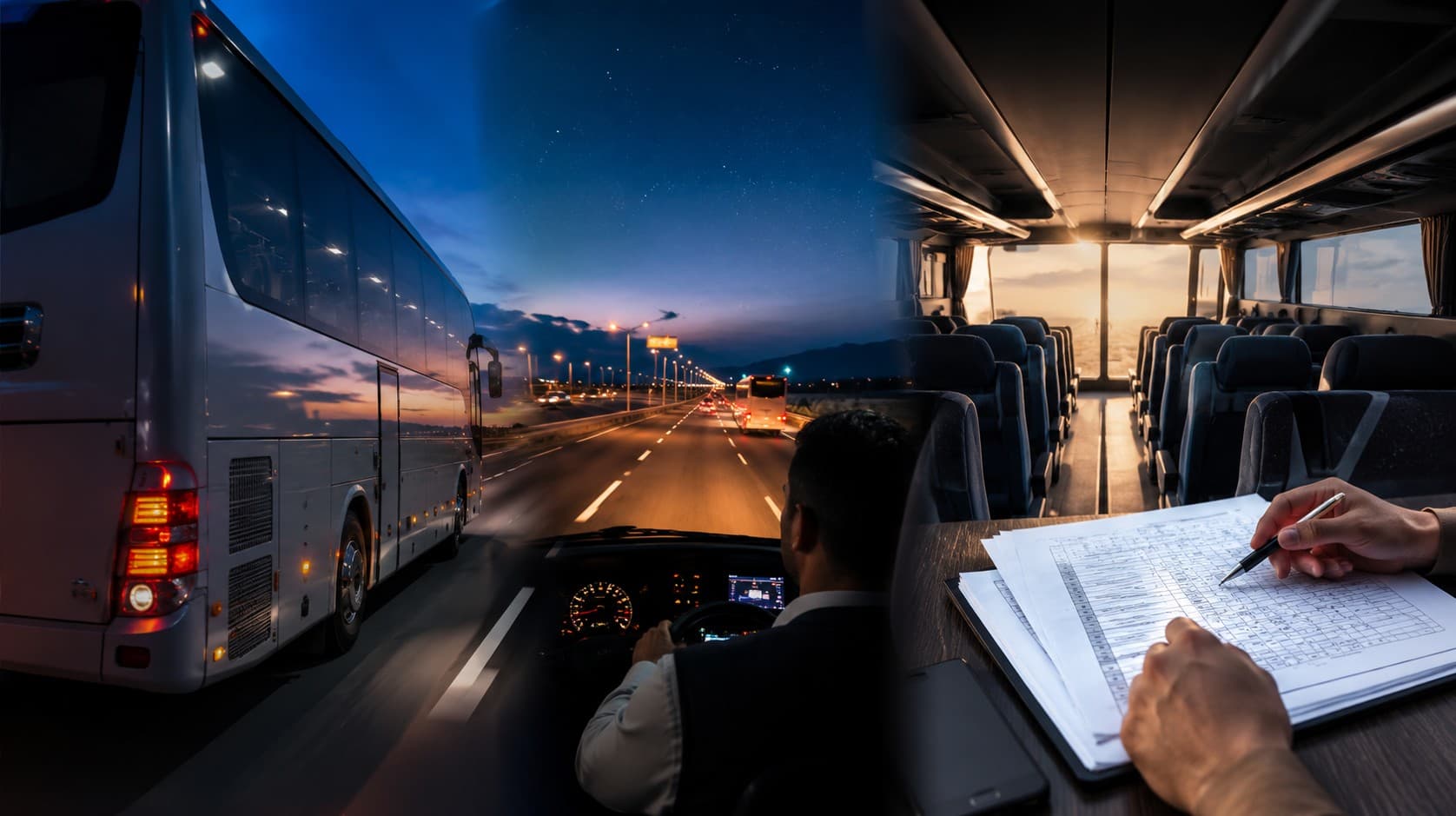
Bus call is the fixed time an entertainer coach leaves a venue after load-out, printed on the day sheet and enforced by the tour manager. It is not a suggestion, a rough plan, or a starting point for negotiation. The coach leaves at bus call whether or not everyone is aboard, and the reason sits in federal law rather than in anyone’s temper.
Federal Motor Carrier Safety Administration rules cap a passenger-carrying driver at 10 hours of driving after 8 consecutive hours off duty, inside a 15 hour on-duty window. A driver who has been on duty since 5:00 PM has a hard stop coming, so a 1:15 AM departure that slips to 2:30 AM can put the arrival past the point where the driver has to park and take a legally required break. Missing the next load-in follows from that.
The day sheet is where all of it gets published. One page per show day carries the city, venue, addresses, load-in, soundcheck, doors, set times, curfew, bus call, drive distance, and the following day’s schedule. Tour managers build it, distribute it the night before, and everyone from the artist to the backline tech runs their day off it.
This guide covers what bus call means in practice, who sets it and why it doesn’t move, how to read a day sheet, the sequence of an overnight drive from load-out to arrival, fuel stop rules, what actually happens when someone misses the call, how relief drivers change the pattern, morning arrival and gate times, and how day sheets get distributed. The FAQs cover what first-time crew ask.
What bus call actually means
Bus call is the departure time, not the boarding time. Being at bus call means being on the coach with your gear stowed, showered or not, ready for the doors to close. Arriving at the lot at bus call is arriving late.
Most tours set it 15 to 45 minutes after load-out finishes, which gives the crew time to settle and the driver time to walk the coach, check tires and lights, and confirm the count with the tour manager.
The word carries weight because the consequences are real. Nobody sends a search party, nobody calls twice, and the driver does not sit idling while somebody finishes a beer inside the venue. On tours with an early gate closure at the venue, bus call can be earlier than load-out completion, with production staying behind to finish and catching the coach at the lot exit. That timing comes from one place.
Who sets bus call and why it never moves
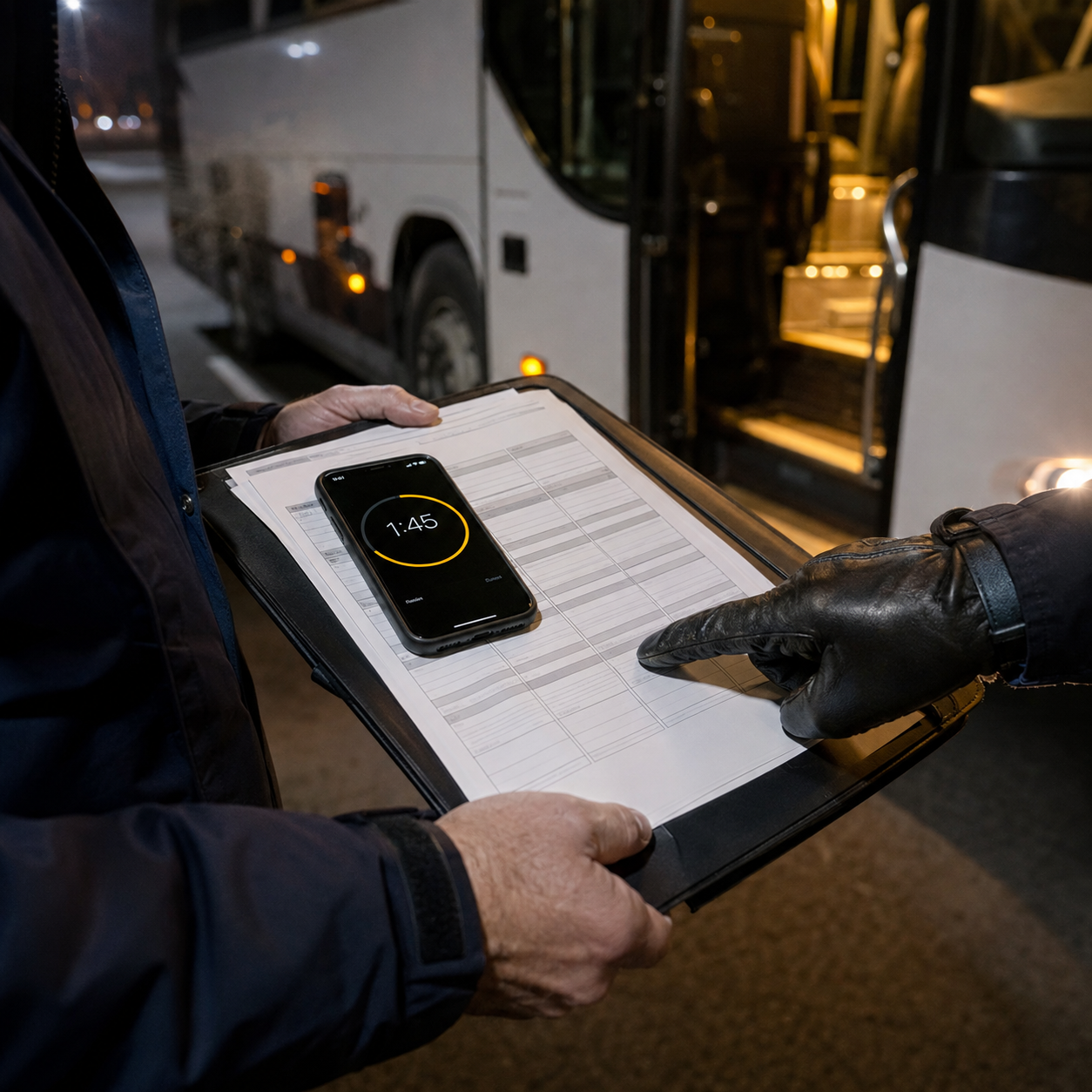
Tour managers set bus call in consultation with the driver, working backward from the next day’s load-in and forward from the driver’s clock. The driver knows their available hours to the minute, because those hours are logged and audited.
Three constraints lock the time. The driver’s remaining driving hours, the distance to the next market, and the load-in time at the far end. Change one and the others have to absorb it, which is why a delayed load-out rarely produces a delayed departure. It produces a faster load-out instead.
Weather and construction tighten it further. Dispatch reroutes around closures, but a reroute that adds 60 miles takes an hour out of the same fixed window. The full arithmetic behind these decisions is covered in the guide to routing a tour around coach drive times. What the crew sees of it is one printed page.
Reading a day sheet
Day sheets condense the whole day into a single page. The header carries the date, day of the week, city, and venue name with its full address, because half the crew is finding it independently by ride-share.
The body runs chronologically: bus arrival, load-in, local crew call, backline set, soundcheck, catering times, doors, support set, changeover, headline set, curfew, load-out, and bus call. Curfew matters more than people expect, since venue curfews carry financial penalties and push every downstream time.
The footer covers logistics: drive distance and duration to the next market, next day’s city and venue, hotel details on off days, Wi-Fi passwords, promoter and production contacts, weather, and time zone changes. Good day sheets also flag drop and run days where the coach leaves the venue after load-in, a pattern explained in the guide to venue bus parking and shore power. With the page in hand, the night runs in a predictable sequence.
The night in sequence
Load-out starts as soon as the last note ends and the audience clears. Backline breaks down first, then audio and lighting, then the truck pack. Crew who finish early head to the coach and stow personal gear.
Departure follows at bus call. The coach pulls out, the front lounge stays awake for an hour or so, and bunk alley starts filling as people give up on the night. Interior lights drop to dim, and the coach settles into the quiet that lasts until morning.
Mid-drive, the driver takes a fuel and service stop, usually between 2:00 AM and 4:00 AM at a truck stop with 24 hour facilities. That stop covers diesel, waste tank service, trash, and the driver’s own break. Most of the coach sleeps through it. The ones who wake up need to understand one rule before they step off.
The fuel stop rule that costs people money
Drivers do not perform headcounts before pulling away from a fuel stop. Checking bunks means opening curtains and waking eleven sleeping people, which defeats the purpose of a sleeper coach, so drivers finish their break and roll.
Anyone stepping off at a truck stop tells the driver first. Every time, without exception, even for two minutes. If the driver isn’t in the seat, leave a note on it. Veteran tour manager Andy Reynolds suggests a neatly folded T-shirt as a backup signal, on the grounds that neatly folded anything is rare enough on a tour bus to get noticed.
The failure mode is always the same. Someone wants food at 3:00 AM, walks 200 feet to the diner, and watches their passport, phone charger, and in-ear moulds head for the next state. The same discipline applies at venues, and the wider set of conventions is covered in the guide to tour bus bunk etiquette.
Missing bus call
Missing bus call means the coach leaves without you. What happens next is entirely your problem and your expense: a flight, a rental car, or a long ride-share to the next market, arriving mid-afternoon and explaining yourself to a tour manager who has already covered your job for half a day.
Tours do not wait because waiting is not free. A 40 minute delay can push the arrival past load-in, cost the driver their legal hours, or force a stop that turns into an eight hour break. The math punishes the whole tour to accommodate one person.
There is one narrow exception. Tour managers hold the coach when the delay is the tour’s fault, such as a promoter settlement running long or a production issue keeping a tech in the building. Personal delays do not qualify. On tours where a lot of long jumps stack up, the departure pattern changes anyway.
Relief drivers and continuous running
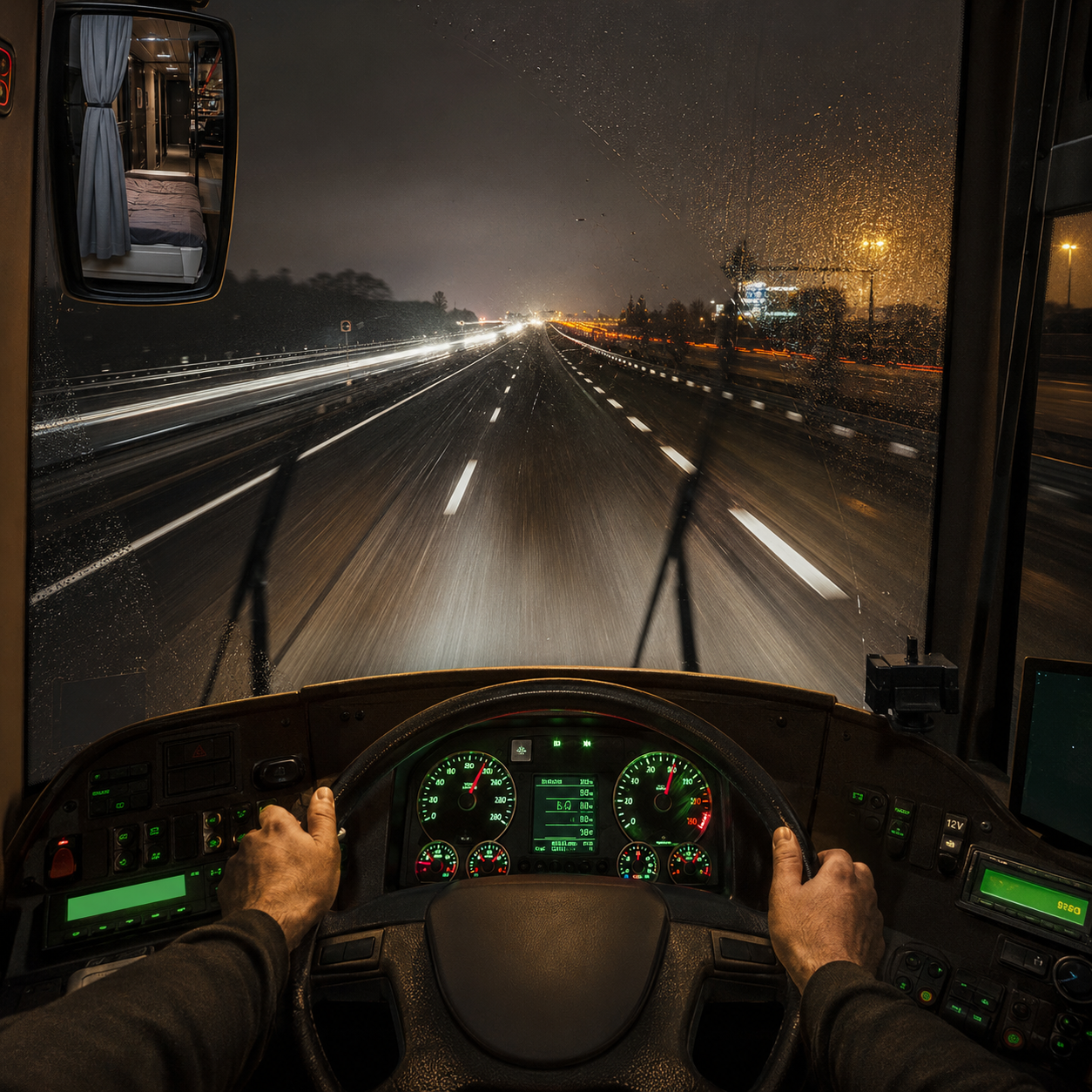
Relief drivers, sometimes called second drivers, ride along so the coach can keep moving past a single driver’s limit. One drives while the other takes their off-duty rest in the driver’s bunk, and the pair alternate through the night.
That setup extends the reachable distance from around 500 miles to somewhere between 900 and 1,100 miles in a single overnight, which turns impossible jumps into routine ones. Tours crossing the mountain west or chasing fixed festival dates in distant markets use it most.
Bus call gets stricter, not looser, with a relief driver aboard. The second driver’s clock starts when they come on duty, so a late departure wastes rest that has already been scheduled. Knights Coaches arranges relief drivers through the same 24/7 dispatch team that handles routing and mechanical support. Whichever setup runs, the night ends the same way.
Dark hours and the sleeping coach
Dark hours describe the period after departure when the coach runs quiet. Overhead lighting drops, the front lounge empties, and conversation moves to headphones or ends entirely.
The convention exists because the driver is not the only person whose rest is protected. Crew who load in at 8:00 AM need sleep that band members finishing at 1:00 AM do not yet want, and one loud game in the front lounge can cost four people two hours each.
Practical dark-hour habits are simple. Close doors instead of letting them swing, keep phone calls out of bunk alley, keep volume in headphones, and leave the thermostat alone. A coach that runs quiet from 2:00 AM produces a crew that works properly at load-in, which is ultimately what the schedule is protecting.
Morning arrival and gate times
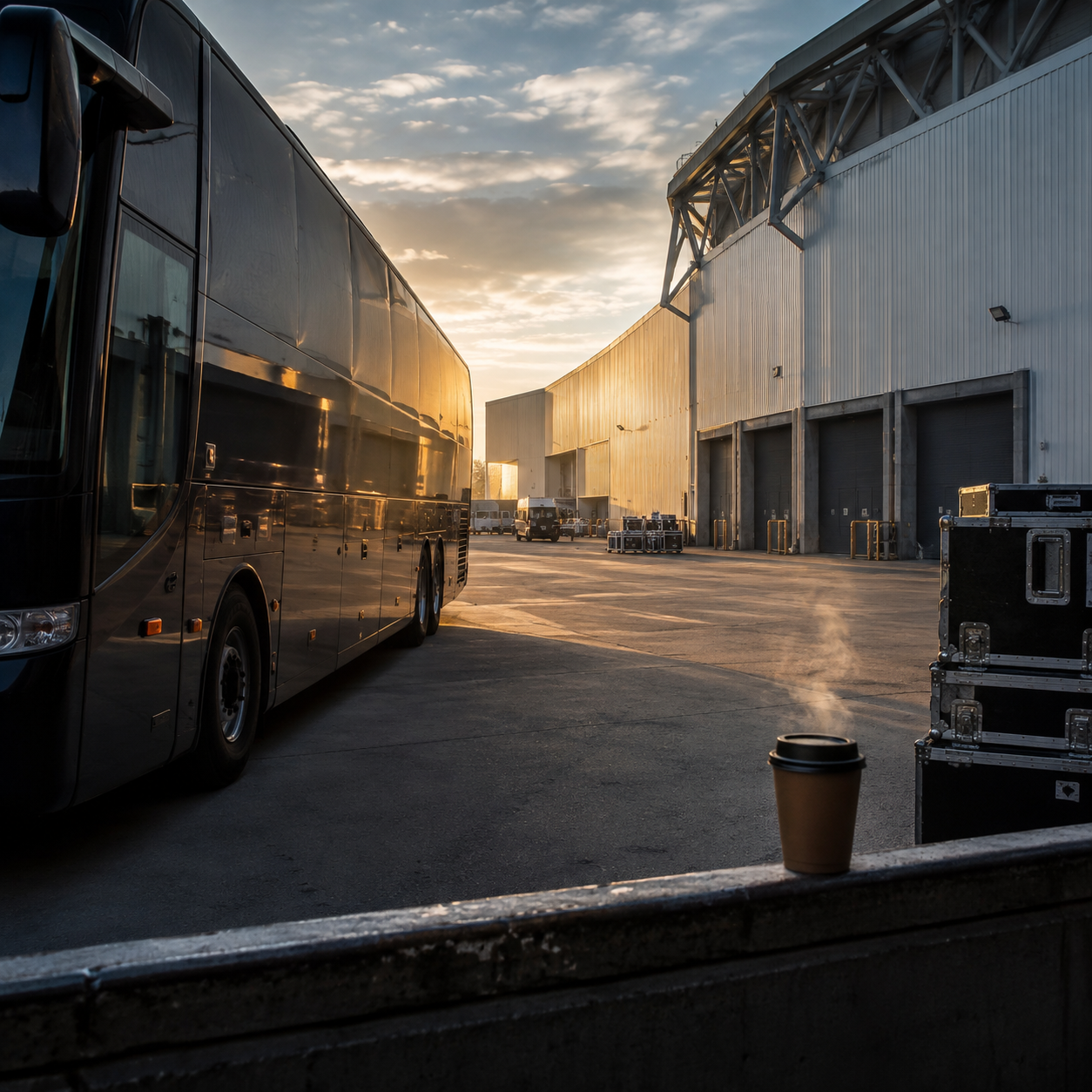
Arrival usually lands between 8:00 AM and noon. The coach parks in the venue’s designated bus position, plugs into shore power where the venue provides it, and switches off the generator.
Gate times matter here. Many venues restrict lot access to specific hours, especially arenas and downtown theaters, so a coach arriving at 6:00 AM may have to wait at a nearby truck stop until the gate opens. Day sheets should carry the gate time alongside load-in.
Crew wake on their own schedules after that. Nobody gets woken for arrival unless there’s a reason, and the coach becomes a stationary hotel for the day, which is the entire economic case behind coach touring and is covered in the guide to how a coach replaces hotel nights. The page that coordinates all of this gets distributed the night before.
How day sheets get distributed
Distribution happens the night before, not the morning of. Printed copies go on the front lounge table and get taped inside production offices, while digital copies go out through the tour’s group chat and scheduling app.
Master Tour and similar tools push updates automatically, which matters when a set time or a gate time changes at short notice. Printed sheets stay useful anyway, because phones die and venue Wi-Fi fails.
Version control is the real discipline. One person owns the day sheet, usually the tour manager, and changes flow through them rather than through side conversations. A crew running on two different versions of the same day is how call times get missed and how bus call turns into an argument at 1:00 AM.
What does bus call mean on tour?
Bus call is the fixed departure time for the tour coach, published on the day sheet. Being at bus call means being aboard with your gear stowed and ready to roll, not arriving at the lot at that minute.
What happens if you miss bus call?
The coach leaves without you and you cover your own transport to the next city at your own cost. Tours hold the coach only for tour-caused delays such as settlement or production overruns, never for personal ones.
Who sets the bus call time?
The tour manager sets it with the driver, working backward from the next load-in and forward from the driver’s remaining legal hours. Distance, load-in time, and the driver’s clock lock the time in place.
What is a day sheet?
A day sheet is the one-page schedule for a show day, covering city, venue, addresses, load-in, soundcheck, doors, set times, curfew, load-out, bus call, drive distance, and the next day’s plan. The tour manager writes and distributes it the night before.
Does the bus wait for people?
No. Waiting costs driver hours that cannot be recovered, and a delayed departure can push arrival past the next load-in. Drivers also skip headcounts at fuel stops, so anyone off the coach needs to have told them.
Can you get off the bus at a fuel stop?
Yes, provided you tell the driver first or leave a note on the driver’s seat. Drivers finish their break and pull away without checking bunks, because opening curtains would wake the whole coach.
How long does an overnight drive take?
Most overnight drives run 6 to 10 hours of driving, covering roughly 500 to 550 miles at a 55 mile per hour working average including one fuel and service stop of 30 to 45 minutes.
When does the bus arrive at the next venue?
Typically between 8:00 AM and noon, subject to the venue’s gate times. Coaches that arrive before the lot opens wait at a nearby truck stop rather than blocking the street.
What is a relief driver?
A relief driver is a second CDL driver who alternates with the primary driver so the coach can run beyond one driver’s 10 hour limit. The pair cover 900 to 1,100 miles overnight, which single-driver setups cannot do legally.
Do you sleep during the drive?
Yes. Bunks are designed for travel, the corridor is kept dark and cold, and the coach is quietest between departure and the fuel stop. Sleeping feet-first toward the front of the coach is the standard safety orientation.
Who decides where the bus parks overnight?
The driver picks rest locations inside their legal break, usually 24 hour truck stops. Venue overnight parking gets advanced with the promoter in advance, and dispatch coordinates both sides.
What are dark hours on a tour bus?
Dark hours are the quiet period after departure when lights go down and the coach runs silently for sleep. Conversation moves to the front lounge or to headphones, and doors get closed rather than allowed to swing.
Is bus call the same as lobby call?
No. Lobby call is the hotel departure time on days when the crew sleeps in rooms, while bus call is the coach departure from the venue. Tours that mix hotel nights with coach nights publish both on the day sheet.
How early should bus call be after load-out?
Fifteen to forty-five minutes after load-out finishes covers most tours, giving the driver time for a walk-around inspection and the crew time to stow gear. Larger productions stretch the gap, which shortens the drive window.
The night, start to finish
Bus call is the fixed departure that a tour builds its night around, set by the tour manager against the driver’s legal clock and published on the day sheet with every other time that matters. The page runs chronologically from load-in to load-out, then carries the drive distance and the following day’s plan.
Overnight drives follow the same sequence every night: load-out, departure, a quiet run, a fuel and service stop in the small hours, then arrival at the next venue between 8:00 AM and noon inside the venue’s gate times. Telling the driver before you step off at a truck stop is the rule that saves people from watching their home drive away, and relief drivers extend the reachable distance when routing demands it.
Knights Coaches runs CDL-certified drivers with 24/7 dispatch on every booking across all 48 contiguous states. Send your date sheet through the contact form or call 1-855-838-5542 to check your bus calls against real drive times.