
Tour Bus Bunk Layouts: 12, 14 and 16 Bunk Plans Explained
A tour bus bunk layout is the arrangement of sleeping berths inside a converted motorcoach, and the North American standard is 12 bunks : six per side, split into a front and a rear block, with three berths stacked vertically in each block. Each berth measures roughly 29 inches wide by 74 inches long by 35 inches high…
Knights Coaches
Knights Coaches
- Published
- Reading time
- 11 min read
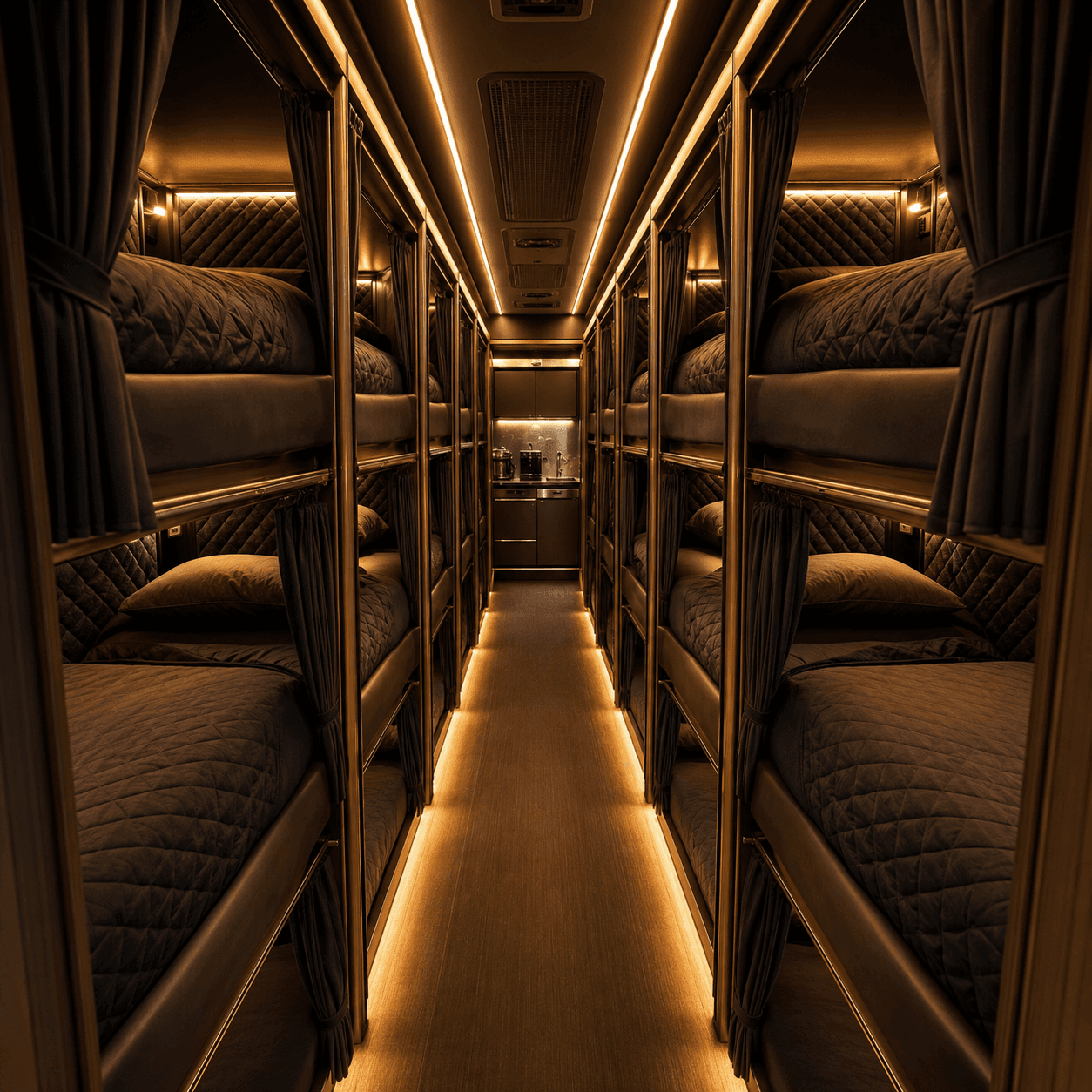
A tour bus bunk layout is the arrangement of sleeping berths inside a converted motorcoach, and the North American standard is 12 bunks: six per side, split into a front and a rear block, with three berths stacked vertically in each block. Each berth measures roughly 29 inches wide by 74 inches long by 35 inches high, closes with a privacy curtain, and carries its own light, climate vent, and charging point.
Bunk counts across the industry run from 6 to 18, with 12 the working average. A rear bed kit converts a standard coach to 14 berths by taking floor space from the back lounge. Sixteen-berth builds exist, mostly in Europe on double-deck coach shells, and rarely in American fleets. At the other end, condo layouts drop to 8 taller berths by removing the middle tier.
Layout drives more of a tour’s daily experience than any other specification on the quote. It sets how many people can travel, how much common space survives, whether the artist has a private room, and how much storage the coach absorbs before luggage starts living in the aisle. Crews describe a 12-bunk coach as comfortable for eight, because the four unused berths swallow bags, coats, and cases.
This guide maps the plans that actually exist: how a bunk block is arranged, what the standard dimensions accommodate, the 12-bunk default, the 14-bunk rear kit, the 16-berth double-deck format, condo and star configurations, how slide-outs interact with the layout, and how to match a plan to your party.
How a bunk block is arranged
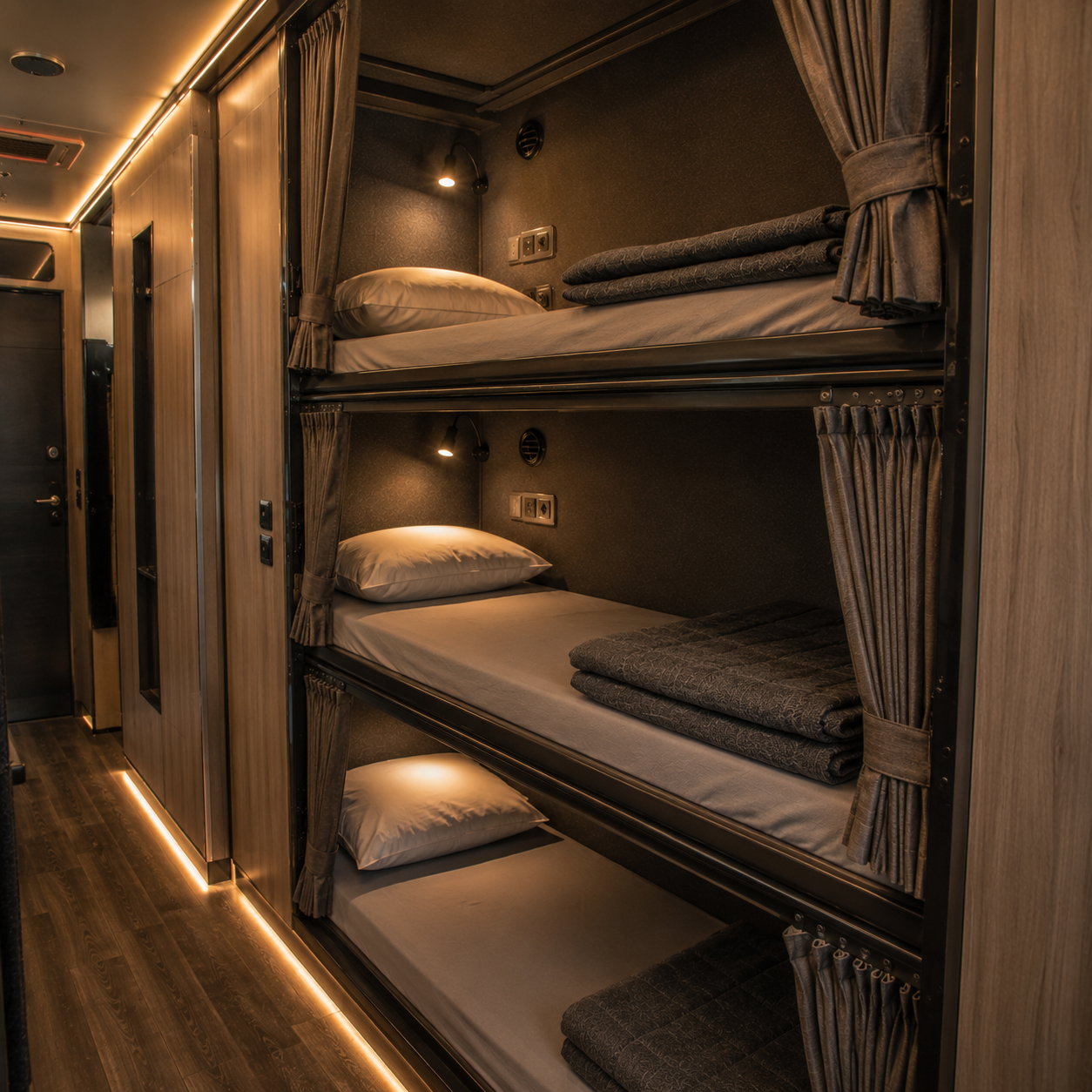
Arrangement follows a repeating grid that every touring crew learns in one night. The bunk corridor sits between the galley and the rear lounge, with berths on both sides of a center aisle.
Each side carries two columns, one forward and one aft. Each column stacks three berths: top, middle, and bottom. That produces four quadrants across the coach, which is the vocabulary drivers and tour managers use when assigning berths: front driver-side, rear driver-side, front passenger-side, rear passenger-side.
Position matters to the people sleeping. Bottom berths are easiest to enter and catch the most road noise. Middle berths ride best. Top berths are quietest and require a climb. Experienced tour managers assign berths in advance rather than letting the party sort it out at midnight after a show.
Every unit in the Knights Coaches Prevost coach fleet publishes its bunk count and rear configuration on the specification card, so a tour manager can compare floor plans before the quote rather than after arrival.
Standard bunk dimensions and what actually fits
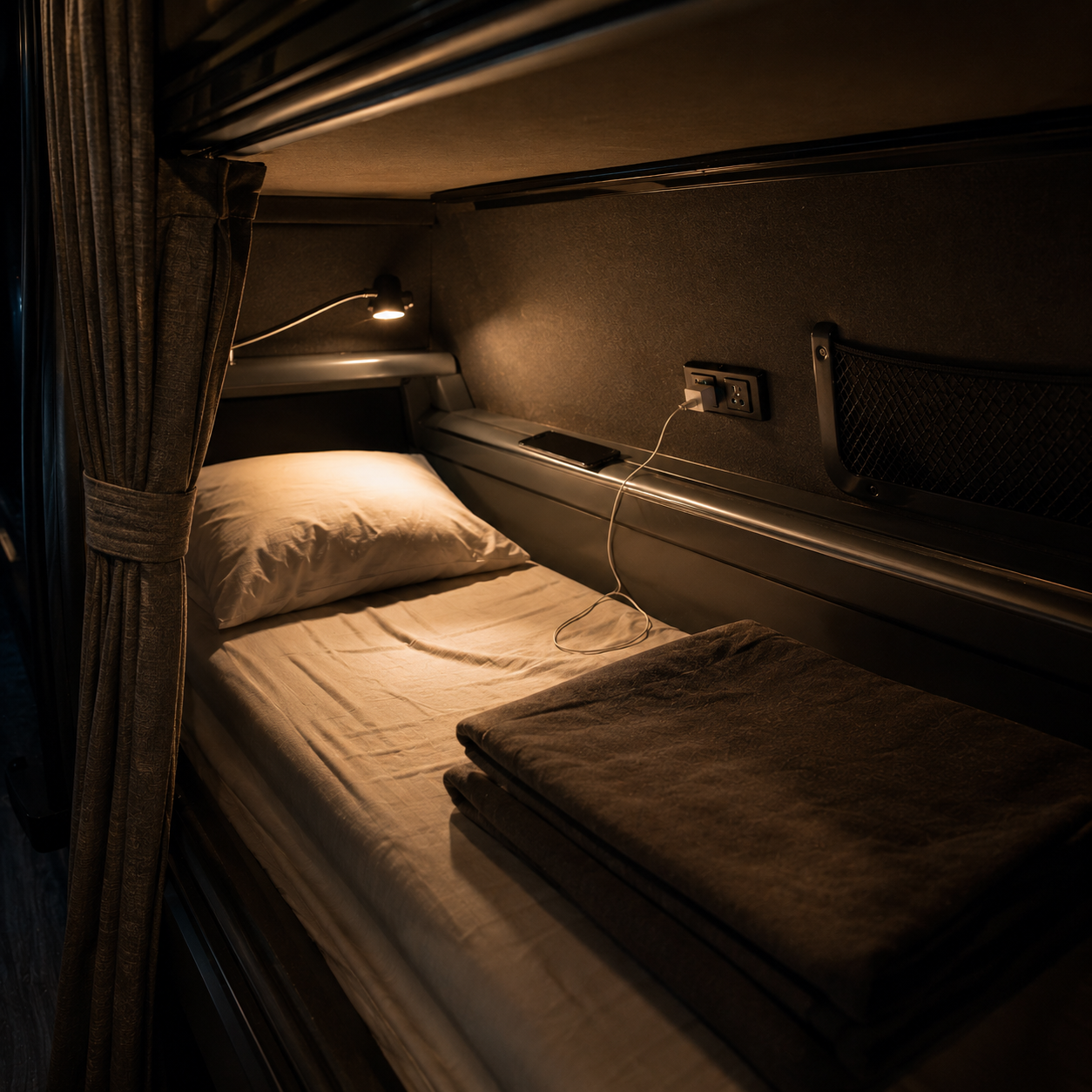
Dimensions are consistent enough across converters to plan around. A standard berth measures 29 inches wide, 74 inches long, and 35 inches high.
Those numbers have consequences. Length accommodates most adults comfortably and becomes tight past roughly six foot two. Width is genuinely single-occupancy. Height allows sitting upright only in a hunched position, which is why the lounges exist and why nobody spends waking hours in a bunk.
Fittings raise practical comfort above the raw dimensions. Standard berths include a curtain, a reading light, a climate vent, a charging outlet, and a storage pocket. Higher-tier conversions add screens and deeper storage.
Storage behavior is the detail nobody explains to a first-time touring party. Unoccupied berths become storage on every tour, absorbing suitcases, jackets, and stage clothes. A crew of eight riding a 12-bunk coach effectively gains four dedicated storage compartments, which keeps the lounges usable. Book to the exact head count and the coach fills with luggage instead.
The 12-bunk plan: the North American default
Twelve berths is the format the entire American touring industry prices and builds against. Six per side, two columns each, three high, with the galley forward of the block and the rear lounge behind it.
Popularity is functional rather than traditional. Twelve fits inside a 45-foot shell while preserving a front lounge large enough to seat six to eight and a rear lounge that works as a green room. It also matches the size of a typical touring party once a band, a tour manager, a sound engineer, and a merchandise seller are counted.
Real occupancy sits below capacity. Most tours on a 12-bunk coach travel with eight to ten people. The remaining berths handle storage, give somebody a spare when a bunk turns out to be too warm or too loud, and provide a place for a guest engineer on a one-off date.
Resale reflects the same logic. Twelve-bunk conversions trade fastest in the used market because they match how tours actually operate, which is worth knowing even if you never buy one. Acts booking entertainer coach rental will be quoted this configuration by default unless they specify otherwise.
The 14-bunk plan: the rear bed kit trade-off
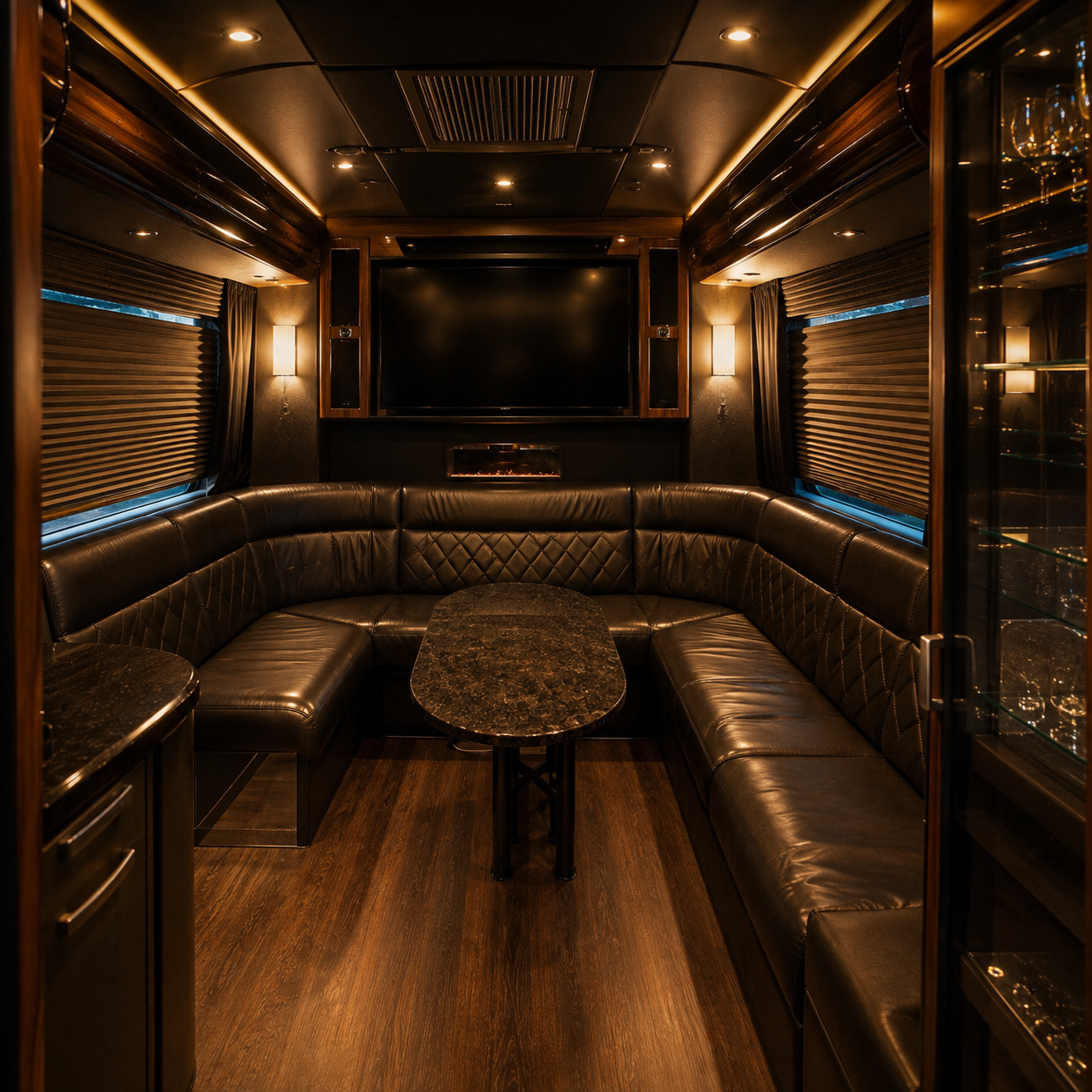
Fourteen berths is a modification rather than a distinct build. A rear bed kit adds two berths by taking space from the back lounge, and it can usually be installed and removed between tours.
Cost is modest and specific. Conversion runs around $500 as a one-time charge, and the driver’s daily rate typically increases by about $50 when a coach runs the rear kit, since the configuration adds handling and service work.
What you give up is the rear lounge, and that trade is bigger than the two berths suggest. The back lounge is where crews decompress after a show, where card games and video games happen, and where the tour manager holds conversations that do not belong in the front lounge. Removing it pushes twelve to fourteen people into one shared space.
Fourteen makes sense for production-heavy runs where the crew genuinely exceeds twelve and splitting across two coaches costs more than losing the lounge. It rarely makes sense for a band. Knights Coaches configures units from twelve berths and will advise on whether a second coach prices better than a rear kit for a given party size.
The 16-bunk plan and why it is rare in America
Sixteen berths requires either a double-deck shell or a layout that sacrifices most of the common space. European nightliners take the first route, stacking berths across two floors on double-deck coaches, and carry 8 to 18 passengers as a normal range.
American fleets rarely run them. Bridge clearances, weight distribution, and the dominance of single-deck Prevost and MCI platforms in the US market all work against double-deck sleepers. Domestic tours needing more than fourteen beds almost always add a second coach instead.
That second-coach approach carries advantages beyond bed count. It separates band from crew, gives two driving clocks rather than one, allows different call times for load-in and departure, and removes the single point of failure one coach represents on a national routing.
Condo bunks and the 8-berth artist layout
Condo layouts run eight berths total, with two columns per side stacked two high rather than three. Removing the middle tier makes each remaining berth substantially taller, which is the entire point.
Comfort improves noticeably. A condo berth allows something close to sitting upright, holds more personal storage, and feels less like a compartment. Parties of six or fewer, artists who spend long stretches on the road, and executive clients all favor this layout.
The cost is capacity. Eight berths means eight travelers with no spare bunks for storage, so a party of six is the practical maximum before luggage overflows into the lounges. Condo coaches are also less common in rental fleets, which makes them harder to secure at short notice during peak season.
Long runs are where the layout pays off most, which is why extended cycles frequently pair a condo coach with a one to twelve month lease that guarantees the same unit and the same driver for the duration.
Star configuration and the rear stateroom
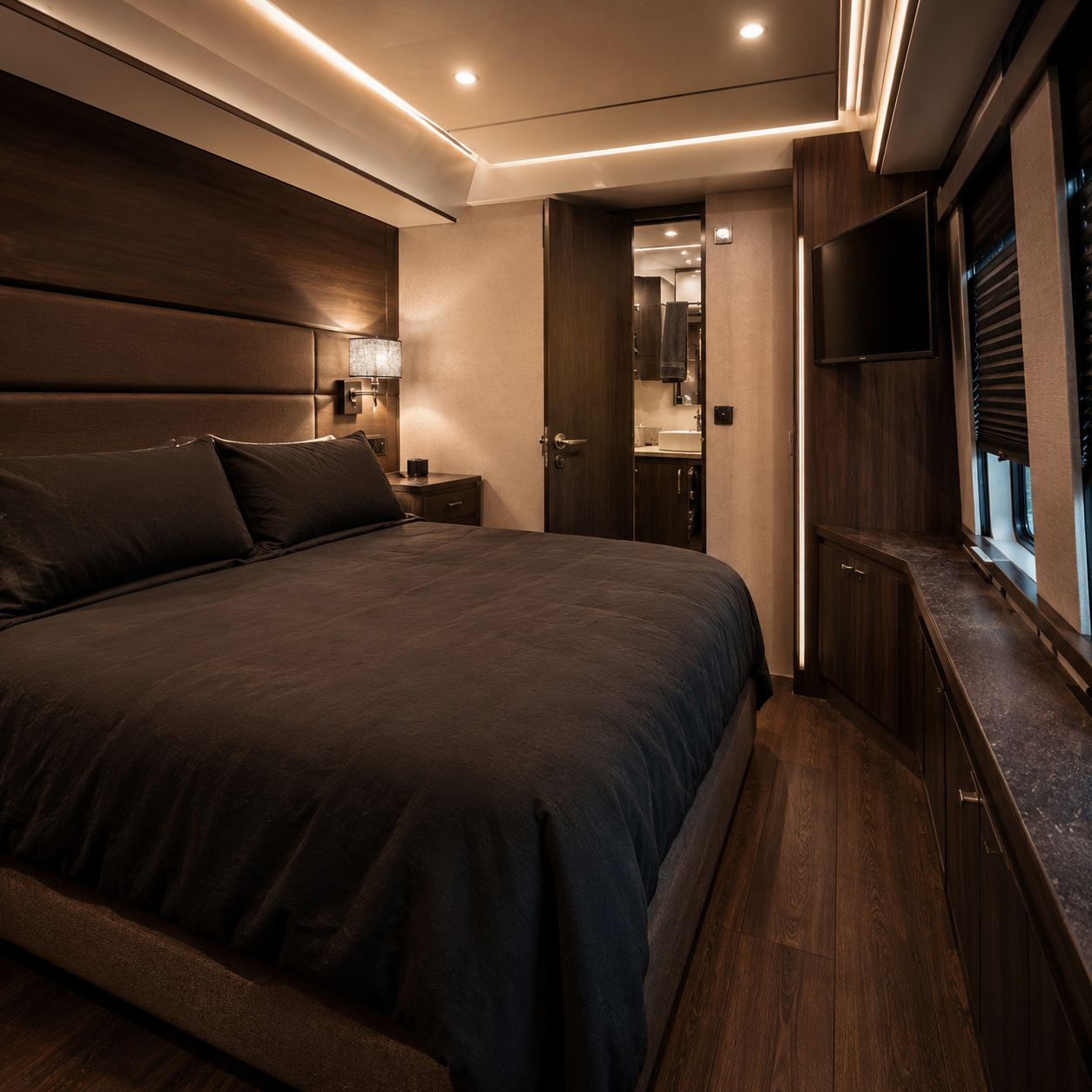
Star coaches convert the rear third of the vehicle into a private bedroom, usually with an ensuite bathroom and sometimes a private shower. Berth count drops, and what remains is a genuinely separate room rather than a curtained compartment.
Headline artists, comedians who tour solo, political principals, and executives book this configuration. Some star coaches add a small number of bunks forward for essential staff. Others carry almost none, functioning as a mobile apartment with a driver.
Cost sits at the top of the fleet range, and in the used market these units occupy the upper price bands alongside triple-slide premium conversions. The functional argument is not luxury: a principal who cannot sleep or prepare in shared space performs worse, and the room replaces both a hotel suite and a venue dressing room across the whole tour.
How slide-outs interact with the layout
Slide-outs widen the coach when parked, and they affect the lounges rather than the bunk block. A single slide typically extends the front lounge. Double slides extend front and rear. Triple and quad configurations extend additional zones.
Bunk dimensions do not change with slide count, because the bunk corridor sits over the chassis and cannot extend. What changes is how much room the crew has when the coach is stationary, which is where most waking hours are spent on a show day.
That distinction matters when comparing quotes. A single-slide 12-bunk coach and a triple-slide 12-bunk coach sleep the same number of people and feel entirely different to live on. Knights Coaches runs single slide-outs layouts across its fleet, with pickup in any major US city in the 48 contiguous states.
Backline remains outside this equation entirely. No bunk plan creates cargo capacity, because generators, water, and waste tanks occupy the bays, so gear moves separately through enclosed trailer and box truck service running alongside the coach.
Matching a layout to your party
Choose the plan by counting travelers, then adding room for storage and change.
Four to six travelers: condo layout with 8 taller berths, or a standard 12-bunk coach for the spare storage.
Seven to ten travelers: standard 12-bunk coach. This is the default for a reason.
Eleven to twelve travelers: 12-bunk coach at full occupancy, with luggage pressure on the lounges.
Thirteen to fourteen travelers: rear bed kit at 14 berths, accepting the loss of the back lounge.
Fifteen or more: two coaches. A second unit prices better than the compromises required to force one.
Artist or principal traveling with staff: star configuration with a rear stateroom.
Confirm the head count before requesting a sleeper bus quote, and include anyone joining for part of the run. Adding a person mid-tour to a fully occupied coach is the single most common layout problem operators are asked to solve after departure.
How many bunks does a standard tour bus have?
A standard tour bus has 12 bunks, arranged as six per side in two columns of three. Configurations across the industry run from 6 to 18 berths, and 12 is the North American default because it preserves both lounges inside a 45-foot shell.
What size is a tour bus bunk?
A standard bunk measures 29 inches wide, 74 inches long, and 35 inches high. Length suits most adults up to roughly six foot two, width is strictly single occupancy, and the height allows only hunched sitting, which is why the lounges carry waking hours.
What are condo bunks?
Condo bunks are berths stacked two high instead of three, giving eight total per coach and substantially more headroom in each. The layout suits parties of six or fewer, artists on long cycles, and executive travel where comfort outranks capacity.
Can a 12-bunk coach be converted to 14?
Yes. A rear bed kit adds two berths for a one-time charge around $500, and the driver’s daily rate typically rises by about $50. The berths come out of the rear lounge, so the crew loses its second common space.
Do 16-bunk tour buses exist?
Yes, mostly in Europe. Sixteen-berth builds use double-deck coach shells and are standard on European nightliners carrying 8 to 18 passengers. US fleets rarely run them because of clearance, weight distribution, and single-deck platform dominance.
Which bunk position is best?
Middle berths ride best. Bottom berths are easiest to access but catch the most road noise and suspension movement, and top berths are quietest but require a climb. Assign positions before departure rather than letting the party sort it out after a show.
How many people should travel on a 12-bunk coach?
Eight to ten travelers is the practical occupancy on a 12-bunk coach. The spare berths absorb luggage, coats, and cases, which keeps the front and rear lounges usable. Booking twelve people onto twelve berths pushes storage into the living space.
What is a star coach?
A star coach is an entertainer coach with the rear third converted into a private bedroom, usually with an ensuite bathroom. Total berth count drops, and the configuration sits at the top of both rental and resale price ranges.
Do slide-outs add bunks?
No. Slide-outs widen the lounges when the coach is parked and leave the bunk block unchanged, because the corridor sits over the chassis. Single, double, and triple slide layouts sleep identical numbers and feel very different to live on.
Where does luggage go if all bunks are occupied?
Personal luggage goes in the underfloor bays, and those bays are smaller than they look. Generators, fresh water, waste tanks, and house batteries occupy most of the volume, so spare berths are the real overflow storage on a working tour.
Can I request a specific floor plan when booking?
Yes. Specify bunk count, slide configuration, and whether you need a rear lounge or a rear bedroom at the inquiry stage. Peak season books months ahead and specific plans go first, so name the layout early rather than accepting whatever remains.
What happens if the party grows mid-tour?
Options are limited once a coach is on the road. A rear bed kit needs installation time and a fully occupied coach has no spare capacity, so the usual solution is a second vehicle or a hotel room. Build one or two berths of margin into the original booking instead.
The short version
Tour bus bunk layouts arrange berths in a repeating grid of two columns per side, stacked three high, producing four quadrants and the 12-berth North American standard. Each berth runs 29 by 74 by 35 inches with a curtain, light, vent, and charging point, and unoccupied berths become the coach’s real storage. A rear bed kit takes a standard coach to 14 at the cost of the back lounge, sixteen-berth builds belong to European double-deck nightliners, condo layouts trade the middle tier for eight taller berths, and star configurations convert the rear third into a private stateroom. Slide-outs widen the lounges rather than the bunk corridor, so a single-slide and a triple-slide coach sleep the same crew in very different comfort. Match the plan to head count plus margin, and add a second coach past fourteen rather than compromising the living space.
Knights Coaches configures Prevost H3-45 and X3-45 sleepers from twelve berths with single slide-outs, CDL-certified drivers, and 24/7 dispatch. Call 855 734 5700 and dispatch will match a floor plan to your routing within the hour.