
12-Bunk Entertainer Coach
12-Bunk Entertainer Coach Rental for Bands and Crew
A 12-bunk entertainer coach is the standard US touring configuration: twelve berths stacked three high in a center alley, with a lounge at each end of the coach. It sleeps a band and its crew on one unit, which is the reason most fleets are built around this layout rather than any other.
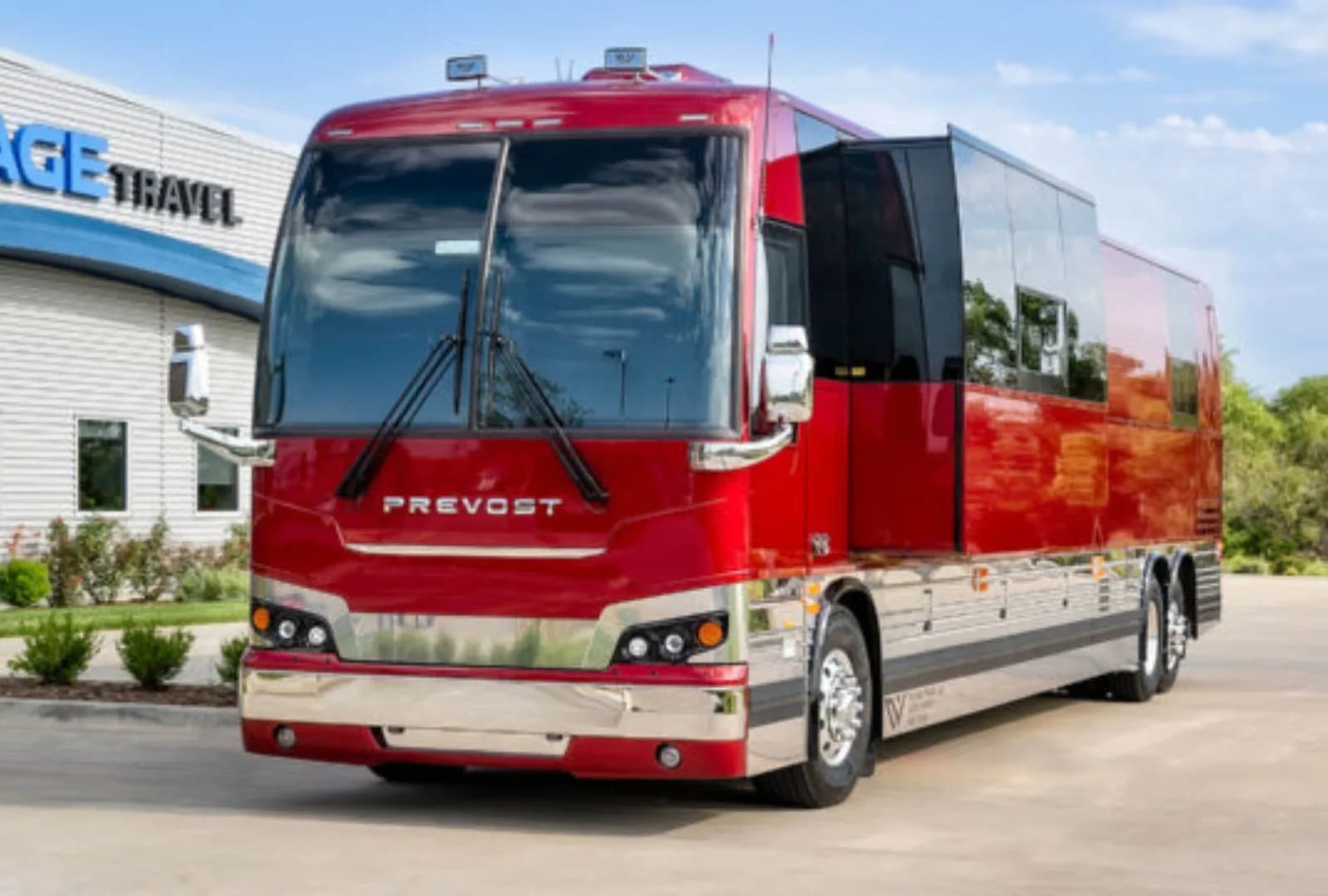
The shell is a 45-foot Prevost, either the flat-floor X3-45 or the raised-floor H3-45, measuring 102 inches across. Behind the driver sits a front lounge with seating and a table. The galley and a full bathroom occupy the middle. Then the bunk alley, then a second lounge at the back. A single slide-out is the most common build, pushing one wall out about 18 inches once the coach is parked.
Each berth carries a privacy curtain, a reading light and a 110V outlet. Both lounges carry flat screens, satellite television and a sound system. The galley runs a refrigerator with freezer, a microwave, a coffee maker and a sink. Undercarriage bays take the luggage and whatever gear does not need a trailer.
That combination is why the configuration dominates. Village Coach's lease fleet is almost entirely 12-bunk single-slide units, and TCS lists its 12-bunk builds as crew coaches with slide and shower variants. The market converged on it.
This page covers why twelve became the standard, the full onboard specification, the two-lounge layout and slide options, who books one, the star conversion, and how to check availability.
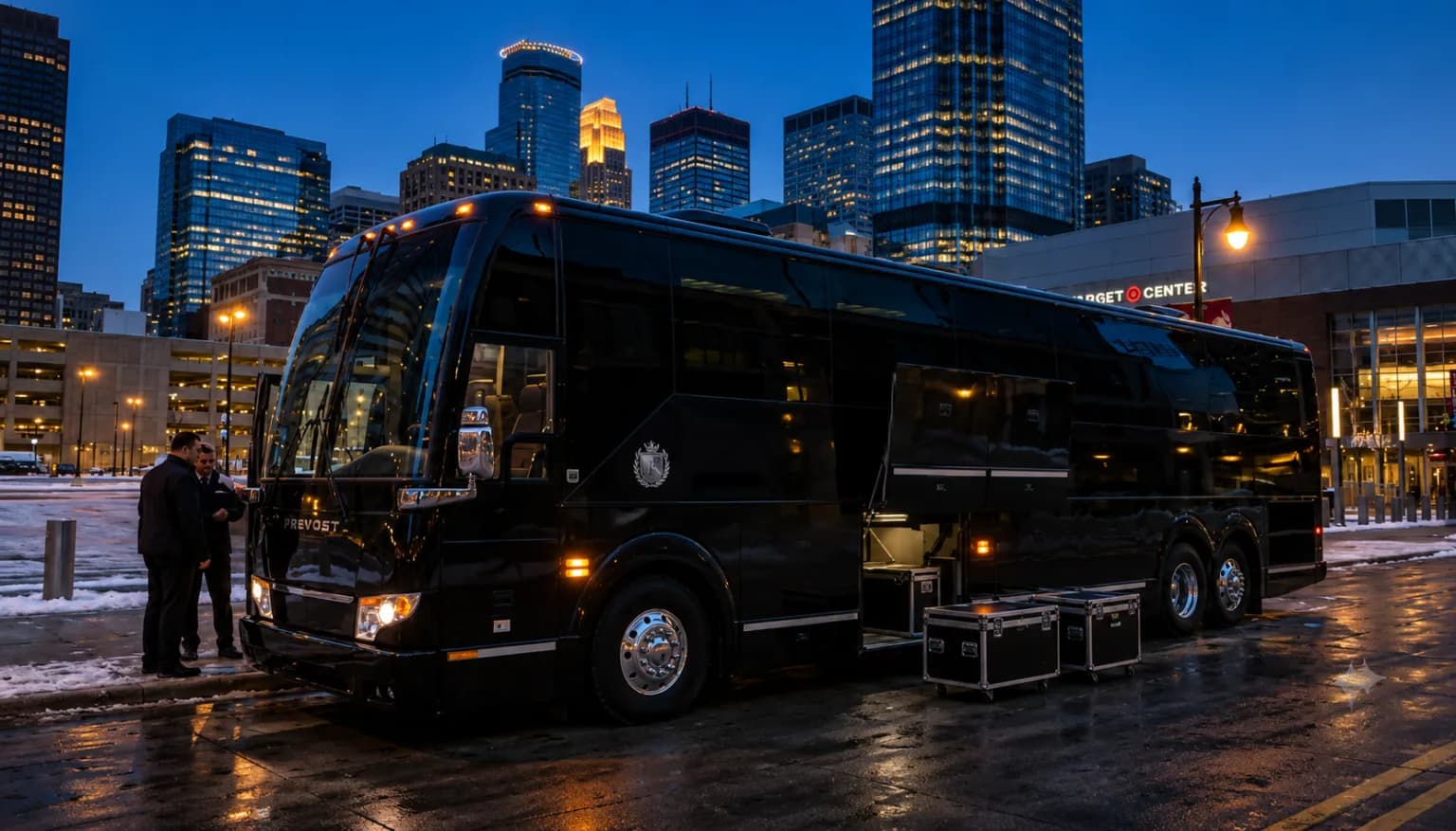
Why 12 berths became the touring standard
Twelve works because it matches how touring parties are sized. A four or five piece band with a tour manager, a front-of-house engineer, a monitor engineer, a backline tech and a lighting operator lands between nine and twelve people. One coach carries all of them.
Below twelve, a tour either leaves people behind or books a second unit for three passengers, which is the worst economics available. Above twelve, the coach needs a rear bed kit that removes the back lounge, and the party loses its second living space.
The configuration also holds resale and lease value, so operators buy it preferentially. That is why availability on a 12-bunk is better than on any other layout, and why what is inside them is fairly consistent.
What is on board
Specification across a modern 12-bunk build:
- Twelve berths three high along the alley, each with curtain, reading light and 110V outlet
- Front lounge with seating, table, flat screen and satellite television
- Rear lounge with the larger screen and the primary sound system
- Galley with refrigerator and freezer, microwave, coffee maker, sink and pantry storage
- Full bathroom with a stand-up shower
- WiFi backed by cellular boosters, with USB charging through both lounges
- Climate control zoned separately for the alley and the living spaces
- Undercarriage bays for luggage, personal gear and small production cases
Sleeping runs feet-forward, which matters under braking rather than for comfort, and the alley is curtained on both sides so the walkway stays dark while the lounges are lit. Bays underneath hold several hundred cubic feet, enough for personal luggage and a modest amount of backline before a trailer becomes necessary.
Everything above is standard rather than optional on a current touring unit. What varies between two 12-bunk coaches is the layout of the space around it.
Two lounges, and the slide decision
Lounges at both ends are what separate this configuration from a crew build. Twelve people cannot share one room for eight weeks, so the second lounge is a scheduling tool rather than a luxury. Crew watch something in the back while the band works in the front, and neither group is trapped with the other.
Slide-outs then decide how those rooms feel. A single slide widens one lounge by roughly 18 inches when parked, turning a room that seats four into one that seats six. A single slide-out does it at both ends. Non-slide units cost less per day and park in tighter lots, which matters on club routings and in winter, when a slide should not be deployed into freezing rain.
Layout settled, the next question is who the coach suits.
Who books one, and how many should travel
Bookings come from four groups: headline bands traveling with their own crew, support acts sharing a unit, production and lighting crews on arena tours, and corporate or campaign tours that need overnight capacity rather than seats.
On headcount, book one berth per person and leave at least one spare. A party of twelve in a twelve-berth coach has nowhere to put bags beyond the bays. Ten or eleven is the comfortable load, with the unclaimed berths becoming the shared storage the industry calls a junk bunk.
Where one person needs separating from that arrangement, the same shell offers a different build.
The star conversion
Star conversions take a 12-bunk shell and rebuild the rear lounge as a private bedroom with an en-suite bathroom. The coach keeps a front lounge and drops to roughly six berths, which suits a headliner keeping hours the crew does not.
Some fleets list units as "12 bunk with optional star conversion", meaning the same coach can be specced either way depending on the booking. It is worth asking whether a conversion is available rather than assuming a separate unit is needed, since availability on a convertible coach is usually better.
Either specification books the same way.
Checking availability and what to send
Availability on this configuration moves fastest in high season, so send a routing early. Dispatch needs your tour dates, the city for each day, headcount, whether you want a slide, and whether a gear trailer travels with the coach.
Knights Coaches runs Prevost 12-berth units, each with a CDL driver who has run entertainer work. Current availability by configuration sits on the fleet page, and a routing sent through gets three matching coaches back, priced line by line.
Got questions?
Frequently asked questions
Twelve, one per berth, with the berths stacked three high along a center alley. Ten or eleven travels more comfortably, because the spare berths absorb bags that otherwise have nowhere to go. Sleeping capacity and comfortable capacity are not the same number.
Yes, a stand-up shower in the full bathroom is standard on current touring builds. Older conversions occasionally lack one, so confirm per unit. The bathroom sits mid-coach, between the galley and the bunk alley.
Seating, a table, a flat screen, satellite television and a sound system in each, with the larger screen usually at the back. Both carry 110V outlets and USB charging. The rear lounge normally gets the better audio, which is why crews gravitate there after a show.
One coach wins below about twelve people, two win above it. Splitting a party of eleven across two units doubles the driver cost, the deadhead and the parking for no gain. Past twelve you need the second unit regardless, and that is when a crew coach joins a band coach.
A star conversion replaces the rear lounge with a private bedroom and en-suite bathroom. Berth count drops to around six. Some 12-bunk units are built to convert either way, so the same coach can serve a band tour or a headliner run.
Yes, and towing is standard on club and theater routings. A trailer adds a daily rate plus a towing supplement, and drops fuel economy from roughly 6 miles per gallon to nearer 5. Trailer dimensions and gear weight should go in with the quote request.
The Prevost X3-45 and H3-45, almost without exception in the US. The X3-45 has a flat floor that suits an uninterrupted bunk alley. The H3-45 raises the deck and gains bay volume underneath for gear.
Published US pricing runs $1,900 to $2,900 a day fully loaded, with the vehicle alone at $350 to $1,400. Driver, fuel, hotel, per diem and road charges make up the rest. A 12-berth unit sits mid-range, since it is the volume configuration rather than a specialist one.
Take non-slide for tight club lots and single slide when the coach parks for longer stops. A slide is unusable in a cramped load-in area and adds to the day rate whether you deploy it or not. On theater and festival runs with room to park, it earns its money.
Check availability on a 12-berth coach
A 12-bunk entertainer coach puts twelve berths in a center alley with a lounge at each end, on a 45-foot Prevost shell. That layout carries a band and its crew together, which is why it became the US touring standard and why fleets stock more of it than anything else. Onboard runs to a full galley, a bathroom with a shower, satellite television and sound in both lounges, connectivity throughout and power at every berth. Slide-outs widen a lounge when parked. Star conversions trade the rear lounge for a private bedroom. Book one berth more than your headcount and the spare becomes storage. Send your dates, cities and headcount to 1-855-838-5542, and dispatch will come back with the 12-berth coaches available for your routing.